A family of waveforms
Not every signal looks like a sine. A flute, a snare drum and radio static all make sound, but each has a different waveform, and the signals inside a chip don’t all share one shape either.
Four more shapes to know by sight
| Shape | Where you’ll meet it | What it looks like |
|---|---|---|
| Square | Digital clocks | Snaps between two levels, with nothing in between |
| Triangle | ADC ramps, test signals | Straight-line rise, straight-line fall |
| Pulse | Digital clocks with a tunable on-time (the duty cycle) | A square that spends more time low than high, or the other way round |
| Noise | Sensor readouts, the thermal noise floor | Never repeats, so it has no period at all |
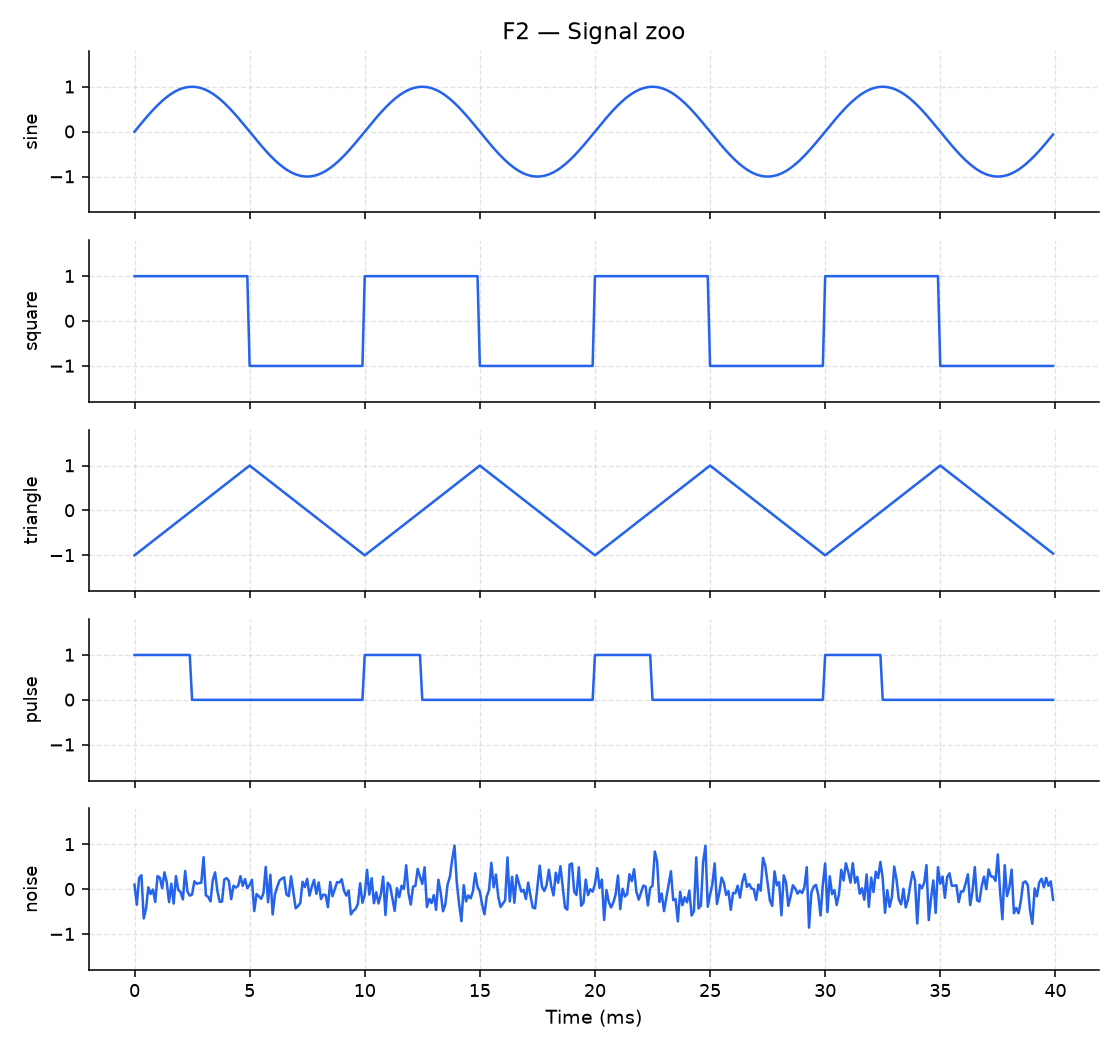
The F2 explorer drives every shape from the same amplitude setting, and they still look completely different. That’s why you can’t judge a trace by its height alone: two waveforms can have the same height on a datasheet and still carry completely different information.
You can build the square, pulse and triangle from the same time array t you met on What is a signal?, using a phase that counts from 0 to 1 once per cycle. If you compare the phase to a threshold you get a square or a pulse, and if you ramp it up and then down you get a triangle. You’ll build those three this way in Lab 01, Part 4, along with a noise trace, and the duty cycle comes back in Rhythm and duty cycle.
Why an engineer cares
- The clocks in a digital chip are square waves.
- The ramps an ADC uses are triangle waves.
- The noise trace is what the thermal noise floor looks like: the chip’s own randomness, which sets the smallest signal the chip can resolve.
Next: Two voices in time