Distortion and THD
Turn a guitar amp’s gain up past the clean setting and the sound gets crunchy, with harsh new overtones that were never in the original note. The input’s frequency hasn’t changed; the circuit has clipped the wave, and the clipping created the new frequencies. That’s distortion, and only a nonlinear system can produce it, because a truly linear circuit can only rescale and delay a sine and can never add new tones to it.
New frequencies from one
Push a clean sine through a soft nonlinearity such as \(\tanh\) (a smooth version of clipping), and harmonics that weren’t in the input appear in the spectrum. The harder you drive it, the more it clips, and the bigger those harmonics get.
Total harmonic distortion (THD) sums up how much energy has moved into those extra harmonics, relative to the fundamental. \(A_1\) is the amplitude of the fundamental and \(A_2, A_3, \ldots\) are the amplitudes of the harmonics:
\[ \mathrm{THD} = \frac{\sqrt{A_2^2 + A_3^2 + \cdots}}{A_1} \]
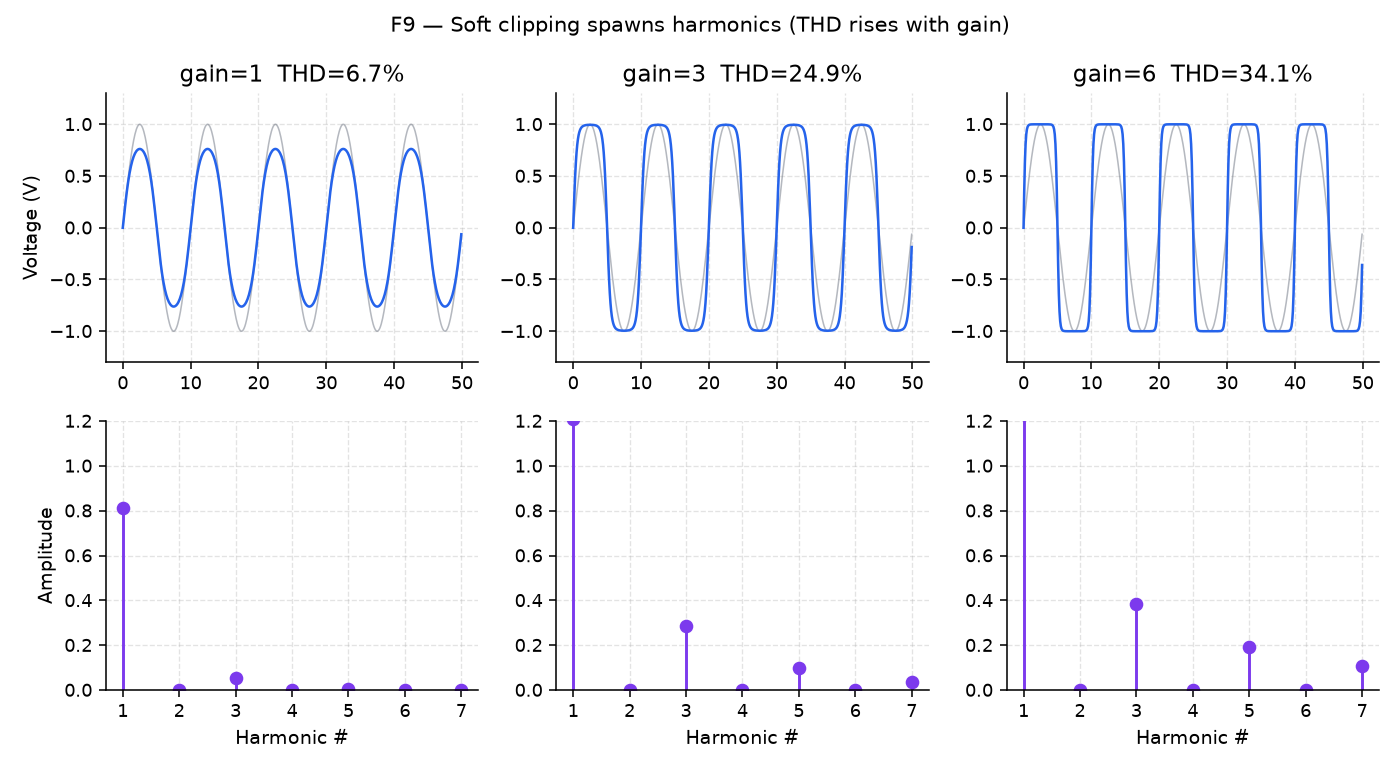
THD turns the question “how distorted does it sound?” into a single number you can read off, so you don’t need a listening test to answer it. In Lab 03, Part 3, you’ll raise the gain on the F9 explorer and watch THD climb, and then clip a sine in your own script and measure its THD.
Why an engineer cares
Every amplifier datasheet quotes a linearity or THD number, so this is a figure you’ll keep meeting. AD103 comes back to distortion with MOSFET curves and AD201 with amplifiers, and both treat it more precisely than this page does.
Next: Sampling fast enough