Classes for testbenches
This page answers: what does a class give a testbench that a module doesn’t, and what do I need to know about handles before I write a monitor and a scoreboard?
Lab 01’s UVM testbench was made of classes. You read them in Part 3, and in Part 5 you added the flag checks to one of them, alu_scoreboard. In Lab 02 you’ll write the router’s monitor and scoreboard, two plain SystemVerilog classes with no UVM in them. This page covers what those two classes need: objects that are made while the simulation runs, the handles that point at them, and the difference between functions and tasks. Static members and inheritance with virtual methods come last. The two classes you’ll write use neither, but Lab 01’s tests shared one run_phase through inheritance, and UVM calls your build_phase and run_phase through virtual methods.
We ran every example on this page in the course image. The source is in guide-examples/classes-for-testbenches/. The commands that produced each output are at the top of that folder’s Makefile, and in the README one level up, guide-examples/README.md.
Modules and classes
A module behaves like hardware. Its instances are fixed when the design is elaborated, before simulated time starts, and each one exists for the whole run. That suits a design, and it suits the top module of a testbench, which holds the clock, the interfaces and the design under test.
A class is a type. The things made from it are called objects, and they’re created while the simulation runs, as many as the testbench needs. Most of a testbench is written as classes for that reason. Lab 02’s generator makes a new packet object for every packet the test sends, 100 of them by default, and puts each one in a mailbox for the driver. Your monitor will make one for each packet it sees on a stream. A transaction like that has no fixed place in the hardware. It exists from the moment something makes it until nothing refers to it any more.
The classes of a testbench go in a package. Lab 02’s router_tb_pkg.sv is a list of `include lines for packet.svh, generator.svh and the rest, so any file that imports router_tb_pkg can use every class in those files.
A class
handles_test, reuse_test and null_test use this class. It’s a cut-down version of Lab 02’s packet, with a serial number added:
class pkt;
  static int unsigned n_made;   // one variable, shared by every pkt
  int unsigned        id;       // one per object
  bit [7:0]           data[$];

  function new();
    id = n_made;
    n_made++;
  endfunction

  function string sprint();
    string s;
    s = $sformatf("pkt %0d:", id);
    foreach (data[i]) s = {s, $sformatf(" %02h", data[i])};
    return s;
  endfunction
endclass
It has three members (n_made, id and data, a queue of bytes) and two methods (new() and sprint()). new() is the constructor, and it runs once each time you call new() to make an object. A constructor can take arguments, and Lab 02 uses them to connect its pieces. env::new() makes three mailboxes and passes each one to the constructors of the two classes that use it, and every class that touches the pins is given its virtual interface the same way. When an argument has the same name as a member, this. picks out the member, so this.vif = vif copies the argument vif into the member vif, as Python’s self.vif = vif does.
Handles
pkt a; declares a handle, a variable that can point at a pkt object. It doesn’t make a packet. Until something is assigned to it, the handle points at nothing, and its value is null. new() makes an object and returns a handle to it. After that, assigning one handle to another copies the handle and not the object. The example handles_test does this:
pkt a, b, c;
$display("a is %s", a == null ? string'("null") : string'("an object"));
a = new();
a.data = '{8'h80, 8'h11};
b = a;
b.data.push_back(8'h22);
c = new a;
c.data.push_back(8'h33);
and prints:
a is null
a: pkt 0: 80 11 22
b: pkt 0: 80 11 22
c: pkt 0: 80 11 22 33
a == b is 1, a == c is 0, pkt::n_made is 1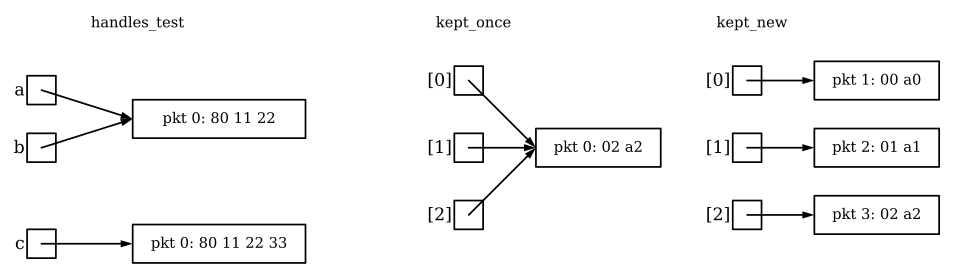
Left, handles_test: a and b point at one object, and c points at a copy of it. Right, reuse_test: kept_once holds three handles to one reused object, and kept_new holds three handles to three objects. The values are the ones the tests printed.
b = a gave the one object a second name, so the 22 pushed through b shows up when you print a. a == b compares the handles, and it’s 1 because they point at the same object. Two different objects with the same contents compare unequal, which is why Lab 02’s packet has a same() method that compares the beats one by one.
c = new a makes a new object and copies every member of a into it, so c has its own queue, and the 33 pushed onto it doesn’t appear in a. The copy doesn’t run the constructor, so c kept a’s id of 0, and n_made stayed at 1. It’s also a shallow copy, which means that if pkt had a member that was itself a handle, c would get a copy of that handle, and the two objects would share whatever it pointed at.
You won’t often copy objects in the labs, but you’ll pass handles around all the time, and every place that keeps a handle to an object shares that object with every other place that kept one. The next example shows what happens when you forget that, and it’s the class bug you’re most likely to write in Lab 02.
The same object kept three times
reuse_test has two loops, and each one stands in for a monitor. Each loop builds the same three two-byte packets and keeps them in a queue, as Lab 02’s scoreboard keeps the packets it expects. The first loop makes one pkt before it starts and reuses it for every packet, and the second makes a new pkt for each packet:
p = new();
for (int k = 0; k < 3; k++) begin
  p.data.delete();
  p.data.push_back(8'(k));
  p.data.push_back(8'hA0 + 8'(k));
  kept_once.push_back(p);
end

for (int k = 0; k < 3; k++) begin
  p = new();
  p.data.push_back(8'(k));
  p.data.push_back(8'hA0 + 8'(k));
  kept_new.push_back(p);
end
one pkt, reused: [0] pkt 0: 02 a2
one pkt, reused: [1] pkt 0: 02 a2
one pkt, reused: [2] pkt 0: 02 a2
a new pkt each: [0] pkt 1: 00 a0
a new pkt each: [1] pkt 2: 01 a1
a new pkt each: [2] pkt 3: 02 a2kept_once holds three handles to one object, and that object holds the last packet, 02 a2, so the queue shows it three times and the first two packets are gone. A mailbox behaves the same way, because what you put into it is a handle. That’s why the TODO in Lab 02’s monitor.svh has you start a new packet when p is null, and set p = null once you’ve put a finished packet into the mailbox. The next packet then gets an object of its own, and the object the scoreboard was given keeps the beats it had.
Null handles
If you use a handle before it points at anything, the run stops. null_test declares pkt p;, prints a line, and then asks for p.data.size(). This is everything in its log after UVM’s Running test null_test... line:
%Error: guide-examples/classes-for-testbenches/classes_demo_pkg.sv:112: Null pointer dereferenced
Aborting...
The file and line in the error are where the null handle was used. Nothing after that line ran, including UVM’s report summary. The labs’ graders mark a run like this BROKEN rather than caught, because a null handle is an error in the testbench and not a check that fired. The line that the test printed just before the error isn’t in the log either, so when a run aborts, look at the line the error names, not at the last thing that was printed. In Lab 02 you’ll see this error if your monitor pushes a beat onto p.data before it has made p.
Functions and tasks
A class has two kinds of method. A function runs in zero simulated time and can return a value. sprint() and Lab 02’s packet::same() are functions. A task can wait for a clock edge with @, for a delay with #, or for a mailbox to have something in it, so any method that follows the simulation through time has to be a task. In Lab 02 the run() methods of the monitor, the driver and the scoreboard are all tasks, and the scoreboard’s run() waits on two mailboxes.
Verilator checks this rule before it builds anything, so a function with #10; in it fails make lint with this error:
%Error-FUNCTIMECTL: guide-examples/classes-for-testbenches/classes_demo_pkg.sv:120:5: Functions cannot contain time-controlling statements (IEEE 1800-2023 13.4)Methods of a class are automatic, which means that each call gets its own copy of the method’s local variables. That’s what lets two threads run the same task at the same time without disturbing each other, and Threads, mailboxes and events shows where it matters.
Static members
A static member belongs to the class rather than to any one object, so there’s one n_made however many packets exist, and code outside the class reads it as pkt::n_made. The usual use is a counter like this one, which numbers objects as they’re made. Members that aren’t static exist once per object, so every pkt has its own id and data.
Inheritance and virtual methods
A class can extend another class. It inherits all of that class’s members and methods, and it can override any of those methods with a version of its own. In dispatch_test, the class base_test has a run() task that calls name(), which isn’t virtual, and stimulus(), which is declared virtual. The class rand_test extends base_test and overrides both:
class base_test;
  function string name();
    return "base_test";
  endfunction
  virtual task stimulus();
    $display("  stimulus() of base_test: no stimulus");
  endtask
  task run();
    $display("run() of %s", name());
    stimulus();
  endtask
endclass

class rand_test extends base_test;
  function string name();
    return "rand_test";
  endfunction
  virtual task stimulus();
    $display("  stimulus() of rand_test: 2000 random vectors");
  endtask
endclass
The test makes one rand_test object and calls run() on it twice, once through a base_test handle and once through a rand_test handle:
through a base_test handle:
run() of base_test
  stimulus() of rand_test: 2000 random vectors
through a rand_test handle:
run() of base_test
  stimulus() of rand_test: 2000 random vectors
run() is defined only in base_test, so both calls run that code. Inside it, the call to stimulus() went to rand_test’s version, because stimulus() is virtual, and a virtual call goes to the method of the object’s own class, whatever type of handle you called it through. The call to name() went to base_test’s version both times, even though the object is a rand_test. A call to a method that isn’t virtual is bound when the code is compiled, by the type of the handle it’s made through. Inside run(), name() is called through this, and in code written in base_test, this is a base_test handle.
Lab 01’s two tests share one run phase this way. alu_base_test::run_phase() raises an objection, calls stimulus(), waits three cycles and drops the objection. stimulus() is a virtual task, and alu_rand_test and alu_directed_test each override it to start their own sequence. UVM calls your code the same way. build_phase, run_phase and the other phase methods are declared virtual in the UVM library, so when UVM calls them on your components, it runs your versions.
A method that overrides another can still call the version it replaced, through super. Lab 01’s alu_base_test::build_phase() starts with super.build_phase(phase), which runs dd105_base_test’s build_phase(), where the course checks that the constraint solver works. If you leave the super call out, the check doesn’t run, and no message tells you it was skipped.
Check yourself
A scoreboard reports that every packet it expected has the same beats as the last packet. Its monitor runs
p = new()once, in the monitor’s constructor. What’s wrong, and how do you fix it?TipAnswerThe monitor puts the same object into the mailbox for every packet and refills it each time, so every handle the scoreboard kept points at one object, and that object holds whatever was written into it last. Make a new
packetfor each packet the monitor sees, and stop using the old one once it’s in the mailbox, which is what settingp = nullafter theput()does.In
dispatch_test, the call through therand_testhandle still printedrun() of base_test. Why, and what would it print ifname()were declaredvirtual?TipAnswerrun()isbase_test’s code. Inside it,name()is called throughthis, and inbase_test’s codethisis abase_testhandle. Becausename()isn’t virtual, the call was bound tobase_test::name()when the class was compiled. The type of the handle you calledrun()through doesn’t come into it. Ifname()were virtual, the call would go to the object’s own class, and both lines would readrun() of rand_test.After
c = new a,c.idis 0, the same asa.id, andpkt::n_madeis still 1. Why didn’t the copy get a new number?TipAnswernew acopies the members ofainto a new object without calling the constructor, and the constructor is the only code that numbers objects. If a copy needs its own number, givepkta copy method of its own that makes the object withnew()and then copies the data.Which of these has to be a task: the monitor’s
run(),packet::sprint(), the scoreboard’spredict()?TipAnswerOnly the monitor’s
run(), because it waits for clock edges.sprint()builds a string, andpredict()decides whether a packet should come out of output 0. Neither has to wait for anything, so both are functions, and that’s how Lab 02 ships them.
Further reading
ChipVerify has a page on each of the class features below, and most of them include a complete example. The logs on its SystemVerilog pages mostly come from Cadence simulators, not from Verilator, and the course doesn’t reuse its code.
- Class and Class Handle: objects, handles,
null, and two handles to one object. - Class Constructor:
new(), default arguments, andsuper.new(). - Copying Objects: shallow copies with
new, and deep copies written by hand. - Static Variables & Functions.
- Inheritance, Virtual Methods and super Keyword. The Virtual Methods page runs the same code with and without
virtual, asdispatch_testdoes. - Polymorphism: base handles to derived objects, and
$cast. Correction: it says that a failed$castreturns 0 and the simulation goes on, which is true only when$castis called as a function. Called as a task, a failed cast is a run-time error, as the page’s own log shows. Cast Dynamic gets this right.