Monitors, analysis ports and scoreboards
This page answers: how does what a monitor sees on the pins get to the scoreboard and the coverage, and what does the scoreboard do with it?
Lab 01’s UVM testbench for the ALU already used an analysis port. Its monitor wrote each vector to the port, and the scoreboard checked each vector in its write function. Lab 02’s router testbench was built without UVM, and its classes passed packets through mailboxes. Your monitor turned the handshakes on a stream into whole packets and put them in a mailbox, and the scoreboard ran two threads of its own, one for each mailbox, that took them out. Lab 03 added a tracker, with a loop of its own, that watched the pins directly.
In Lab 04 the router testbench is rewritten in UVM, and it uses analysis ports, as Lab 01’s did. Each of its monitors writes every beat, or every APB transfer, to its analysis port as soon as it sees it, and the scoreboard has no thread at all. It’s a class with three write functions, and the monitors call them. This page shows how that works on the ALU, what Lab 04’s scoreboard does when a beat arrives, and what goes wrong when a monitor reuses one object for every write.
The example for this page, guide-examples/monitors-analysis-ports-and-scoreboards/, tests SimProc’s ALU with a complete agent, made of a sequencer, the driver from the example for Sequences, sequencers and drivers, and a monitor. The environment connects three subscribers to the monitor’s one analysis port: a scoreboard, a coverage collector and a history that keeps every item it’s given. The ALU is the one from Lab 01, and its bug switch works here too. You set it when you run the simulator, so make run BUG=A01 runs the same test, on the same build, with the ALU whose SUB computes B - A.
The monitor
A monitor reads the pins and reports what it saw. It doesn’t drive anything, and it doesn’t know what the driver sent or what the answer should be, so the same monitor can feed a scoreboard, a coverage collector and anything else you add later. The example’s monitor reads the pins through a clocking block that has only inputs, so it sees each signal as it was just before the clock edge, which is the value the signal held during the cycle that the edge ends:
virtual function alu_item next_item();
  return alu_item::type_id::create("seen");     // a new item every time
endfunction

task run_phase(uvm_phase phase);
  alu_item t;
  forever begin
    @(vif.mon_cb);
    if (vif.mon_cb.valid) begin
      t        = next_item();
      t.op     = alu_op_e'(vif.mon_cb.ALUop);
      t.A      = vif.mon_cb.A;
      t.B      = vif.mon_cb.B;
      t.ALUout = vif.mon_cb.ALUout;
      t.N      = vif.mon_cb.N;
      t.Z      = vif.mon_cb.Z;
      n_seen++;
      ap.write(t);
    end
  end
endtask(next_item() is a separate function only so that a test can swap in a monitor that gets its items some other way, as mon_alias_test does in “One object per write”, below.)
Lab 04’s monitors do the same for the router’s streams, with one stream_beat per handshake, stamped with its cycle number, and for its APB port, with one apb_item per completed transfer.
Analysis ports
ap is a uvm_analysis_port #(alu_item). Its write(t) is a function, so it can’t wait, and it calls the write function of every subscriber connected to the port, one after another, before it returns. A port with no subscribers is allowed, and write then does nothing. The monitor can’t tell who, if anyone, is connected to its port. The environment makes the connections, in its connect_phase:
agent.mon.ap.connect(sb.imp);
agent.mon.ap.connect(cov.analysis_export);
agent.mon.ap.connect(hist.analysis_export);
On the receiving end, the example’s scoreboard declares an imp, uvm_analysis_imp #(alu_item, alu_scoreboard), and the imp calls the scoreboard’s own write(alu_item t). A class that extends uvm_subscriber #(alu_item) gets its receiving end already built, as a member called analysis_export, and you write only its write function. The example’s coverage collector and history both extend uvm_subscriber.
A scoreboard with several inputs needs a separate write function for each one, but an imp can call only a function named write. The macro `uvm_analysis_imp_decl(_in) declares a new imp class, uvm_analysis_imp_in, that calls write_in() instead. Lab 04’s router_env_pkg declares three of these classes at package scope, for the input stream, the outputs and the APB port, and its scoreboard has one imp of each. The figure shows which monitors write to each one.
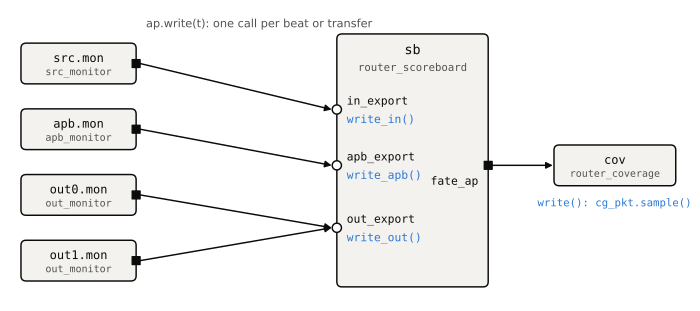
The connections that Lab 04’s router_env::connect_phase makes once you’ve done Part 2, which adds output 1’s agent. Before Part 2, only output 0’s monitor is connected. Both output monitors write to the same out_export, and each stream_beat carries its port number, so write_out() can tell which output a beat came from. The scoreboard decides what happens to each packet and writes a pkt_fate record for it to its own analysis port, fate_ap, which the coverage collector subscribes to.
Here are the report lines from one run of mon_rand_test, which sends 200 vectors. The history kept 200 items and the scoreboard checked 200, the same number that the monitor wrote:
UVM_INFO guide-examples/monitors-analysis-ports-and-scoreboards/mon_pkg.sv(238) @ 3995000: uvm_test_top.env.cov [COV] cg: 100.0% of its bins hit
UVM_INFO guide-examples/monitors-analysis-ports-and-scoreboards/mon_pkg.sv(260) @ 3995000: uvm_test_top.env.hist [HIST] kept 200 handles to 200 different objects
UVM_INFO guide-examples/monitors-analysis-ports-and-scoreboards/mon_pkg.sv(217) @ 3995000: uvm_test_top.env.sb [SB] 200 vectors checked: 0 wrong
UVM_INFO guide-examples/monitors-analysis-ports-and-scoreboards/mon_pkg.sv(313) @ 3995000: uvm_test_top [MON] the monitor wrote 200 items
The scoreboard
A scoreboard predicts what the design should have done and compares that with what the monitors saw. The example’s scoreboard does all its work inside write. It gets the expected answer from predict(), a model of the ALU written from SimProc’s instruction set, as Lab 01’s scoreboard does, and compares it with the item:
virtual function void write(alu_item t);
  bit [7:0] want = predict(t);
  bit       bad  = (t.ALUout != want);
  if (check_flags) bad |= (t.N != want[7]) || (t.Z != (want == 8'h00));
  n_checked++;
  if (bad) begin
    n_bad++;
    `uvm_error("SB", $sformatf("%s, expected ALUout=%02h N=%0b Z=%0b", t.convert2string(),
               want, want[7], want == 8'h00))
  end
endfunction
On the ALU with bug A01 the run reports 33 errors, and this is the first one:
UVM_ERROR guide-examples/monitors-analysis-ports-and-scoreboards/mon_pkg.sv(207) @ 35000: uvm_test_top.env.sb [SB] SUB A=1f B=34 -> ALUout=15 N=0 Z=0, expected ALUout=eb N=1 Z=0In check_phase the scoreboard also makes sure that it checked at least one vector, because a scoreboard that was never called would report no errors either.
Because write is a function, a scoreboard can’t wait inside it for the design’s answer. The ALU is combinational, so the monitor reads its inputs and its result in the same cycle, and they arrive in the same item. In the router, a packet goes in on one stream and comes out on another several cycles later, so Lab 04’s scoreboard splits the work between its write functions. When a packet’s header comes in, write_in() decides what the router must do with the packet: forward it to output 0 or 1, or drop it as NOROUTE or FULL. It decides from the routing table, as it has seen it written over APB, and from the level of each output. If the router should forward the packet, write_in() queues each beat that it expects to come out of that output. write_out() takes the next expected beat off the queue for the output that the beat came from, and compares the two. write_apb() keeps the scoreboard’s copy of the routing table up to date, and checks every read of DROP_CNT against the drops the scoreboard has counted. At the end of the test, check_phase reports any beats still left in the queues, because those are beats the router never delivered. (As shipped, write_in() queues only output 0’s beats, and level() takes output 1’s level as 0. Parts 2 and 3 of Lab 04 have you change those.)
A scoreboard catches only the bugs that show up in what it compares. With check_flags off, which is the default, the example’s scoreboard compares ALUout and nothing else. Against Lab 01’s three bugs, make check-all gives:
  caught  tier 1  A01_sub_operands_swapped         33 UVM_ERROR                    0.2s
  caught  tier 1  A02_nand_is_nor                  26 UVM_ERROR                    0.2s
  MISSED  tier 1  A03_zero_flag_low_nibble         0 UVM_ERROR, 0 UVM_FATAL        0.2s
A03 makes the zero flag look only at the low four bits of ALUout. The monitor put every wrong Z into an item, but no subscriber compared Z with anything. The next page, The factory and config_db, turns check_flags on from a test, without editing the scoreboard.
One object per write
ap.write(t) passes the same handle to every subscriber, so they all see one object. That’s cheap, and it’s safe as long as no code changes the object after the write. The example’s monitor makes a new alu_item for every vector. mon_alias_test swaps in a monitor that makes one item and fills it in again for every vector. (The swap is a factory override, which the next page explains.) The history subscriber keeps every handle it’s given, and at the end of that test it prints this:
UVM_INFO guide-examples/monitors-analysis-ports-and-scoreboards/mon_pkg.sv(260) @ 3995000: uvm_test_top.env.hist [HIST] kept 200 handles to 1 different objects
UVM_INFO guide-examples/monitors-analysis-ports-and-scoreboards/mon_pkg.sv(262) @ 3995000: uvm_test_top.env.hist [HIST] vector 0: ADD A=c7 B=91 -> ALUout=58 N=0 Z=0
UVM_INFO guide-examples/monitors-analysis-ports-and-scoreboards/mon_pkg.sv(262) @ 3995000: uvm_test_top.env.hist [HIST] vector 1: ADD A=c7 B=91 -> ALUout=58 N=0 Z=0
UVM_INFO guide-examples/monitors-analysis-ports-and-scoreboards/mon_pkg.sv(262) @ 3995000: uvm_test_top.env.hist [HIST] vector 2: ADD A=c7 B=91 -> ALUout=58 N=0 Z=0
UVM_INFO guide-examples/monitors-analysis-ports-and-scoreboards/mon_pkg.sv(217) @ 3995000: uvm_test_top.env.sb [SB] 200 vectors checked: 0 wrong
All 200 handles point at one object, which holds the last vector. In mon_rand_test the first three vectors were an OR, a SUB and a SHL. The scoreboard still passed, because it finishes with each item inside write, before the monitor fills the object in with the next vector. A subscriber that keeps the handle for later, or queues it to compare when the answer arrives, sees the wrong values. So a monitor should make a new object for every write. A subscriber that keeps anything should either copy the values it needs, as Lab 04’s scoreboard does when it queues {last, data} for each expected beat, or keep the handle and never change the object.
Coverage as a subscriber
A coverage collector is the simplest kind of subscriber, because its write only samples a covergroup. On Verilator 5.050 the covergroup has to take its values as arguments, as in covergroup cg with function sample(int op, bit eq). Verilator leaves out a covergroup whose coverpoints read a member of the class, and prints only a warning. Functional coverage you can read shows the warning.
What a collector subscribes to depends on what it covers. The example covers what went into the ALU, so it subscribes to the monitor. Lab 04’s router_coverage covers each packet’s fate and the level of its route’s output when its header came in. Only the scoreboard works those out, so router_coverage subscribes to the scoreboard’s fate_ap.
Check yourself
write()on an analysis port is a function. What does that rule out for a scoreboard’swrite, and how does Lab 04’s scoreboard live with it?TipAnswerThe scoreboard’s
writecan’t wait for anything, so it can’t use@,#or a blockingget. The router’s answer comes out cycles after the packet goes in, sowrite_in()predicts and queues the expected beats, andwrite_out()compares each beat when an output monitor reports it. The scoreboard doesn’t need a thread of its own for any of that.In
mon_alias_testthe scoreboard passed and the history was wrong. Would a scoreboard that pushed each input item onto a queue and compared it when an output arrived have passed?TipAnswerNo. Every handle on its queue would point at the one object, which by the time an output arrives holds a later vector, so the scoreboard would compare the wrong inputs with each output. The example’s scoreboard passed only because it finished with each item inside
write.Two monitors write
stream_beats to the sameout_export. How doeswrite_out()tell output 0’s beats from output 1’s?TipAnswerEach output monitor stamps
b.porton every beat, from itsout_cfg, andwrite_out()usesb.portto pick which queue of expected beats to compare with.
Further reading
- ChipVerify’s UVM Monitor builds a monitor for a register file. Correction: it says a monitor that didn’t get its virtual interface can keep running after a
uvm_error. It can’t keep running, because itsrun_phaseuses the interface straight away, so useuvm_fatalthere, as its driver page does. It also sets two knobs throughconfig_dbthat the monitor never reads. - UVM TLM Analysis Port, with a broadcast to three subscribers. Its log comes from UVM 1.1d, which is older than the UVM library the course uses.
- Using _decl macro in TLM builds a two-input scoreboard. Correction: it says the macro can’t go inside a class because SystemVerilog doesn’t allow a class inside another class. Nested classes are legal, but package scope, where Lab 04 puts the macro, is still the right place for it.
- UVM Scoreboard and UVM Scoreboard Architecture, for in-order and out-of-order comparison. The second page recommends checking at the end of the test that nothing is left waiting for a match and that the match count isn’t zero. Neither of its examples checks the match count, and the in-order one doesn’t check for leftovers either.
- UVM Subscriber. Its covergroup reads a member of the class, so Verilator 5.050 would leave it out. Write yours
with function sample.
Next: The factory and config_db.