Lab 07: Capstone
In this lab you take your Lab 06 testbench to sign-off. You’ll write a verification plan from the specification, run a regression on ten seeds and read its coverage, and hunt three mystery bugs, each dealt from all fifteen in the catalogue. The package you start from misses one of the fifteen. You’ll catch it by writing assertions for the rules about reset and a sequence that resets the router while packets are in flight, so that make check-all prints 15 of 15 caught. Then you’ll write a sequence that takes both drop counters to 255, which fills the last two coverage bins that a test can reach, and finish with a verification report. The plan, the report, your testbench and its results go into a GitHub repository of your own.
Package: labs/lab-07-capstone/
Before you start
Finish Lab 06.
Read Verification plans and sign-off and Writing the verification report, and reread Regressions and seeds.
Keep the router’s specification open for the whole lab, with the router in one page beside it if you like. The plan you write in Part 2 is a list of the specification’s rules.
You need a GitHub account, and a token the workbench can push with. If you made one in IC102-A Lab 01, Part 2 and it hasn’t expired, use it. Otherwise make one the way that part describes. This lab needs only the Contents permission, read and write, because your repository has no workflows.
In a terminal on the workbench desktop:
. /foss/designs/common/.designinit
mod dd105-a
cd labs/lab-07-capstone
The package is the Lab 06 testbench with our solution to Lab 06 filled in: the four registers’ fields and the adapter, the predictor’s connections, the irq check and router_lab06_vseq’s steps. If your own Lab 06 printed 5 of 5 caught., your code did the same job, but keep ours, because this lab adds to the files you edited. Until now the router has been reset only at time 0, and nothing in the testbench could reset it again. The table lists what we added for you.
| File | What Lab 07 adds |
|---|---|
tb/router_ifs.sv, tb/router_tb_top.sv |
a reset the testbench can drive: rst_req_n in router_sys_if, with rst_soon beside it to warn the APB driver that a reset is coming, and rst_n in the top module, made from rst_req_n and the reset at time 0 |
tb/router_agents_pkg.sv |
the reset driver (sys_agent, router_reset_seq); a source driver that abandons its packet at a reset (rule I3), and an APB driver that keeps psel at 0 during one and starts an interrupted transfer again (rule A4) |
tb/router_env_pkg.sv |
in the scoreboard, reset_model(), which at a reset throws away every beat it expected and puts its own models and the register model’s mirror back to their reset values; four corners that the scoreboard counts (a reset with beats still to come out, a reset with a packet half accepted, and a drop of each kind with its counter already at 255), and the covergroup cg_corner, with a bin for each |
tb/router_sva.sv, tb/router_sva_bind.sv |
the APB port and irq in the bound module, and a counter for each rule about reset; the assertions are yours (Part 5) |
tb/router_vseq_pkg.sv |
reset() in the base sequence; router_reset_vseq and router_saturate_vseq, whose bodies are yours (Parts 5 and 6); router_lab07_vseq, four phases of random traffic whose resets are yours (Part 5) |
tb/router_tests_pkg.sv |
router_test runs router_lab07_vseq last; three new tests, router_lab07_test, router_reset_test and router_saturate_test |
Makefile |
BUG_LIST: all fifteen bugs, B15 first, because make check grades the first |
Time: about 3 h 30 min. About 20 minutes of that is waiting for the machine, as we measured it on the course’s 2 CPUs. The first build took 130 s, each of the three rebuilds after your edits took 114 to 118 s, each of the two regressions about 4 minutes, and each of the three runs of make check-all about 75 s. You’ll spend most of the rest writing the plan, eight assertions, two sequences and the report.
Part 1: Your repository and the first build
Start the build first, so that you can make the repository in step 2 while it runs:
make buildThe banner says a cold build takes 1.5 to 2.5 minutes. Ours, with an empty ccache, took 130 s. Near the end it printed Verilator’s summary:
- Verilator: Walltime 130.147 s (elab=0.929, cvt=3.622, bld=124.720); cpu 5.833 s on 2 threads; allocated 382.234 MBand then a line saying that it built
build/simin 130 s.While it builds, make the repository. On GitHub, create a new repository under your own account named
dd105-capstone, with a README so that it starts with one commit. It can be private, because nobody needs to read it yet.Clone it beside the course, and tell git who you are in it:
mkdir -p /foss/designs/projects && cd /foss/designs/projects
git clone https://github.com/YOUR-USERNAME/dd105-capstone.git
cd dd105-capstone
git config user.name "Your Name"
git config user.email "ID+USERNAME@users.noreply.github.com"
git config credential.helper 'cache --timeout=28800'
cd /foss/designs/modules/dd105-a/labs/lab-07-capstone
Use your GitHub no-reply address, and leave out
--global. A global setting goes in the container’s home folder, which is thrown away when the workbench restarts. Without--globalthe settings go in.git/config, which is inside your repository, on your own disk, so they stay. In IC102-A Lab 01, Part 2 says where to find your no-reply address, and Part 3 explains the token cache and--global. You’ll write your plan and your report in the repository itself. The testbench stays here in the course clone while you work on it, because it builds only from insidelabs/, and Part 8 copies it across.When the build has finished, run the graded test,
router_test, and pull the scoreboard’s summary out of the log:make run grep -o '\[SB\] [0-9a-z].*' build/runs/router_test-s1/run.logYou should see
ok: 0 UVM_ERROR, 0 UVM_FATAL 7.38 sfrommake run, and fromgrep:[SB] 1733 packets in: 479 to output 0, 381 to output 1, 260 NOROUTE, 613 FULL; the highest level a header saw was 16 [SB] beats checked: 2183 on output 0, 1700 on output 1; 45 DROP_CNT reads checked [SB] registers: 884 reads, 65 of STATUS checked; 492 transfers to bad addresses; irq checked in 19951 cycles, wrong in 0 [SB] resets: 0 after the one at time 0, 0 expected beats lost; corners hit: reset_with_beats=0 reset_mid_packet=0 noroute_saturated=0 full_saturated=0At the end of Lab 06 your
router_testcheckedirqin 14840 cycles. This one checks it in- What ran in the other 5111 cycles, and did anything before them change?
TipAnswerrouter_lab07_vseq, whichrouter_testnow starts after everything Lab 06’srouter_testran. Its four phases of random traffic take those cycles. Each phase sends 150 packets on a random routing table of its own and random interrupt enables, while both sinks change their modes. It doesn’t run your two sequences yet. It goes last so that the random choices it makes can’t move anything before it. Withrouter_lab07_vseqleft out,router_testprinted Lab 06’s lines number for number (1133 packets in: 282 to output 0, 226 to output 1, 195 NOROUTE, 430 FULL, andirq checked in 14840 cycles), so nothing we added changes a run that has no reset in it.
Check: make run passes, and git -C /foss/designs/projects/dd105-capstone log --oneline shows the one commit that GitHub made.
Part 2: The verification plan
Which of the specification’s rules does this environment check, and which does it never make happen?
Copy the template into your repository:
cp PLAN-template.md /foss/designs/projects/dd105-capstone/PLAN.mdIt has a row for each rule in the specification. The input, output and APB rules keep the specification’s numbers (I1 to I7, O1 to O8, A1 to A9), and the template gives labels of its own (RT1, DR2, RS2 and so on) to the rules that the specification states in prose. Three rows, O1, RT1 and A7, are filled in as examples.
Fill in the table under “How the environment checks”. There are three checkers: the scoreboard (
write_in,write_out,write_apbandwrite_sysinrouter_scoreboard, intb/router_env_pkg.sv), the register model’s mirror (the predictor andset_check_on_read(1)inrouter_env::connect_phase, which you connected in Lab 06), and the assertions intb/router_sva.sv. The comment at the top of each file says what it covers.Run
grep -n TODO tb/*.svfirst, because the parts that this lab leaves for you are markedTODO. Then, for every row, fill in “Checked by” and “Made to happen by”, and write “nothing” where nothing does. Every virtual sequence intb/router_vseq_pkg.svhas a comment over each step saying what it sets up, androuter_testintb/router_tests_pkg.svlists what the graded test runs.Mark the rows you think
router_testnever reaches. Then look at what the scoreboard says about resets in your Part 1 run:grep -o '\[SB\] resets.*' build/runs/router_test-s1/run.logIt’s the line you saw in Part 1,
resets: 0 after the one at time 0, with every corner at 0. Which rows of your plan need more than the reset at time 0, and which have no checker?TipAnswerAt time 0 the router holds nothing, so RS2 and RS3 (a reset with beats in a buffer, and a reset in the middle of an input packet), the second half of O4 and the source’s rule I3 all need a reset with traffic in flight. I7, O4, the first half of A4 and RS1 have no assertion yet, because theirs are the
TODO (Part 5)comments intb/router_sva.sv. Of RS1’s four values, onlyirqis checked, by the scoreboard. DR2, the rule that each counter stops at 255, needs 255 drops with no clear or reset between them, butrouter_inject_testandrouter_lab07_vseqboth clearDROP_CNTat the end of each of their phases.Nothing in the environment checks
in_ready(I4, I5, I6, RT5), the cycle a beat appears (O8), that the outputs come from flip-flops (O3), whatCTRL.ENdoes (EN1), the APB master’s rules (A1 to A3),pready(A5, A6) orLEVEL(RG4), and nothing in this lab adds a check for them, so those rows stay “nothing”. Put them in the plan’s Open items, because Part 8’s report has to say what the environment doesn’t show.
Check: every row of your plan has an entry in “Checked by” and “Made to happen by”, and the rows that say “nothing” include the ones in the answer above.
Part 3: A seed regression
Does a regression that passes on every seed tell you the environment is finished?
make regressruns every test inTESTSon seeds 1 to 10. Look atTESTSin the Makefile, and write down how many runs you expect and how many will pass.Run it, and time it:
time make regressIt took us 3 min 57 s. You should see
110 ok (110 runs)and then the coverage of those runs:verilator_coverage: covergroup : 81.7% (49/60)with, at the end of the bin list:
11 bins never hit: __vlAnonCG_cg_corner.cp_corner.reset_with_beats __vlAnonCG_cg_corner.cp_corner.reset_mid_packet __vlAnonCG_cg_corner.cp_corner.noroute_saturated __vlAnonCG_cg_corner.cp_corner.full_saturated __vlAnonCG_cg_pkt.x_fate_level.full_x_at_8 __vlAnonCG_cg_pkt.x_fate_level.full_x_empty __vlAnonCG_cg_pkt.x_fate_level.full_x_low __vlAnonCG_cg_pkt.x_fate_level.out0_x_at_9 __vlAnonCG_cg_pkt.x_fate_level.out0_x_high __vlAnonCG_cg_pkt.x_fate_level.out1_x_at_9 __vlAnonCG_cg_pkt.x_fate_level.out1_x_highcg_cornerhas a bin for each of the four corners incorner_e, near the top oftb/router_env_pkg.sv, and the scoreboard counts each corner and sends it tocg_corneras it happens. Which of the eleven empty bins could any test ever hit, and which rows of your plan are they?TipAnswerOnly the four in
cg_corner. The seven inx_fate_levelare ones the specification rules out, as they were in Labs 04 to 06, because a packet is FULL only at a level of 9 or more, and written to an output only at 8 or less.noroute_saturatedandfull_saturatedare drops whose counter is already 255 (row DR2), andreset_with_beatsandreset_mid_packetare a reset with beats in a buffer and a reset with a packet half accepted (RS2 and RS3). You found the same rows in Part 2 by reading the environment, and the regression’s bin counts point at them too. So a regression that passes on every seed doesn’t tell you the environment is finished. 110 passes mean that no check fired in 110 runs, and the four empty bins are situations that the stimulus never made, so no check ever saw them.Fill in “Seen in coverage” for every row, from the bin list (
build/coverage/regress/bins.txthas every bin with its count) or from thecorners hit:part of the[SB] resetsline at the end of each run’s log. Then write your sign-off criteria under “Sign-off criteria”, each one a command and the output it must print.Commit and push the plan:
cd /foss/designs/projects/dd105-capstone
git add PLAN.md && git commit -m "Verification plan for the router" && git push
cd -
git asks for your username and, as the password, the token.
Check: 110 ok (110 runs) and 81.7% (49/60), and your plan on GitHub with its sign-off criteria written.
Part 4: Mystery hunts
Can you tell which rule a design breaks from your environment’s log alone?
Deal a mystery bug, and run
router_testagainst it:make new make huntmake newseals one of the fifteen bugs in.huntwithout telling you which.make huntruns the graded test with that bug switched on, which takes about 7 s, or less for a bug that piles up 50 UVM_ERRORs early, because the base test has UVM stop a run at the 50th. On one of our deals, the hunt printed:caught the mystery bug 1 UVM_ERROR 7.4s UVM_ERROR [IRQ] irq is 1 from cycle 5909, but STATUS = 001 and INT_EN = 000 make it 0Copy
REPORT-template.mdinto your repository asREPORT.md:cp REPORT-template.md /foss/designs/projects/dd105-capstone/REPORT.mdBefore you ask for a verdict, fill in the first three columns of its hunt table. They hold the deal’s number, the first check that fired, copied from the hunt, and your diagnosis, which is the rule the router broke and the file in
labs/common/rtl/that you’d look in. The specification’s Building the router section says what each file holds, and in the log frommake hunt VERBOSE=1the[VSEQ]lines say which sequence was running when the first error came. What would you write for the hunt above?TipAnswerThe rule is IRQ1, that
irqis the OR ofSTATUS & INT_EN. In cycle 5909STATUS.NOROUTEis set and its enable is 0, and the router raisesirqanyway, so it isn’t masking withINT_EN. The interrupt is inrouter_regs.sv, with the registers. In the full log frommake hunt VERBOSE=1the error comes betweenstarting router_lab06_vseqandrouter_lab06_vseq is done, so it came from the step you wrote in Lab 06, Part 5, which drops a packet whileINT_ENis still 0.Ask for the grade:
make verdictIt runs the golden design first (row 1) and then the mystery bug (row 2), about 15 s in all. For the hunt above you should see:
      ok  1. the golden design  must PASS          0 UVM_ERROR, 0 UVM_FATAL        7.4s
  caught  2. the mystery bug    must FAIL          1 UVM_ERROR                     7.3s
then the same error, and:
 VERDICT: PASS
   The bug was B02_irq_ignores_int_en.
   It hides behind: turning on every interrupt enable before looking at irq
   It teaches: an enable is a mask, and a mask has to be tested off as well as on
Fill in the last two columns of the row.
Deal again, until the table has three rows. If a hunt prints this instead:
   quiet  the mystery bug                          0 UVM_ERROR, 0 UVM_FATAL        7.4s
------------------------------------------------------------------------
 Nothing your test drives tells this design from a correct one. The
 bug is in there; your stimulus or your checks have not reached it.
 `make cov` shows what the stimulus covered.
keep that one.
make newreplaces whatever is in.hunt, so copy the file aside (cp .hunt hunt-quiet.sealed) before you deal again, and copy it back to.huntwhen you come to its verdict in Part 7. In its row, write which rows of your plan could hide a bug fromrouter_test.make revealwould tell you the bug’s name, and then remind you that the name isn’t the deliverable, becausemake verdictstill needs row 2 to fire.
Check: your report’s hunt table has three rows, each with its diagnosis written before its verdict.
Part 5: Reset with traffic in flight
What does the environment need before it can check a reset that happens while the router is busy?
Read
reset_model()andwrite_sys()inrouter_scoreboard. Lab 06’swrite_sys()reset only its model ofSTATUSandINT_EN, because the router was never reset after time 0. Write down what the Lab 06 scoreboard would have reported, on the golden router, after a reset with a beat waiting on a stalled output.TipAnswerIt would have reported errors on a router that is right. The beats it expected would still be queued, so the first beats out of that output after the reset would be compared with beats from before it, and any it never matched would be reported at the end as
[LEFT]. Its routing table, its levels and its drop counts would still hold the values from before the reset, so the next packets would be predicted wrongly. Lab 06’s scoreboard didn’t reset the register model either, so the mirror would still sayCTRL.ENis 1, and the register model would fail the first read ofCTRLafter the reset.reset_model()throws all of that away in the first reset cycle. Lab 06’s drivers needed changing too, because the source driver would go on offering the rest of its packet after the reset, and the APB driver would keeppselat 1 through a reset that came in the middle of a transfer.Write the assertions marked
TODO (Part 5)intb/router_sva.sv:a_I7,a_O4_rst,a_O4_afteranda_A4, anda_R_pready,a_R_pslverr,a_R_prdataanda_R_irqfor the specification’s Reset table. All buta_O4_aftercheck rules about reset itself, so unlike Lab 05’s assertions they have nodisable iff (!rst_n); the specification’s Valid/ready rules section says why.a_O4_afterchecks the cycles after a reset, so it keeps thedisable iff, and it needs the two flip-flops that its comment describes. As ina_O1, each failure should increment the assertion’s counter and call$errorwith the rule’s name.Predict which of the eight will fail on the golden router. Then rebuild and run:
make build
make run
The rebuild took us 118 s. You should see the same
[SB]lines as in Part 1 andDD105: TEST PASSED. None of the assertions fails. The golden router obeys every one of these rules that is its own, anda_A4checks a rule of the APB master’s, which our APB driver obeys. If one of yours does fail, its%Errorline names it, and the mistake is in that assertion. So far the only reset they have seen is the one at time 0, three cycles long, when the router holds nothing.Write
router_reset_vseq::body()intb/router_vseq_pkg.sv. ItsTODOlists the situations to reach. The first is the specification’s example E8, in which output 0 is stalled with a packet in its buffer and the next packet is half accepted whenrst_nfalls. Fork the reset beside the traffic, the wayrouter_lab05_vseqforks its route writes beside its random packets, and after each reset let the sinks take beats, callsetup()and send more.reset()gives the APB driver a cycle’s warning and then holdsrst_nlow, so a reset starts two cycles after you call it.In
router_lab07_vseq, write the line that runs your sequence (theTODO (Parts 5 and 6); Part 6 adds the other line), and the twoTODO (Part 5)s in the random phases, which setdo_resetand add the thread that resets the router. Then addrouter_reset_testtoTESTSin the Makefile.Write down what you expect the
corners hit:part of the[SB] resetsline to say for your test. Then rebuild (114 s for us) and run it:make build make run UVM_TESTNAME=router_reset_test grep -E 'reset from|abandoned|\[SB\] resets' build/runs/router_reset_test-s1/run.logWith the reference solution’s sequence, the first lines are from the E8 reset:
UVM_INFO labs/lab-07-capstone/tb/router_env_pkg.sv(397) @ 305000: uvm_test_top.env.sb [SB] reset from cycle 31: 4 expected beats are lost, 2 beats of the packet coming in
UVM_INFO labs/lab-07-capstone/tb/router_agents_pkg.sv(202) @ 305000: uvm_test_top.env.src.drv [SRC] reset: abandoned dst 0, 8 beats: 01 e5 9f 2b 57 45 55 fe after 2 beats
then, in the reset during register traffic,
UVM_INFO labs/lab-07-capstone/tb/router_agents_pkg.sv(591) @ 1435000: uvm_test_top.env.apb.drv [APB] reset: abandoned a read of 08; it will start again after the resetand the run ends with
[SB] resets: 4 after the one at time 0, 11 expected beats lost; corners hit: reset_with_beats=3 reset_mid_packet=1 ...andDD105: TEST PASSED, in 0.35 s. If your log has no[APB] ... abandonedline, your reset fell between two transfers, and nothing in your test has made rule A4 happen yet. In our sequence a read and a write together take 7 cycles, idle cycles included. Aftercycles(8),reset(1)raisedrst_soonas the second read’s setup cycle ended, andrst_nfell after the read’s first access cycle. Move your reset a cycle at a time until it lands in a transfer.
Check: router_reset_test passes on the golden router, with reset_with_beats and reset_mid_packet above 0, and an [APB] ... abandoned line in its log.
Part 6: Counters at 255
Does each drop counter stop at 255, and how will you know that the regression got there?
Write
router_saturate_vseq::body(). ItsTODOnames the two corners. The specification’s Sizes section says that a stream of 1-beat packets for a disabled route makes one drop per cycle, so it takes a counter to 255 in 255 cycles. ReadDROP_CNTon the way past 255, but only between bursts. The scoreboard compares a read with the drops it has counted when the read completes, and a read returns the counter as it was a cycle earlier, so while drops are still coming in the two can differ, and the check would report an error that isn’t the router’s. Then clear the counters with a write and read them again.Add the line that runs it to
router_lab07_vseq, addrouter_saturate_testtoTESTS, then rebuild (116 s for us) and run the test:make build make run UVM_TESTNAME=router_saturate_testWith the reference solution you should see
noroute_saturated=5 full_saturated=5in the[SB] resetsline, andDD105: TEST PASSED, in 0.45 s.Will closing these two bins catch a bug that your environment misses now? Write down your answer. Then run the regression again, keeping its output:
mkdir -p results
time make regress | tee results/regress.txt
It took us 4 min 12 s. You should see
130 ok (130 runs)and:verilator_coverage: covergroup : 88.3% (53/60)with only the seven bins of
x_fate_levelnever hit.TipAnswerNo. None of the fifteen bugs changes what a counter does at 255. We ran
make check-allwith Part 5’s work in and none of Part 6’s, and it printed15 of 15 caught.on seed 1, with B15 at50 UVM_ERROR, 18 assertions. The new sequence readsDROP_CNTpast 255, and a check that you already had looks at those reads. The scoreboard compares everyDROP_CNTread with its own counts, which stop at 255, so it would catch a counter that wraps. Until now nothing gave row DR2 of your plan any evidence either way.Update the Status column of your plan, then commit and push it.
Check: 130 ok (130 runs) and 88.3% (53/60).
Part 7: Sign-off
Does your environment meet the plan’s sign-off criteria, and what did your work in Parts 5 and 6 add?
If you kept a quiet mystery bug, copy its file back to
.hunt, runmake verdict, and fill in its row.Write down how many of the fifteen you expect
router_testto catch now. Then run the catalogue on three seeds, keeping the output:make check-all | tee results/check-all-s1.txt make check-all SEED=2 | tee results/check-all-s2.txt make check-all SEED=3 | tee results/check-all-s3.txtEach took us about 74 s. With the reference solution, seed 1 printed:
      ok  the golden design                        0 UVM_ERROR, 0 UVM_FATAL        7.6s
------------------------------------------------------------------------
  caught  tier 6  B15_output_valid_survives_reset  50 UVM_ERROR, 45 assertions     6.6s
  caught  tier 1  B01_status_write_clears_all      3 UVM_ERROR                     7.6s
  caught  tier 1  B02_irq_ignores_int_en           6 UVM_ERROR                     7.6s
  caught  tier 1  B03_route3_readback_swapped      5 UVM_ERROR                     7.7s
  caught  tier 1  B04_misaligned_address_accepted  50 UVM_ERROR                    1.3s
  caught  tier 2  B05_dst_field_off_by_one         50 UVM_ERROR                    1.7s
  caught  tier 2  B06_disabled_route_forwards      50 UVM_ERROR                    1.8s
  caught  tier 2  B07_full_counted_on_disabled_route 6 UVM_ERROR                     7.6s
  caught  tier 3  B08_admission_off_by_one         50 UVM_ERROR                    1.8s
  caught  tier 3  B09_write_pointer_power_of_two   50 UVM_ERROR                    1.7s
  caught  tier 4  B10_output_reloads_while_stalled 50 UVM_ERROR, 256 assertions    1.8s
  caught  tier 4  B11_cut_packet_has_no_last       48 UVM_ERROR, 45 assertions     7.6s
  caught  tier 5  B12_out1_uses_out0_ready         50 UVM_ERROR, 3 assertions      1.6s
  caught  tier 5  B13_admission_checks_other_output 50 UVM_ERROR, 1 assertion       1.7s
  caught  tier 6  B14_enable_resets_to_one         4 UVM_ERROR, 23 assertions      7.6s
------------------------------------------------------------------------
 15 of 15 caught.
Seeds 2 and 3 printed
15 of 15 caught.too, with B15 at10 UVM_ERROR, 53 assertionsand5 UVM_ERROR, 23 assertions. Your error counts will differ, because your sequences aren’t ours.As shipped, the package caught 14 of the 15. Which one did it miss, and which check fires first on it now?
TipAnswerIt missed B15. We ran
make check-allon the package before Parts 5 and 6, and it printed:MISSED tier 6 B15_output_valid_survives_reset 0 UVM_ERROR, 0 UVM_FATAL 7.4sand, after the other fourteen rows,
 14 of 15 caught.
 Still hiding from this test:
   B15_output_valid_survives_reset
      hides behind: resetting only at time 0, when every buffer is already empty
With B15 on, a reset doesn’t clear an output’s register, so a beat that was waiting on a stalled output when
rst_nfell is still there afterwards. Until Part 5 the only reset came at time 0, with both buffers empty, so there was never a beat for B15 to keep. After your last run,build/grade/B15/run.logholds seed 3, and in our seed 3 run the first failure came in the E8 step of the reset sequence:[146155000] %Error: router_sva.sv:81: Assertion failed in router_tb_top.dut.u_sva.u_out0.a_O4_rst: O4: out_valid is 1 during resetThen
a_O4_rstfailed once more anda_O4_aftertwice, and three cycles after the first failure the scoreboard reported the beat that came out:UVM_ERROR labs/lab-07-capstone/tb/router_env_pkg.sv(274) @ 146185000: uvm_test_top.env.sb [OUT] output 0: got 00 in cycle 14619, and no beat was expectedB14 makes
CTRL.ENreset to 1. The register model caught it before this lab, in Lab 06, Part 2. Which check fires first on it now?grep -m1 -E '%Error|UVM_ERROR [^:]' build/grade/B14/run.logTipAnswerIn the starter the first check was the register model’s, in cycle 12, when
uvm_reg_hw_reset_seqreadCTRLin the Part 2 step ofrouter_lab06_vseq:[RegModel] Register "regs.CTRL" value read from DUT (0x0000000000000001) does not match mirrored value (0x0000000000000000). Now the first is your assertiona_I7, in cycle 2, during the reset at time 0:[15000] %Error: ... a_I7: I7: in_ready is 1 during reset. WithCTRL.ENat 1 the router is ready even whilerst_nis 0. The register model catches B14 ten cycles later and says which register is wrong;a_I7catches it at once and names the rule the router breaks.Look at B15 beside the golden router, in the E8 step of the reset sequence:
make waves UVM_TESTNAME=router_reset_test
make waves UVM_TESTNAME=router_reset_test BUG=B15
surfer build/runs/router_reset_test-s1/waves.fst &
surfer build/runs/router_reset_test-s1-B15/waves.fst &
Add
clkfromrouter_tb_top,rst_soonandrst_nfromsys,valid,readyanddatafromin_sandout0,level0fromdut, andn_O4_rstandn_O4_afterfromdut.u_sva.u_out0, and look at 230 to 380 ns: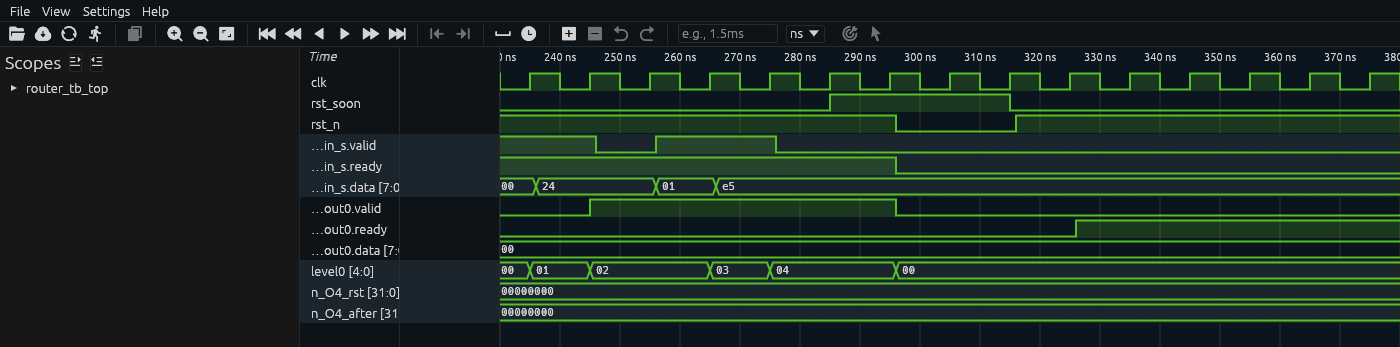
The E8 reset on the golden router, in Surfer The golden router, with the reference solution’s sequence. Output 0 has been stalled since 226 ns. The 2-beat packet
00 24went in first, and its header00has been waiting on output 0 since 245 ns, whenout0_validrose. The next packet’s first two beats,01 e5, went in after it, solevel0is 4. (After 276 nsin_validis 0, because that packet’s third beat waits out a 3-cycle gap.)rst_soonrises at 285 ns, a cycle before the reset, andrst_nfalls at 296 ns;out0_valid,in_readyandlevel0fall with it, without waiting for a clock edge. The sink is ready from 326 ns, and nothing comes out, as example E8 says.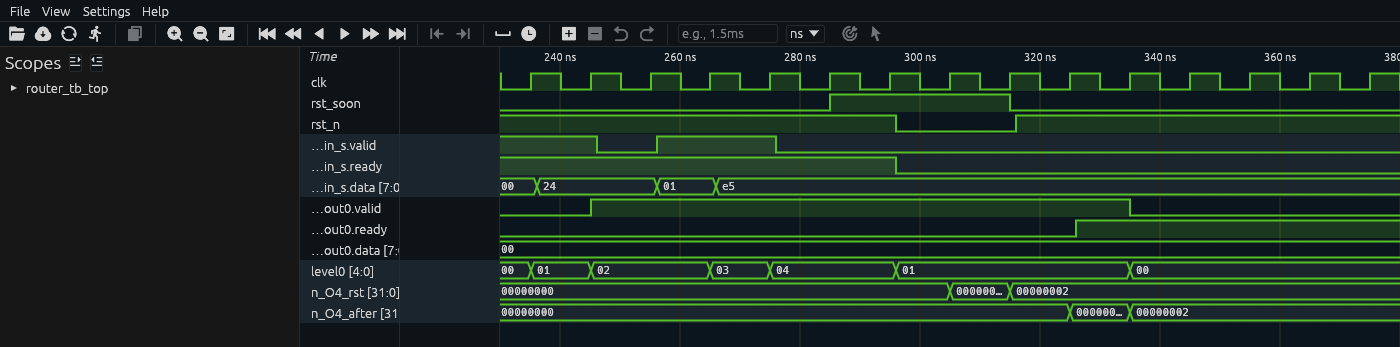
The same reset with B15 on, in Surfer B15, from the same seed. The reset empties the buffer behind the output but not the output register, so
out0_validstays 1 through the reset with00still onout0_data, andlevel0reads 1, because the level counts the beat on the pins.a_O4_rstcounts a failure at each of the two rising edges inside the reset (305 and 315 ns), anda_O4_afterat the next two. The sink takes00at the edge at 335 ns, and the scoreboard reports it:[OUT] output 0: got 00 in cycle 34, and no beat was expected.Go through your plan’s sign-off criteria one at a time, against the files in
results/.
Check: 15 of 15 caught. on three seeds, with the reset assertions and the two sequences that you wrote.
Part 8: The report
Can someone else check your claim without redoing your work?
Fill in
REPORT.mdsection by section. Paste each number as the tool printed it, fromresults/and from your notes. Section 7, “What this doesn’t show”, is the only place where a reader who has to rely on your claim can find out where your evidence stops, so don’t leave it short. Your plan’s Open items from Part 2 go there.Copy your testbench and its outputs into the repository, and push:
R=/foss/designs/projects/dd105-capstone
mkdir -p $R/tb $R/results
cp Makefile $R/ && cp tb/*.sv tb/*.vlt $R/tb/ && cp results/*.txt $R/results/
cd $R
git add -A && git commit -m "The capstone environment, its results and the report" && git push
cd -
The last line takes you back to the lab folder. The copy is safe to repeat from there, so run the block again whenever you change a file and want the repository to have it.
Open the repository on GitHub, and check that a reader who has only that page could find the command behind every number in your report.
Check: your repository on GitHub has PLAN.md, REPORT.md, Makefile, tb/ and results/.
Finishing
You’re done when make check-all prints 15 of 15 caught. with the reset assertions and the reset and saturation sequences that you wrote, and the REPORT.md in your GitHub repository quotes that run.
Questions:
B15 was caught by an assertion and by the scoreboard. If you could keep only one of the two checks, which would you keep?
TipAnswerEither can be defended.
a_O4_rstfired in the reset cycle itself and names the rule it checks. It needs no model, so it fires whether or not the sink ever takes the stale beat. In our seed 3 log the scoreboard fired three cycles later, and only because the sink took the beat, but its message says what the bug does to whoever uses the router, which is to deliver a beat from before the reset as if it were new.Part 3’s regression passed 110 runs out of 110. What would a reader who saw only that line have believed, and what did your plan say at the time?
TipAnswerThat the router worked. At the time the plan had no assertion for I7, O4, the first half of A4 or RS1, nothing that made RS2, RS3 or DR2 happen, and a list of rows with no checker at all; the coverage had four empty bins that a test could hit; and, as Part 7 showed, the graded test passed on one of the fifteen planted bugs.
Submit: nothing yet. Your repository is the record of your capstone. We plan a certification process that will review capstone repositories, but it doesn’t exist yet.
Going further (optional)
- Close one of the reference plan’s open items (
solutions/PLAN.md). Assertions for I5 and I6, withCTRL.ENas written over APB kept beside them, would give thein_readyrows a checker, and a check ofLEVELreads against the levels the scoreboard already counts would close RG4. Runmake check-allafterwards. If your new check fires on the golden router, the mistake is in the check. - Run more seeds, with
make regress NSEEDS=50. The simulator is built at-O0, which keeps builds short but makes it run slower, souvm.mksays to useOPT_FAST=-Osfor long regressions, at the cost of a longer build. - Deal more mystery bugs, until you’ve had one from every tier.
Next on the Course path: this is the last lab.