Lab 02: A class testbench without UVM
You’ll finish a class testbench for the router. Every class in it is plain SystemVerilog except the test, which is a UVM test that the top module starts with run_test(). You write the monitor, which turns the handshakes on a valid/ready stream into packets, and the scoreboard, which predicts the packets that should come out of output 0 and checks the ones that do. Then you’ll use the testbench to catch two planted bugs, and rerun it with different plusargs to find out what each catch depends on.
Package: labs/lab-02-a-class-testbench-without-uvm/
Before you start
- Finish Lab 01. This lab uses the same
maketargets, the same terminal and the same course folder. - Read Classes for testbenches, Interfaces, clocking blocks and virtual interfaces and Threads, mailboxes and events.
- Read The router in one page, and keep the specification open. You’ll use its Packets, Routing and The outputs sections, and the stream rules under Valid/ready rules.
Time: about 2 h. The three builds in it took us 90 s, 89 s and 86 s.
Part 1: The starter
What does the shipped testbench do, and what does it check?
Open a terminal on the workbench desktop, as in Lab 01, and go to the lab folder:
. /foss/designs/common/.designinit   # in every new terminal
mod dd105-a
cd labs/lab-02-a-class-testbench-without-uvm
Start the build now, because it’s the slowest step:
make buildThe banner estimates 1.5 to 2.5 minutes, and with an empty ccache it took us 90 s. It ends with:
- V e r i l a t i o n   R e p o r t: Verilator 5.050 2026-07-01 rev v5.050
- Verilator: Built from 48.403 MB sources in 393 modules, into 23.194 MB in 2538 C++ files needing 80.303 MB
- Verilator: Walltime 89.763 s (elab=0.694, cvt=2.551, bld=85.825); cpu 4.237 s on 2 threads; allocated 312.547 MB
========================================================================
 built /w/labs/lab-02-a-class-testbench-without-uvm/build/sim in 90 s (48M; the 898M of generated C++ was deleted, SLIM=0 keeps it)
 ccache:  Hits: 0 / 36 ( 0.00%)  Misses: 36 / 36 (100.0%)
========================================================================
 /w/labs/lab-02-a-class-testbench-without-uvm/build/sim is up to date.
We ran it with the course folder mounted at
/w, so your paths start with/foss/designs/modules/dd105-ainstead. The ccache counts add up over every build in your clone, Lab 01’s included, so yours will be higher.While it builds, read the files in
tb/. Each class has one job. The generator hands its packets to the driver through a mailbox, and each monitor hands the packets it sees to the scoreboard through a mailbox of its own.File Class Its job packet.svhpacketone packet: its beats, header first router_cfgthe test’s knobs, read from plusargs generator.svhgeneratormakes the packets and puts them in a mailbox driver.svhdriveroffers each beat on the input until the router takes it sinkholds one output’s ready ( out0_readyorout1_ready) at 1, and counts its beatsapb_masterwrites the routing table and CTRL.ENmonitor.svhmonitoryours: turns a stream’s handshakes into packets scoreboard.svhscoreboardyours: predicts output 0 and checks it env.svhenvmakes the classes above from generatortoscoreboard, connects them, and runs the testrouter_test_pkg.svrouter_class_testthe one UVM class router_tb_top.sv(module) the clock, the reset, the interfaces, the router and run_test()Read
env::run()closely. It waits for reset and writes the configuration, then starts the sinks, the monitors and the scoreboard in afork ... join_none. It sends the packets, waits 50 cycles for the outputs to drain, and asks the scoreboard for its report. Nothing in it waits for the monitors or the scoreboard, so the test ends after those 50 cycles however much of them you’ve written.router_class_testmakes theenvand callsrun(). It’s a UVM test only so that this lab runs the way Lab 01 did, withmakepicking the test by name with+UVM_TESTNAMEand the graders reading UVM’s report summary at the end of every log. If the driver or the scoreboard counted any errors, the test reports a singleUVM_ERRORsaying how many, and the base test turns that into a failing exit status.When the build has finished, run the test:
make runAfter UVM’s release notes you should see:
UVM_INFO @ 0: reporter [RNTST] Running test router_class_test...
[ENV] 100 packets, DST from 0123, routes 0110, 1 to 8 beats
[ENV] sent 100 packets (448 beats); output 0 took 252 beats and output 1 took 196
[SB] 0 packets in, 0 predicted for output 0, 0 checked, 0 errors
DD105: TEST PASSED
followed by UVM’s report summary and, last:
------------------------------------------------------------------------
 ok: 0 UVM_ERROR, 0 UVM_FATAL   0.07 s   log: build/runs/router_class_test-s1/run.log
------------------------------------------------------------------------
The first
[ENV]line gives the test’s knobs, which are plusargs (the package README lists them).routes 0110is the routing table, one character per entry fromROUTE0toROUTE3, so packets forDST0 and 3 go to output 0, and packets forDST1 and 2 go to output 1.make check-allruns the test on the golden router and on the two bugs this lab hunts. Write down what you expect it to report, then run it:make check-allYou should see:
      ok  the golden design                        0 UVM_ERROR, 0 UVM_FATAL        0.1s
------------------------------------------------------------------------
  MISSED  tier 2  B05_dst_field_off_by_one         0 UVM_ERROR, 0 UVM_FATAL        0.1s
  MISSED  tier 3  B09_write_pointer_power_of_two   0 UVM_ERROR, 0 UVM_FATAL        0.1s
------------------------------------------------------------------------
 0 of 2 caught.
 Still hiding from this test:
   B05_dst_field_off_by_one
      hides behind: sending to DST 0 only, or setting every route the same way
   B09_write_pointer_power_of_two
      hides behind: short tests: fewer than 16 beats through one output
On the golden router, output 0 delivered 252 beats and the test passed. It passed on both broken routers as well. Why?
TipAnswerThe
[SB]line says the scoreboard saw 0 packets and checked 0, because the starter’s monitor and scoreboard are empty, so nothing compared those 252 beats with anything. A pass means only that no check fired, and with no checks the test passes on the golden router and on both bugs alike.
Check: 0 of 2 caught, and [SB] 0 packets in in make run.
Part 2: The monitor
What goes into the router, and what comes out of output 0, packet by packet?
Open
tb/monitor.svhandtb/stream_if.sv. The monitor holds avirtual stream_mon_if, an interface whose signals are all inputs, so a monitor can’t drive the stream it watches. The top module makes two of these interfaces,in_monwired to the input’s four signals andout0_monwired to output 0’s. Both have the same type, so onemonitorclass watches either. The clocking block samples with#1step, so after@(vif.cb)returns at a rising edge,vif.cb.validis the value thatvalidhad just before that edge, which the specification calls its value in the cycle that the edge ends. The type is written out in full,virtual stream_mon_if, and never through atypedef, because on Verilator 5.050, when a class in a package reaches an interface through a typedef of its virtual interface type, the class reads 0 from every clocking-block input, with no warning.This is the golden router taking one packet on its input and delivering it on output 0:
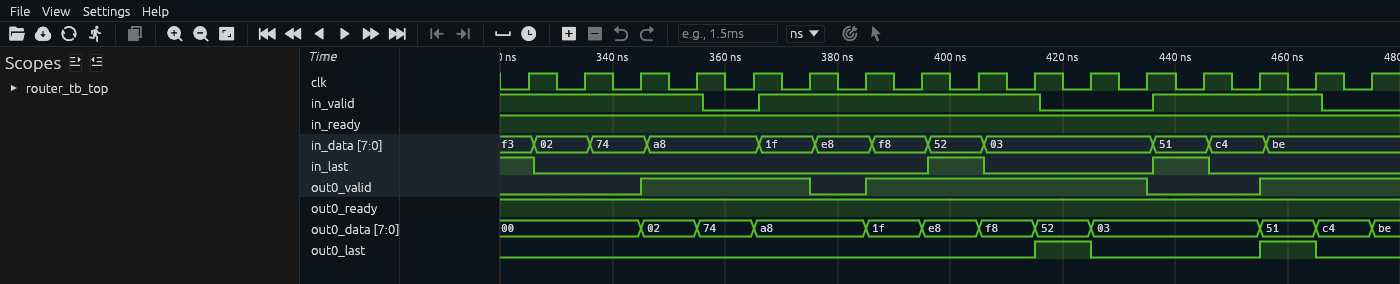
The packet 02 74 a8 1f e8 f8 52 going in and coming out of output 0, in Surfer Seed 1, 320 to 480 ns. The input takes
02at the rising edge at 335 ns, and02is onout0_datafrom 345 ns.out0_readyis 1 throughout.A beat moves at a rising edge where
validandreadywere both 1. Finda8onin_data. At how many rising edges is it onin_data, and how many beats is it?TipAnswerIt’s on
in_dataat two edges, 355 ns and 365 ns, and it’s one beat. The driver put it there at 346 ns, the router took it at the edge at 355 ns, and the driver then left one idle cycle within_validat 0, so at 365 ns the pins still showa8but nothing moves. A monitor that looked only atin_datawould record it twice. The output shows the same gap two cycles later.Write
monitor::run(), following theTODO. Each time round aforeverloop, wait with@(vif.cb); drop any half-assembled packet whilevif.cb.rst_nis 0; and in a handshake cycle add the beat to the packetp, starting a new one whenpis null. When the beat haslast= 1, the packet is finished, so put it into_sband setpback to null for the next one. Keep the$displayformat that theTODOgives, so that your output can be compared with the one below.Check the syntax, which takes a few seconds, then build:
make lint
make build
make lintends with0 warnings, by kind:when your code is clean, and it prints any syntax error with its line number. With the reference monitor the build took 89 s, nearly as long as the first one, because filling in the empty task changed most of the C++ that Verilator generates, and the ccache could reuse only 10 of the 36 compiled files.+SHOW=5makes each monitor print the first 5 packets it sees, with the time of the edge at which each packet’s last beat moved. The clock period is 10 ns. Using the routing table0110and rule O8 of the specification, write down which input packets you expect to see again on output 0, and how many ns after its[in]line each[out0]line should come. Then run it:make run PLUSARGS="+SHOW=5"You should see, with the reference monitor:
[ENV] 100 packets, DST from 0123, routes 0110, 1 to 8 beats
[in] 235 ns: dst 2, 5 beats: 80 b4 e5 26 c1
[in] 325 ns: dst 2, 6 beats: 81 f3 06 8e bc f3
[in] 405 ns: dst 0, 7 beats: 02 74 a8 1f e8 f8 52
[out0] 425 ns: dst 0, 7 beats: 02 74 a8 1f e8 f8 52
[in] 445 ns: dst 0, 2 beats: 03 51
[out0] 465 ns: dst 0, 2 beats: 03 51
[in] 575 ns: dst 3, 8 beats: c4 be 9e 50 be fe e2 92
[out0] 595 ns: dst 3, 8 beats: c4 be 9e 50 be fe e2 92
[out0] 685 ns: dst 0, 2 beats: 08 df
[out0] 835 ns: dst 0, 1 beat: 0b
[ENV] sent 100 packets (448 beats); output 0 took 252 beats and output 1 took 196
The header’s low six bits are the packet’s sequence number, so
80is packet 0,81packet 1 and02packet 2. Why are packets 0 and 1 missing from output 0, and why does each[out0]line come 20 ns after the[in]line of the same packet?TipAnswerTheir headers,
80and81, haveDST2 in bits 7:6, andROUTE2sends packets to output 1, which this testbench doesn’t watch. The 20 ns is two clock cycles. Rule O8 puts each beat on the output from the second cycle after its input handshake, as example E2 in the specification shows, unless the beat before it is still waiting there, as in E3. Here the sink takes every beat in the first cycle it’s offered, so nothing waits, and each packet’s last beat leaves output 0 two cycles after it went in.
Check: your [in] and [out0] lines match the ones above. The seed is the same, so the packets are too.
Part 3: The scoreboard
Which packets should come out of output 0, and did they?
Read the comment at the top of
tb/scoreboard.svh. The rule you’re checking is O5, which says that an output delivers the beats of the packets routed to it in the order the router accepted them, unchanged. In this lab the sinks never stall, so no packet is dropped for a full output, and a packet goes to output 0 exactly whenROUTE[DST]is enabled withPORT0.Write the four
TODOs:run(): afork ... joinof twoforeverloops, one taking packets fromfrom_inand callingpredict(), the other taking packets fromfrom_out0and callingcheck().predict(): push the packet ontoexpectedif it will come out of output 0.check(): compare what came out with the oldest packet inexpected, usingpacket::same(). A packet that comes out whileexpectedis empty is an error too.report(): report an error for each packet still inexpected, because it never came out, and one more if the test checked no packets at all.
Report each error with
$error, which takes a format string like$display, and count it:n_errors++; $error("out0 delivered %s at %0d ns; expected %s", got.sprint(), got.t_last, want.sprint());Lab 01’s
`uvm_errorwon’t work here, because this package doesn’t import UVM. We tried it, andmake lintstopped with twoCan't find definition of task/functionerrors, one foruvm_get_report_objectand one foruvm_report_error.Run
make lintandmake build. With the reference scoreboard the build took 86 s. A small edit after that rebuilds faster. When we changed the text of one$error, the rebuild took 21 s.Run the test on the golden router:
make runYou should see
[SB] 100 packets in, 51 predicted for output 0, 51 checked, 0 errors,DD105: TEST PASSEDandok. If an error fires here, the golden router is right, so the mistake is in your scoreboard or your monitor.Run it on five seeds:
make seeds NSEEDS=5You should see
5 ok (5 runs). The coverage report under it says there are no covergroup bins, because this testbench has no covergroup yet. You’ll add one in Lab 03.Write down what you now expect from
make check-all, then run it. With the reference scoreboard you should see:ok the golden design 0 UVM_ERROR, 0 UVM_FATAL 0.1s ------------------------------------------------------------------------ caught tier 2 B05_dst_field_off_by_one 1 UVM_ERROR, 50 assertions 0.1s caught tier 3 B09_write_pointer_power_of_two 1 UVM_ERROR, 46 assertions 0.1s ------------------------------------------------------------------------ 2 of 2 caught.The grader counts each
$erroras an assertion, because Verilator prints a$errorand a failed assertion the same way, so the 50 and 46 are the reference scoreboard’s errors. The oneUVM_ERRORis the test’s summary of them. Your counts depend on how your scoreboard reports, so they may differ.Look at the first error on B05:
make run BUG=B05With the reference scoreboard, the first two lines after
[ENV]are:[255000] %Error: scoreboard.svh:65: Assertion failed in router_tb_pkg.scoreboard.check: out0 delivered dst 2, 5 beats: 80 b4 e5 26 c1 at 255 ns, and no packet was expected -Info: labs/lab-02-a-class-testbench-without-uvm/tb/scoreboard.svh:65: Verilog $stop, ignored due to +verilator+error+limitThe
-Infoline appears only once, after the first error. By default Verilator stops a run at its first$error. When we ranbuild/simby hand without the plusarg, it stopped at this error withVerilog $stop, before the scoreboard’s report and UVM’s summary. That’s why the lab’s Makefile adds+verilator+error+limit+100to every run, so that your runs go on past each error until the 100th.The header is
80, which is1000_0000. Which routing table entry should the router have used, which one did it use, and which bits of the header did it read?TipAnswerDSTis bits 7:6,10, so it should have usedROUTE2, which sends to output 1. The packet came out of output 0, which onlyROUTE0andROUTE3send to. Bits 6:5 of80are00, so the router read the field one bit too low and usedROUTE0. That’s B05,dst_field_off_by_one.Now the first error on B09:
make run BUG=B09[895000] %Error: scoreboard.svh:72: Assertion failed in router_tb_pkg.scoreboard.check: out0 delivered dst 3, 13 beats: c4 be 9e 50 be fe 02 74 a8 1f e8 f8 52 at 895 ns; expected dst 3, 8 beats: c4 be 9e 50 be fe e2 92, which went in at 455 nsThe first six beats are right. Compare the other seven with your Part 2 printout. Where have you seen them before?
TipAnswerThey’re packet 2,
02 74 a8 1f e8 f8 52, the first packet that output 0 delivered in this run. Its beats came out of the buffer a second time, and itslastflag ended the packet, which is why this one has 13 beats. Before it went wrong, output 0 had delivered all 7 beats of packet 2, both beats of packet 3 and the first 6 of packet 4’s 8, which is 15 beats, so the 16th beat (packet 4’s seventh,e2) is the first bad one. Part 4 shows why.
Check: 2 of 2 caught from make check-all.
Part 4: What each catch depends on
Which property of the stimulus does each catch depend on? The test’s knobs are plusargs, so each of these runs reuses the simulator you built.
+ROUTES=0000sets all four routes to output 0. Predict whether your test still catches B05, then run:make check BUG=B05 PLUSARGS="+ROUTES=0000"You should see
okon the golden design,MISSEDon B05 andVERDICT: FAIL. Why does the test miss B05 now?TipAnswerB05 changes which routing table entry the router reads. With all four entries set the same way, every entry sends the packet to output 0, so whichever one the router reads, the packet still comes out of output 0 in the order it went in, and nothing at the pins shows which entry was used. A test checks the
DSTfield only when each of its values, and each of its bits, has an effect of its own on where a packet goes.+DSTS=0sends every packet toDST0. Predict both results, then run:make check BUG=B05 PLUSARGS="+DSTS=0 +N=32" make check BUG=B05 PLUSARGS="+DSTS=0"The first prints
MISSED. The second, with the default 100 packets, printscaught B05_dst_field_off_by_one 1 UVM_ERROR, 68 assertions 0.1sand its first error is:
[4725000] %Error: scoreboard.svh:72: Assertion failed in router_tb_pkg.scoreboard.check: out0 delivered dst 0, 1 beat: 00 at 4725 ns; expected dst 0, 8 beats: 20 69 85 07 03 c1 02 4b, which went in at 2435 nsWhy does
DST0 alone catch B05 with 100 packets and not with 32?TipAnswerThe header’s other six bits are the sequence number, which counts 0 to 63 and wraps. For packets 0 to 31, bits 7:5 are all 0, so bits 6:5 read
00, the same asDST, and the bug has no effect. Packet 32’s header is20,0010_0000, whose bits 6:5 are01, so the router usesROUTE1and sends packets 32 to 63 to output 1. The error shows this. Output 0 was expecting packet 32 (20), and the next packet it delivered was packet 64, whose sequence number has wrapped to 0, so its header is00. With 100 packets, the sequence number’s top bit happened to give header bit 5 an effect of its own.In Part 1,
make check-allsaid that B09 hides behind short tests, with fewer than 16 beats through one output. With+DSTS=0 +LEN=1, every packet is one beat long and goes to output 0. Work out the smallest+Nthat should catch B09 and write it down. Then try it and the number below it:make check BUG=B09 PLUSARGS="+DSTS=0 +LEN=1 +N=15" make check BUG=B09 PLUSARGS="+DSTS=0 +LEN=1 +N=16"You should see, from the two commands:
MISSED B09_write_pointer_power_of_two 0 UVM_ERROR, 0 UVM_FATAL 0.0scaught B09_write_pointer_power_of_two 1 UVM_ERROR, 1 assertion 0.0s UVM_ERROR [TB] the testbench reported 1 error scoreboard.svh:72: Assertion failed in router_tb_pkg.scoreboard.check: out0 delivered dst 0, 1 beat:make runwith the sameBUGandPLUSARGSprints the whole error:out0 delivered dst 0, 1 beat: 00 at 405 ns; expected dst 0, 1 beat: 0f, which went in at 385 ns.Record the 16-beat run and open it:
make waves BUG=B09 PLUSARGS="+DSTS=0 +LEN=1 +N=16"
surfer build/runs/router_class_test-s1-B09/waves.fst &
Add
clkfromrouter_tb_top,in_valid,in_ready,in_data,out0_validandout0_datafromdut, andwr_ptr_qandrd_ptr_qfromdut.u_buf0, output 0’s buffer:
Sixteen one-beat packets through output 0 with B09 switched on, in Surfer B09. Beats
00to0ecome out as they went in.wr_ptr_qgoes on frometofwhilerd_ptr_qwraps frometo0, and the 16th beat comes out as00instead of0f.The buffer holds 16 beats, one in the output register that drives the pins and 15 in a small RAM behind it (
labs/common/rtl/router_fifo.sv), so both pointers should wrap after entrye. Why does the 16th beat come out as00?TipAnswerThe write pointer wrapped at 16, as if the RAM had 16 entries, so beat
0fwas written to entryf, which doesn’t exist, and was lost. The read pointer wrapped correctly to entry 0, which still held beat00from the start of the test. Up to the 15th beat, each beat is read from the entry it was written to, so no test that puts fewer than 16 beats through an output can see the bug.
Check: MISSED with +ROUTES=0000 and with +N=15, and caught with +N=16.
Finishing
You’re done when make check-all prints 2 of 2 caught. with the monitor and scoreboard you wrote in tb/monitor.svh and tb/scoreboard.svh.
Questions:
In Lab 01 the UVM testbench was split into the same kinds of pieces. Which jobs did UVM do there that the shipped classes, or you, did by hand here?
TipAnswerUVM connected the pieces in Lab 01. Here
env::new()makes three mailboxes and passes each one to its two ends by hand. In Lab 01, UVM’s phases started each component and its objections decided when the test was over. Hereenv::run()forks everyrun()task itself and ends the test after a fixed 50-cycle drain. UVM’s report server counted every`uvm_errorby its ID, while here the driver and the scoreboard each keep their ownn_errors, andenv::n_errors()adds them up for the test. In Lab 01 each test was its own class, picked by name with+UVM_TESTNAME, and every test reused the same driver, monitor and scoreboard. Here there is one test, its variations are the plusargs thatrouter_cfgreads, and anything those can’t express needs a change toenv::run(). In Lab 04 you’ll finish a UVM port of this testbench as it stands after Lab 03, and compare the two piece by piece.On B09 the reference scoreboard’s second error is
out0 delivered dst 0, 2 beats: 03 51 at 935 ns; expected dst 0, 2 beats: 08 df, which went in at 655 ns. Is that a second bug, and which error should you read first when a scoreboard reports many?TipAnswerIt’s the same bug.
03 51is packet 3, the second packet that output 0 delivered, coming out of the buffer again. After the first wrong packet the buffer keeps handing back old beats, so the packets that output 0 delivers no longer line up with the ones inexpected, and most of the later errors follow from the first. Read the first error first. The later ones count comparisons that failed after the two fell out of step, so their number says little about how many packets the router got wrong.
Submit: nothing for this lab.
Going further (optional)
Watch output 1 as well. The top module needs a third stream_mon_if, wired to out1 and set in config_db, and router_class_test has to get it and pass it to the env. The env needs a third monitor, and a fourth mailbox to carry that monitor’s packets to the scoreboard. The scoreboard needs a second queue of expected packets, which predict() fills for routes with PORT 1. Rebuild and run make seeds NSEEDS=5 to check that the golden router still passes.
Next on the Course path: the reading on constrained random and functional coverage, then Lab 03: Constraints and coverage.