The UVM skeleton
This page answers: what are the pieces of a UVM testbench, and in what order does UVM run them?
In Lab 01 you read a whole UVM testbench, the ALU’s, from its tests down to its driver, monitor and scoreboard, and you added the flag check to its scoreboard. Labs 02 and 03 used only one piece of UVM, the test. It extended dd105_base_test so that make could pick it with +UVM_TESTNAME and the graders could read UVM’s report summary at the end of the log. Inside its run_phase it fetched the virtual interfaces from config_db, made the environment with new() and ran it like any other class. In Lab 04 the router testbench becomes UVM classes too, and Part 5 of that lab counts what this costs in lines against your Lab 03 testbench. Much of what it counts is the structure that this page describes. The drivers, the monitors and the scoreboard become components in a tree, UVM builds the tree and connects it in a fixed order of phases, and objections decide when the run ends.
The example for this page, guide-examples/the-uvm-skeleton/, has no design at all. It has a test, an environment, two agents with one child each, and a component called mon that loops forever the way a monitor does. Each of them prints a line in every function phase, and the test, the two children and mon also print in the run phase, so you can watch the order in which UVM calls them.
Objects and components
Every UVM class in a testbench extends either uvm_object or uvm_component. (In the library, uvm_component is itself built on uvm_object, but a testbench uses the two in different ways.)
A uvm_object is data: a packet, an APB transfer, a set of knobs for an agent. You make one whenever you need it, pass it around and drop it, and many of them come and go in a run. Lab 04’s router_pkt, stream_beat, apb_item and out_cfg are objects.
A uvm_component is one of the testbench’s fixed parts, such as a driver, a monitor, a scoreboard or the test. It’s made once, at the start, and lasts for the whole run. Every component has a name and a parent, given to its constructor as new(name, parent), and the parents link the components into a tree. Lab 04’s tree looks like this:
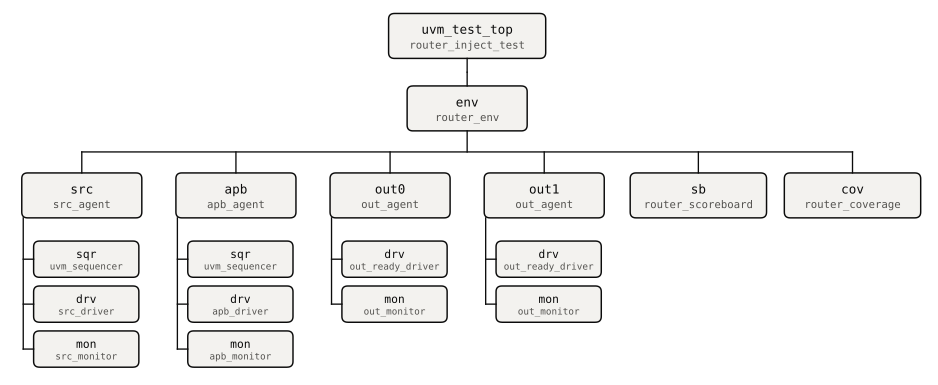
The components that router_base_test, router_env and the agents build in Lab 04, once you’ve added out1 in Part 2. When a component reports a message, UVM prints the component’s name as a path down this tree, such as uvm_test_top.env.out1.mon for the monitor on output 1.
The test is at the top of everything the testbench builds, and UVM always names it uvm_test_top. Above it sits UVM’s own root, uvm_root, which you’ll see in a printout of the tree later on this page. The test makes the environment, env, and the environment makes the agents, the scoreboard and the coverage collector. An agent holds the components for one interface: a driver that drives its pins, a monitor that watches them, and, if the agent sends items, a sequencer that hands the driver its items.
The library has a class for each of these jobs: uvm_test, uvm_env, uvm_agent, uvm_driver, uvm_monitor, uvm_sequencer, uvm_scoreboard and uvm_subscriber. Most of them add little or nothing to uvm_component. uvm_driver adds the port that it gets items through, and uvm_subscriber adds the port that it receives transactions on; the next two pages describe both ports. uvm_monitor and uvm_scoreboard add nothing, and each is a plain component whose name says what it’s for. In Lab 04’s output agent, out_ready_driver takes no items, so it extends uvm_component rather than uvm_driver.
Every UVM class also has a registration line, such as `uvm_object_utils(router_pkt) or `uvm_component_utils(router_env), which tells UVM’s factory that the class exists, and the components are made with router_env::type_id::create("env", this) instead of new(). The factory page explains what the factory does with them. For now, the registration is the reason that +UVM_TESTNAME can name a test that no other code in the testbench refers to.
run_test() and +UVM_TESTNAME
Every lab’s top module makes the clock, the design and the interfaces, puts each interface into config_db for the components that will need it (in Labs 02 and 03, the test), and ends by calling run_test(). run_test() reads +UVM_TESTNAME, asks the factory for a component of that class, names it uvm_test_top, and starts the phases. That’s how one build serves every test in a lab.
If the name doesn’t match a registered class, no test is built. make run UVM_TESTNAME=sk_phase_tset, with two letters of the name swapped, prints these two lines among its other output:
UVM_WARNING @ 0: reporter [BDTYP] Cannot create a component of type 'sk_phase_tset' because it is not registered with the factory.
UVM_FATAL @ 0: reporter [INVTST] Requested test from command line +UVM_TESTNAME=sk_phase_tset not found.
and the simulator exits with status 0, which the last section of this page comes back to.
Phases
Instead of running each component as soon as it’s made, UVM calls a fixed list of methods, the phases, on every component in the tree, and finishes each phase everywhere before it starts the next. A component overrides the phases it needs. The ones you’ll write are:
| Phase | Kind | Order in the tree | What goes in it |
|---|---|---|---|
build_phase |
function | top down | make the children; read configuration |
connect_phase |
function | bottom up | connect ports between children |
end_of_elaboration_phase |
function | bottom up | print or check the finished tree |
start_of_simulation_phase |
function | bottom up | last settings before time moves |
run_phase |
task | all at once | everything that takes simulated time |
extract_phase, check_phase, report_phase |
function | bottom up | collect results, look for leftovers, print summaries |
final_phase |
function | top down | the very end |
The function phases take no simulated time. The run phase is a task, and UVM starts every component’s run_phase at the same moment, each in its own thread. Here is the start of sk_phase_test’s output:
0    ns  build_phase                uvm_test_top
0    ns  build_phase                uvm_test_top.env
0    ns  build_phase                uvm_test_top.env.a0
0    ns  build_phase                uvm_test_top.env.a0.child
0    ns  build_phase                uvm_test_top.env.a1
0    ns  build_phase                uvm_test_top.env.a1.child
0    ns  build_phase                uvm_test_top.env.mon
0    ns  connect_phase              uvm_test_top.env.a0.child
0    ns  connect_phase              uvm_test_top.env.a0
0    ns  connect_phase              uvm_test_top.env.a1.child
0    ns  connect_phase              uvm_test_top.env.a1
0    ns  connect_phase              uvm_test_top.env.mon
0    ns  connect_phase              uvm_test_top.env
0    ns  connect_phase              uvm_test_top
The build phase has to go from the top down, because a component’s children don’t exist until its own build_phase makes them, so UVM can’t call env’s build_phase until the test’s build_phase has created env. Within each parent, the course’s UVM library visited the children in name order (a0, a1, mon), although env made them in the order mon, a1, a0.
The connect phase goes from the bottom up, so by the time env connects its agents’ monitors to the scoreboard, every agent has already connected its own pieces. A component connects ports in connect_phase and never in build_phase, because the component on the other end may not exist yet during build_phase. UVM finishes build_phase in the whole tree before any connect_phase starts, so every component exists by the time it connects.
In end_of_elaboration_phase the test asks UVM to print the tree it has built:
Name            Type           Size  Value
------------------------------------------
<unnamed>       uvm_root       -     @64
  uvm_test_top  sk_phase_test  -     @150
    env         sk_env         -     @220
      a0        sk_agent       -     @244
        child   sk_leaf        -     @252
      a1        sk_agent       -     @236
        child   sk_leaf        -     @260
      mon       sk_watcher     -     @228
Objections
A driver loops forever asking for items, and a monitor loops forever watching pins, so the run phase can’t wait for every run_phase task to return. Instead, UVM keeps the run phase going while any component holds an objection. A component that is in the middle of something calls phase.raise_objection(this), and calls phase.drop_objection(this) when it’s done, and the run phase ends once every objection has been dropped. A component can also set a drain time, which keeps the phase open for that long after the last objection drops, so that anything still in flight can arrive.
In sk_phase_test the test holds an objection for 100 ns and sets a drain time of 20 ns, env.a1.child holds one for 150 ns, and env.mon loops forever, printing every 40 ns:
0    ns  run_phase starts           uvm_test_top.env.a0.child
0    ns  run_phase starts           uvm_test_top.env.a1.child
0    ns  run_phase: still looping   uvm_test_top.env.mon
0    ns  run_phase starts           uvm_test_top
40   ns  run_phase: still looping   uvm_test_top.env.mon
80   ns  run_phase: still looping   uvm_test_top.env.mon
100  ns  drops after 100 ns         uvm_test_top
120  ns  run_phase: still looping   uvm_test_top.env.mon
150  ns  drops after 150 ns         uvm_test_top.env.a1.child
160  ns  run_phase: still looping   uvm_test_top.env.mon
170  ns  extract_phase              uvm_test_top.env.a0.child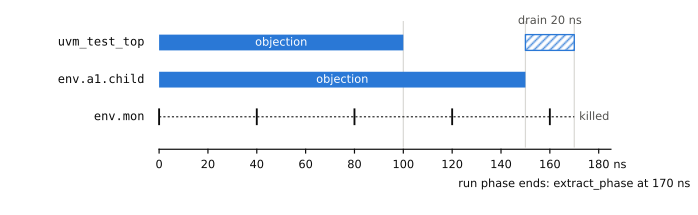
The run phase of sk_phase_test. When the test dropped its objection at 100 ns, a1.child still held one. The phase ended 20 ns after that one dropped, at 170 ns, and UVM killed mon’s loop, which had been running the whole time without holding the phase open.
sk_noobj_test builds the same environment and raises no objection at all. Every run_phase still starts at 0 ns, and the phase ends in the same time step:
0    ns  run_phase starts           uvm_test_top
0    ns  extract_phase              uvm_test_top.env.a0.child
A new UVM test can pass this way without testing anything. If it starts its sequence in run_phase and forgets to raise an objection, the run ends before the first item reaches the driver. Lab 04’s router_base_test raises its objection at the start of run_phase, runs the test’s body() and drops the objection when body() returns. The tests built on it override body() and leave run_phase alone, so none of them has to raise an objection itself. router_base_test also runs a watchdog beside body(), because a test that holds its objection forever never ends on its own either. If the test is still running after +MAX_CYCLES clock cycles, the watchdog reports a UVM_ERROR, and run_phase stops body() and drops the objection, so the run ends.
After the run phase
Checks that need the whole run go in the three function phases that follow the run phase, extract_phase, check_phase and report_phase. Lab 04’s scoreboard uses check_phase to report, for each output, how many beats it expected and never saw, and the first of them. It uses report_phase to print the [SB] lines you’ll read in every run. After final_phase, UVM prints its report summary, which counts the run’s messages by severity and by ID.
Verilator ends a UVM run with exit status 0 even when the summary counts errors, so a script that trusts the exit status would call a failing test a pass. dd105_base_test, which every test in the course extends, fixes that in its final_phase, and in pre_abort when a UVM_FATAL ends the run early. If UVM counted no error or fatal, it prints DD105: TEST PASSED. Otherwise it prints the report summary itself, then DD105: TEST FAILED, and calls $fatal. sk_error_test reports one UVM_ERROR at 50 ns:
UVM_ERROR guide-examples/the-uvm-skeleton/sk_pkg.sv(186) @ 50000: uvm_test_top [CHECK] a check failed at 50 nsand, after the report summary, prints
DD105: TEST FAILED (1 UVM_ERROR, 0 UVM_FATAL)
[150000] %Fatal: dd105_pkg.sv:89: Assertion failed in dd105_pkg.dd105_base_test.m_end_of_test: DD105: UVM counted errors, so the exit status is nonzero
and the simulator exits with status 1. The UVM_ERROR line has the same shape as the messages that the labs’ testbenches report: the severity, the file and line that reported it, @ and the time, the full name of the component, the message’s ID in brackets, and the text. Some of the UVM library’s own messages leave out the file and line, as the [BDTYP] and [INVTST] lines earlier on this page do. The time is in picoseconds, the simulator’s precision, so @ 50000 is 50 ns.
The base test can’t help with the misspelt test name. No test was built, so the base test’s final_phase and pre_abort never ran, and that run exited with status 0. That’s why the course’s make run reads the log as well as the exit status. It reported that run as BROKEN: UVM_FATAL [INVTST].
Check yourself
Why can’t a scoreboard connect a monitor’s analysis port to itself in its
build_phase?TipAnswerThe monitor may not exist yet. It’s made in its agent’s
build_phase, and the agent’sbuild_phasecan run after the scoreboard’s. In Lab 04,env’s children are built in name order, asa0,a1andmonwere above, sosbis built beforesrc, andsrc.mondoesn’t exist yet whensb’sbuild_phaseruns. Byconnect_phaseevery component has been built.A test’s
run_phasestarts a sequence of 200 packets on the input agent and doesn’t raise an objection. What happens, and what would the scoreboard’scheck_phasesee?TipAnswerThe run phase ends at time 0, as
sk_noobj_test’s did, before any packet reaches the pins. The scoreboard expected nothing and saw nothing, socheck_phasefinds no leftover beats. A scoreboard that also counts what it checked can catch this, as the one in Monitors, analysis ports and scoreboards does by reporting an error when it checked nothing.A run’s log ends with a
UVM_FATAL, and the simulator exited with status 0. Was the test built?TipAnswerNo. Every test in the course extends
dd105_base_test, which turns aUVM_FATALinto a nonzero exit status inpre_abort, so a fatal with status 0 means that no test was built, as happens with a misspeltUVM_TESTNAME.make testslists the names the lab knows.
Further reading
- ChipVerify’s Build Your First UVM Testbench walkthrough builds one testbench for a small register file over 17 pages, one component per page, and assembles it on the last, Full UVM Testbench. As you read it, note that its testbench top module (UVM Testbench Top) never drives reset, which only the last page fixes. Its coverage collector (UVM Subscriber) has coverpoints that read a class member, so Verilator 5.050 drops the whole covergroup with a
COVERIGNwarning (see Functional coverage you can read). - UVM Phases and UVM Objection cover every phase, including the twelve run-time sub-phases that this course doesn’t use, and objections raised from sequences.
- UVM Component and UVM Object.