Register models
This page answers: what does a UVM register model know about a design’s registers, and what does it do for you that raw bus transfers don’t?
Up to the end of Lab 05, your testbench reached the router’s registers with raw APB transfers, such as wr(A_ROUTE0, ...) to set up a route and rd(A_DROP_CNT) to read the two drop counters. The scoreboard checked reads of one register, DROP_CNT, and nothing in the testbench read any of the other nine. So the testbench had no way to notice a register that reset to the wrong value, or one that read back with its fields swapped. Lab 06 plants one bug of each of those kinds among its five, and your Lab 05 testbench misses all five. In that lab you’ll give the testbench a register model, which is a set of UVM classes that describes every register and field as the specification’s Register map does. The model can also turn an operation such as “write 1 to CTRL.EN” into a bus transfer.
We wrote a small register block for this page, regblk, and a testbench for it with a register model, an adapter and a predictor. Both are in guide-examples/register-models/, and the sections below use them to show how those parts work together. The UVM register layer reference page has the arguments, policies and messages you’ll look up while you work.
The example block
regblk has four 16-bit registers on a simple bus. Each transfer takes one cycle, in which sel is 1. The block answers in that same cycle, and a write takes effect at the rising edge that ends it.
| Address | Register | Access | Fields |
|---|---|---|---|
0x0 |
ID |
RO | [15:0], reads 105A |
0x4 |
CTRL |
RW | [0] EN, [3:1] MODE; resets to 0 |
0x8 |
FLAGS |
W1C | [0] OVF, [1] ERR; set by the design when an event happens |
0xC |
COUNT |
RO | [7:0], the number of events since reset |
Apart from a reset, only a write changes CTRL, so it holds whatever software last wrote to it, which here means the testbench. FLAGS and COUNT change on their own, whenever the design sees an event. A register model has to treat the two kinds of register differently, and the sections on volatile fields and on the built-in sequences show how.
Fields, registers and the map
Each register is a class, and its build() creates the register’s fields and configures each one. This is CTRL’s:
virtual function void build();
  en   = uvm_reg_field::type_id::create("en");
  mode = uvm_reg_field::type_id::create("mode");
  en.configure  (this, 1, 0, "RW", 0, 0, 1, 1, 0);
  mode.configure(this, 3, 1, "RW", 0, 0, 1, 1, 0);
endfunction
The arguments after this are, in order, the field’s width, its lowest bit, its access policy, whether it’s volatile (changed by the design on its own), its reset value, whether it has a reset value, whether randomize() may choose it, and whether it’s alone in its register. Both fields of FLAGS are configured as "W1C" with volatile set to 1, and the field in COUNT as "RO", also with volatile set to 1. The register block creates the four registers and puts each one at its address in a map:
default_map = create_map("map", 0, 2, UVM_LITTLE_ENDIAN, 1);   // 2 bytes per register
default_map.add_reg(id,    'h0, "RO");
default_map.add_reg(ctrl,  'h4, "RW");
default_map.add_reg(flags, 'h8, "RW");
default_map.add_reg(count, 'hC, "RO");
For every field, the model keeps two values. The mirror is what the model believes the design holds right now. The desired value is what the testbench last asked for. A read with a check, such as mirror(UVM_CHECK), compares what the design returns with the mirror, and update() compares the desired value with the mirror to decide whether to write the register. The sections below show both.
From a register operation to a transfer
A test calls regs.ctrl.write(status, 'h0005). The model looks up CTRL in the map, finds its address, and hands an abstract operation (a write of 0005 to address 4) to an adapter. The adapter’s reg2bus() turns that operation into the sequence item that your bus agent uses, and the map starts that item on the agent’s sequencer, so it goes through the same driver as every other transfer. When the driver has finished, the adapter’s bus2reg() turns the item back into an operation, with the read data and a status, which is UVM_IS_OK, or UVM_NOT_OK if the bus reported an error. Those two functions are the only code in the register layer that knows what your bus looks like, and in Lab 06, Part 2 you’ll write them for the router’s APB agent.
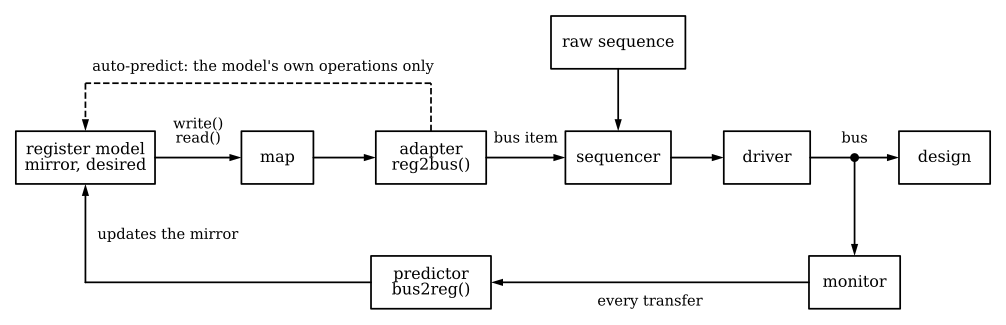
Auto-predict and the predictor
The model’s mirror follows the bus only if something tells the model about each transfer, and there are two ways to do that. With auto-predict on (set_auto_predict(1) on the map), the model updates the mirror after each operation that it sends itself. The other way is a predictor (uvm_reg_predictor), which you connect to the bus monitor’s analysis port. It updates the mirror after every transfer the monitor sees, whoever started it.
Our example’s reg_mirror_test writes 0005 to CTRL through the model, then writes 000b with a raw bus sequence that goes around the model, the way Lab 05’s wr() does. Then it calls regs.ctrl.mirror(status, UVM_CHECK), which reads CTRL and compares the value with the mirror. We ran it three times, with +PREDICT= choosing a different way of keeping the mirror each time:
+PREDICT= |
Mirror after the model’s write | After the raw write | mirror(UVM_CHECK) |
|---|---|---|---|
predictor |
0005 |
000b |
passes |
auto |
0005 |
0005 |
UVM_ERROR |
none |
0000 |
0000 |
UVM_ERROR |
With auto-predict, the error was:
UVM_ERROR third_party/uvm/src/reg/uvm_reg.svh(2812) @ 95000: reporter [RegModel] Register "regs.CTRL" value read from DUT (0x000000000000000b) does not match mirrored value (0x0000000000000005) (valid bit mask = 0x000000000000000f)
UVM_INFO third_party/uvm/src/reg/uvm_reg.svh(2833) @ 95000: reporter [RegModel] Field mode (regs.CTRL[3:1]) mismatch read=3'h5 mirrored=3'h2
In the first line, the valid bit mask has a 1 for each bit that was compared, which here is all four bits of CTRL’s two fields. The second line names the one field that differs, MODE, whose bits 3 to 1 are 101 (5) in 000b and 010 (2) in 0005. The design returned 000b, the value that the raw write put there, and the mirror still held 0005 because auto-predict never saw that write. regblk ran as the golden design, with no bug switched on, and a check that fails on the golden design means the testbench is wrong. This testbench needs a predictor. In Lab 06, Part 3 you connect one to the APB monitor, which the scoreboard already listens to.
Volatile fields
FLAGS is set by the design, so the model can’t know its value until it reads it. The test pulses the design’s ev_ovf input, which sets FLAGS.OVF, and prints the mirror of FLAGS before and after a mirror(UVM_CHECK) of it. These lines are from the run with the predictor:
UVM_INFO guide-examples/register-models/regblk_tb.sv(366) @ 125000: uvm_test_top [RAL] after an overflow event, the mirror of FLAGS is 0000
UVM_INFO guide-examples/register-models/regblk_tb.sv(368) @ 145000: uvm_test_top [RAL] after mirror(UVM_CHECK) reads FLAGS, the mirror is 0001
The mirror said 0000 while the design held 0001, and mirror(UVM_CHECK) reported no error, because the register layer doesn’t compare a volatile field when it reads one. The predictor saw the read and set the mirror to the value read, which is why the second line says 0001. UVM also warns you whenever you ask for the mirror of a volatile field. Asking for the mirror of FLAGS printed one warning for each of its two fields, such as [UVM/FLD/GET_MIRRORED_VAL/VOL] Mirrored value returned for volatile field "regs.FLAGS.ovf" may not reflect the actual current value. So the register model can’t check a register like FLAGS for you. The router’s STATUS, DROP_CNT and LEVEL are all volatile. In Lab 06 the scoreboard keeps its own copies of STATUS and INT_EN, which it updates cycle by cycle the way the router does, and checks STATUS reads and irq against them.
Desired and mirrored values
set() changes only the desired value. update() then writes the register if the desired value differs from the mirror. With the predictor connected, the test printed:
UVM_INFO guide-examples/register-models/regblk_tb.sv(373) @ 145000: uvm_test_top [RAL] after set(3) on CTRL.MODE: desired 0007, mirror 000b, needs_update 1
UVM_INFO guide-examples/register-models/regblk_tb.sv(376) @ 165000: uvm_test_top [RAL] after update(): desired 0007, mirror 0007, needs_update 0
MODE is bits 3 to 1, so setting it to 3, with EN still 1, makes the desired value 0111 in binary, which is 0007. The mirror held 000b from the raw write, which the predictor saw. With +PREDICT=none the last line read desired 0007, mirror 0000, needs_update 1. The write happened, but nothing told the mirror about it, so the model would write the register again on every update().
The built-in sequences
A register model also gives you stimulus without your writing any, because it knows every register’s access policy and reset value. UVM has built-in sequences that work from the model alone, and Lab 06 uses two of them. Neither of the two runs on a sequencer of its own. You set its model to the register block and start it with start(null), and it sends its transfers through the model.
uvm_reg_hw_reset_seq resets the model to its reset values, then reads every register it can check and compares each read with the reset value. On regblk it printed
... [uvm_reg_hw_reset_seq] Verifying reset value of register regs.ID in map "regs.map"...
... [uvm_reg_hw_reset_seq] Verifying reset value of register regs.CTRL in map "regs.map"...
and nothing for FLAGS or COUNT. Every field in those two registers is volatile, so a read of either would compare nothing, and the sequence skips a register like that. With the planted bug en_reset_1, which makes CTRL.EN reset to 1, it reported
UVM_ERROR third_party/uvm/src/reg/uvm_reg.svh(2812) @ 75000: reporter [RegModel] Register "regs.CTRL" value read from DUT (0x0000000000000001) does not match mirrored value (0x0000000000000000) (valid bit mask = 0x000000000000000f)
UVM_INFO third_party/uvm/src/reg/uvm_reg.svh(2833) @ 75000: reporter [RegModel] Field en (regs.CTRL[0:0]) mismatch read=1'h1 mirrored=1'h0
The reset sequence has to run while the design still holds its reset values, which means before anything has written a register, or straight after a reset.
uvm_reg_bit_bash_seq tests every bit it can check, one at a time. For each bit it writes the register with that bit the opposite of its desired value, reads the register back, and compares the read with the desired value, and then it does all of that a second time. On a bit you can write, the second write puts the bit back where it was. The sequence skips the bits of volatile fields, and it treats a bit with no field as read-only, so it still checks that bits 2 to 15 of FLAGS and 8 to 15 of COUNT read 0. On regblk it printed Verifying bits in register for all four registers. With the planted bug mode_stuck, which makes bit 3 of CTRL impossible to set, it reported the same line once for each of its two writes:
UVM_ERROR third_party/uvm/src/reg/sequences/uvm_reg_bit_bash_seq.svh(211) @ 1595000: reporter@@s.reg_single_bit_bash_seq [uvm_reg_bit_bash_seq] Writing a 1 in bit #3 of register "regs.CTRL" with initial value 'h0000000000000000 yielded 'h0000000000000000 instead of 'h0000000000000008Neither sequence knows anything about regblk beyond what the register model describes. In Lab 06 the same two sequences catch two of the five planted bugs, B14 and B03, without a test step written for either bug.
The model can’t send a transfer to an address that has no register, because there’s no register to name, so the router’s 246 bad addresses still need raw transfers (Lab 06, Part 4). The model also knows nothing about what the registers do to the rest of the design. The router’s irq output depends on STATUS and INT_EN, and the scoreboard checks it (Part 5).
The back door
A back-door access reads (peek()) or writes (poke()) a register through the name of the signal that holds it, with no bus transfer and no simulation time. UVM finds the signal through VPI, and Verilator lets VPI see a signal only if it’s marked public. Lab 06’s tb/router_regs.vlt marks the five signals that hold CTRL, STATUS, INT_EN and DROP_CNT (DROP_CNT’s two counters are separate signals), one line each. It names them one at a time because the flag that makes every signal public, --public-flat-rw, breaks the UVM build on Verilator 5.050.
Lab 06’s router_backdoor_test measures whether a poke sticks on the router. It pokes CTRL, INT_EN and DROP_CNT, and peeks each one at once, one rising edge later and two rising edges later. Every peek returned the poked value. These are the lines for DROP_CNT:
165000 ps  poke DROP_CNT with                     505   (UVM_IS_OK)
165000 ps    peek at once:                        505   (UVM_IS_OK)
175000 ps    peek one rising edge later:          505   (UVM_IS_OK)
185000 ps    peek two rising edges later:         505   (UVM_IS_OK)
That’s a measurement of three registers in one design, so before you rely on a poke anywhere else, peek the register after a rising edge, as that test does. A poke also sets the register model’s mirror to the value poked, without applying the field’s access policy. Any write clears DROP_CNT, so when auto-predict or a predictor updates the mirror after a write of 505, the mirror becomes 0, but after the poke it holds 505. A poke puts nothing on the bus, so a scoreboard that keeps its own copy of the register never hears about it. Lab 06’s scoreboard learns DROP_CNT only from the transfers it sees on the bus, so after a poke its copy and the router’s disagree. In Part 6 you read the poked value through the front door to see what the scoreboard makes of it. A peek changes nothing in the design, so it can’t leave a copy out of date, and that makes peek() the safer of the two.
Check yourself
A testbench has auto-predict on and no predictor. A test sets up the routing table with raw transfers, then runs
mirror(UVM_CHECK)onROUTE0. What happens, and is the router at fault?TipAnswerThe read returns what the raw transfer wrote, but the mirror still holds the reset value, so the register model reports a
[RegModel] ... does not match mirrored valueerror, unless the raw transfer happened to write the reset value. The router is right. Auto-predict updates the mirror only after the model’s own operations, so the testbench needs a predictor on the monitor, which sees every transfer.Why did
uvm_reg_hw_reset_seqread onlyIDandCTRLonregblk, and what does the bit bash still test inFLAGS?TipAnswerEvery field of
FLAGSandCOUNTis volatile, and the register layer doesn’t compare a volatile field, so a read of either register would check nothing and the reset sequence skips them. The bit bash skips the bits of volatile fields too, but bits 2 to 15 ofFLAGShold no field, so it treats them as read-only and checks that they still read 0 after it writes 1 to each.After
set(3)onCTRL.MODE,needs_updatewas 1. Which two values differed, and what made them equal again?TipAnswerThe desired value,
0007, and the mirror,000b.update()wrote the desired value to the register, and the predictor saw the write and set the mirror to0007.
Further reading
ChipVerify’s register-layer pages (section 12) build one model for one small APB block, across several pages. Read 12.1 to 12.6 in order.
- UVM Register Abstraction Layer: registers, fields, maps, and the path of a model write down to the bus.
- UVM Register Model Classes, the clearest account of the desired and mirrored values. Correction: its block maps the status register with
"RO"rights, but its write-1-to-clear bit can only be cleared through a map that allows writes. - UVM Register Environment: the adapter, and auto-predict against a predictor.
- Connecting register env: the map’s sequencer and the predictor’s connection, and why each goes in the phase it does.
- UVM Register Access Methods. Correction: it says a front-door
write()orread()always updates the mirror. That’s true only with auto-predict on or a predictor connected, which the same page says further down. - UVM Register Model Example, the whole model in one place. It has no top module, so it doesn’t run as shown, and its bus item’s address constraint leaves out the status register the test reads.
- UVM Register Sequences: the built-in sequences, why the reset test goes before the bit bash, and how to leave a register out.
- UVM Register Backdoor Access. On Verilator a back door needs UVM’s DPI code,
--vpiand the signals listed in a.vltfile, as Lab 06 does.
Next: Regressions and seeds.