Constrained random with pyvsc
This page answers: how do I get the random stimulus I asked for from pyvsc, and how do I know I got it?
Lab 02’s generator chose each packet’s DST and length itself, with calls to Python’s random written into its loop. In Lab 03 the generator makes each packet as a RandPacket instead, and pyvsc randomizes it. The class declares which of its fields are random and the rules that they must follow, and the generator calls randomize(), which hands those rules to a solver and lets it choose the values. That moves the decisions about what the stimulus looks like out of the generator’s code and into one class, where a test can change them. It also means that what comes out depends on how the solver chooses among the values your rules allow, and pyvsc doesn’t always choose evenly.
pyvsc 1.1.0 isn’t in the course image. Lab 03, Part 1 has you make the course venv with make venv, and that installs pyvsc along with its solver, Boolector. The examples on this page are in guide-examples/constrained-random-with-pyvsc/. Each is a small class built on SimProc’s ALU operations, randomized inside a pyuvm test that builds and runs with the course’s pyuvm.mk, the same makefile that every lab uses. In Lab 03, Part 3 you’ll run the same kind of experiment on classes shaped like the router’s packet, and then count what comes out of the packet itself.
randobj, random fields, constraints and randomize()
A pyvsc class is an ordinary Python class with the @vsc.randobj decorator. Its random fields are pyvsc types, such as vsc.rand_bit_t(8) for an 8-bit value and vsc.rand_enum_t(...) for an enum, and each method marked @vsc.constraint holds rules that the fields must follow. Here is a class for one ALU vector:
class AluOp(enum.IntEnum):
    ADD = 0
    SUB = 1
    OR = 2
    NAND = 3
    SHL = 4
    SHR = 5


@vsc.randobj
class AluVec:
    def __init__(self):
        self.op = vsc.rand_enum_t(AluOp)
        self.A = vsc.rand_bit_t(8)
        self.B = vsc.rand_bit_t(8)

    @vsc.constraint
    def c_shift(self):
        with vsc.implies(self.op.inside(vsc.rangelist(AluOp.SHL, AluOp.SHR))):
            self.B < 4
SimProc’s shifts use only B[1:0], so c_shift keeps B below 4 whenever the operation is a shift and leaves it free otherwise. The lines in a constraint method look like Python comparisons, but pyvsc never evaluates them as True or False. It runs the method once, when the object is made (at the end of its __init__), and records each line as a rule for the solver. A call to v.randomize() asks for values of op, A and B that meet every constraint that is switched on, all at the same time. With randomize_with(), a call can add rules of its own, which apply on top of the class’s and only for that call:
with v.randomize_with() as it:
    it.op == AluOp.SUB
    it.A == it.B
A constraint can be switched off with v.c_shift.constraint_mode(False), and on again with True.
CrItemTest randomizes one AluVec a few times:
[ITEM] randomize():                         ADD  A=98 B=dd
[ITEM] randomize():                         SHR  A=5c B=03
[ITEM] randomize():                         NAND A=c3 B=b1
[ITEM] randomize():                         SUB  A=98 B=dc
[ITEM] randomize_with(op == SUB, A == B):   SUB  A=8a B=8a
[ITEM] randomize_with(op == SUB, A == B):   SUB  A=61 B=61
[ITEM] before:                              SUB  A=61 B=61
Solve failure: set 'solve_fail_debug=1' for more details
[ITEM] randomize_with(op == SHL, B == 5) raised SolveFailure: solve failure
[ITEM] after:                               SUB  A=b6 B=61
[ITEM] the same with c_shift off:           SHL  A=87 B=05
The call with op == SHL and B == 5 can’t be met, because c_shift says a shift has B below 4. SystemVerilog’s randomize() returns 0 when that happens, but pyvsc raises an exception, SolveFailure, and prints the Solve failure line first. The failed call also changed the object. A went from 61 to b6 while op and B kept their old values, because pyvsc gives a field that no constraint mentions, such as A, its new value before it hands the other fields to the solver. So after the failure the object held a combination that no call had asked for. With c_shift switched off, the same call succeeds.
So a test shouldn’t carry on past a failed randomize(). A SolveFailure that the test doesn’t catch ends the run, and the course’s graders call such a run BROKEN, because a test that stopped in the middle of its stimulus says nothing about the design. Lab 04’s RouterRandSeq catches the failure only to raise a clearer error, which names the packet’s class and the route_en bits that the sequence was given. Lab 04, Part 4 describes a run that the graders called BROKEN: SolveFailure, and why it failed.
How pyvsc picks the values
pyvsc’s constraints are meant to work as SystemVerilog’s do, and Lab 03, Part 3 has you write down what SystemVerilog’s rules say the first six of its experiments should show. The standard makes every combination of values that meets the constraints equally likely. pyvsc chooses differently, as its source, vsc/model/solvegroup_swizzler_partsel.py, shows. It takes the random fields that the constraints mention (up to four of them) in a random order, and gives each a random target inside the range of values that it has worked out the field can take. An enum’s target goes to the solver as one piece, and a wider field’s is split into pieces of a bit or a few bits each. Then pyvsc offers all the pieces to the solver one at a time, in a random order, keeps each one that the constraints still allow, and drops the rest. Wherever a piece was dropped, the field gets whatever value the solver finds there, and that value isn’t random.
CrSkewTest counts what comes out of 1,000 vectors with no constraint at all, and of 1,000 with c_shift:
[SKEW] no constraint:     ADD 177  SUB 166  OR 172  NAND 159  SHL 165  SHR 161   B < 4 in 18
[SKEW] with c_shift:      ADD 392  SUB 150  OR 168  NAND 179  SHL  50  SHR  61   B < 4 in 119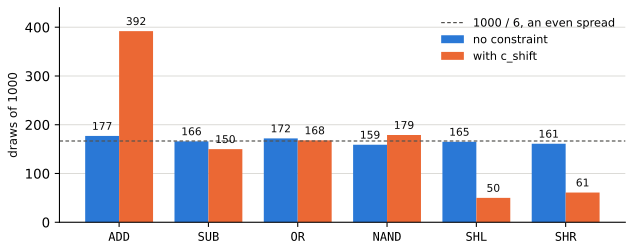
The two [SKEW] lines as bars. The dashed line is 1,000 / 6, an even spread.
Without the constraint, each operation came out close to 1,000 / 6 times, and B was below 4 in 18 draws, about the 16 that 4 values in 256 would give. With c_shift, a target of SHL or SHR survives only if the solver is offered it before any piece of B’s target that would put B at 4 or more, and 252 of the 256 targets that B can get are 4 or more. When such a piece goes first, the shift is dropped, and the solver puts ADD in its place. So the two shifts came out 50 and 61 times, and ADD 392. Every draw met c_shift, so pyvsc had nothing to warn you about. A constraint says which values can come out, not how often each one does, and to know that you count them, as Lab 03’s coverage does for the router’s packet.
The operations in the first line came out even because pyvsc draws each field that no constraint mentions without the solver, evenly over its values. (In DD105-A, on Verilator 5.050, an enum whose four names fill its two bits came out as its first name 813 times in 1,000.)
Attributes that a constraint reads
A constraint can also read attributes that aren’t random. In Lab 03’s packet, c_dst reads route_en, which holds the routing table’s enable bits, to keep each packet on an enabled route. pyvsc runs the constraint methods only once, when the object is made, so the way you declare such an attribute decides whether the solver sees a change made to it after that. CrAttrTest uses this class:
@vsc.randobj
class Limited:
    def __init__(self):
        self.A = vsc.rand_bit_t(8)
        self.B = vsc.rand_bit_t(8)
        self.a_max = 4                 # a plain Python attribute
        self.b_max = vsc.uint8_t(4)    # a non-random pyvsc attribute

    @vsc.constraint
    def c_lim(self):
        self.A < self.a_max
        self.B < self.b_max
It randomizes the object 200 times, sets both limits to 200, and randomizes it 200 times more:
[ATTR] a_max = 4, b_max = 4, 200 draws:     the largest A 3, the largest B 3
[ATTR] a_max = 200, b_max = 200, 200 draws: the largest A 3, the largest B 199
When pyvsc read c_lim, at the end of __init__, self.a_max was the number 4, and it went into the rule as the number 4, so changing the attribute later changed nothing. self.b_max is a pyvsc field, so the rule refers to the field and reads its value at every call. Lab 03’s packet holds route_en and its three length weights in vsc.uint8_t attributes for that reason. The generator sets route_en on each new packet after making it, and the weights are fields so that a test can change them before it randomizes. pyvsc gives no error or warning when a plain attribute has gone into a rule as a fixed number.
dist
vsc.dist() gives each value or range a weight, and the solver picks among them in proportion to the weights. AluVecWeighted makes ADD five times as likely as each other operation:
@vsc.constraint
def c_op(self):
    vsc.dist(self.op, [vsc.weight(AluOp.ADD, 5), vsc.weight(AluOp.SUB, 1),
                       vsc.weight(AluOp.OR, 1), vsc.weight(AluOp.NAND, 1),
                       vsc.weight(AluOp.SHL, 1), vsc.weight(AluOp.SHR, 1)])
A dist is one more constraint, so a call can add others on the same variable. CrDistTest draws 1,000 vectors, then asks for SUB 1,000 times with the dist still on:
[DIST] op dist ADD 5, others 1:                   ADD 516  SUB  89  OR 103  NAND 100  SHL 104  SHR  88
[DIST] the same, then randomize_with(op == SUB):  failed 0 times in 1000; ADD   0  SUB 1000  OR   0  NAND   0  SHL   0  SHR   0
The weights ask for ADD in 5 draws of 10, and it came out in 516 of 1,000, so they came out right. Asking for SUB with the dist still on never failed. pyvsc draws a target from the dist by its weights, up to four times, and keeps the first one that the other constraints allow. If none of the four fits, it falls back to a target from the field’s own range of values. The weights in a dist can be enum names, as here, or numbers.
The labs put the dist on a selector and choose the other fields from it with vsc.if_then. Lab 03’s packet has a kind, weighted 25 / 50 / 25, and a length that c_len chooses from the kind. VecKind does the same for A, with four kinds, weighted 10 / 20 / 30 / 40, that make A 00, make it ff, make it equal to B, or leave it free. Then the test asks for A < 0x10, which rules out K_ONES:
[DIST] kind dist 10/20/30/40:                     K_ZERO  89  K_ONES 194  K_SAME 295  K_ANY 422
[DIST] the same, then randomize_with(A < 0x10):   failed 0 times in 1000; K_ZERO 127  K_ONES   0  K_SAME 374  K_ANY 499
No call failed, and the other three kinds shared the draws in about the ratio 10 : 30 : 40 of their weights. In DD105-A, Verilator failed 921 and 199 times in 1,000 on the same two shapes, because it behaves as if it picks an entry of the dist first and solves the rest afterwards. On pyvsc you can constrain a packet’s length inline whatever its weights, and line 3 of Lab 03’s experiments shows it on a class with the same kind and length constraints as the router’s packet.
soft
A soft constraint holds unless something else contradicts it, and then it gives way instead of failing the call. SoftVec makes B 1 by default, and has two soft constraints on A that disagree:
@vsc.constraint
def c_b(self):
    vsc.soft(self.B == 1)

@vsc.constraint
def c_a(self):
    vsc.soft(self.A == 0x11)
    vsc.soft(self.A == 0x22)
CrSoftTest randomizes it 100 times, then 100 times with B == 7 inline:
[SOFT] randomize(), 100 times:              A=22 B=01 x100
[SOFT] randomize_with(B == 7), 100 times:   failed 0; A=22 B=07 x100
The inline B == 7 is a hard constraint, and it beat the soft B == 1 without a failure, as the SystemVerilog standard says a hard constraint always does. Of the two soft constraints that disagreed, the later one won every time, which is the order that the standard fixes: a later soft constraint beats an earlier one. The standard also puts an inline soft constraint ahead of the class’s soft ones, which CrSoftTest doesn’t try.
solve_order
vsc.solve_order(a, b) asks for a to be chosen before b. That changes how often each value of a comes out, without changing which values are legal. ShiftSel has a bit, is_shift, that picks between the two shifts and the four other operations, and ShiftSelOrdered adds vsc.solve_order(self.is_shift, self.op):
[SOLVE] solve_order(is_shift, op): is_shift in 509 of 1000;   ADD 251  SUB  60  OR  89  NAND  91  SHL  82  SHR 427
[SOLVE] without solve_order:       is_shift in 412 of 1000;   ADD 224  SUB 105  OR 133  NAND 126  SHL 144  SHR 268
By the standard, is_shift should come out about 500 times in 1,000 with solve_order, because it’s chosen first and has two values, and about 333 without, because two of the six operations are shifts. pyvsc gave 509, and 412. So solve_order gave is_shift the spread that the standard asks for, but the operations within each half are far from even, with SHR at 427 and SHL at 82. Once is_shift is fixed, op’s target is still one of all six operations, and a target that disagrees with is_shift is dropped. When is_shift is 1, the target is an operation that isn’t a shift two times in three, and each time it’s dropped the solver puts SHR. When is_shift is 0, a target of SHL or SHR is dropped, and the solver puts ADD.
unique and sum
Lab 03’s experiments also try vsc.unique() on a list and a constraint on a list’s sum, the two constraints that DD105-A found Verilator gets wrong on an array. Lab 03, Part 4 uses the second, in a FillPlan whose eight lengths add up to 8.
Seeds
Every run starts Python’s random from a seed, which make passes as COCOTB_RANDOM_SEED from its SEED variable (1 unless you set it). cocotb seeds random for each test from that seed and the test’s name, so two tests with the same body send different values. A pyvsc object takes its own random state from Python’s random once, at its first randomize(), and CrSeedTest shows it. Each of its three rows starts from the random state that the test started with. The first row makes an object and randomizes it six times, the second calls random.seed(99) between making the object and its first randomize(), and the third calls it after the first randomize(). On seed 1:
[SEED] make, then randomize() 6 times:          NAND SUB SHL SHL SHL NAND
[SEED] make, random.seed(99), then randomize(): SUB SHL ADD SUB OR OR
[SEED] make, randomize(), random.seed(99), ...: NAND SUB SHL SHL SHL NAND
and on seed 2:
[SEED] make, then randomize() 6 times:          SHR SUB SHR SHL OR SHL
[SEED] make, random.seed(99), then randomize(): SUB SHL ADD SUB OR OR
[SEED] make, randomize(), random.seed(99), ...: SHR SUB SHR SHL OR SHL
The run’s seed decided the first and third rows, and reseeding after the first randomize() changed nothing. Reseeding before it decided the second row, whatever the run’s seed. So an object that the test makes and randomizes repeats with the seed, and you can rerun a failing seed and watch the same failure happen again. Lab 03’s generator makes and randomizes every packet inside the test, so the run’s seed decides them all.
A seed reproduces a run only when the testbench draws the same numbers in the same order. Every random value in the labs comes from Python’s random, one draw after another, including pyvsc’s state for each new packet, the payload bytes and the idle cycles. A change that draws one number more changes every value after it, and for this reason Lab 03 says that your own constraints may give different counts from ours with the same seed.
Speed
pyvsc is slow next to Python’s own random. CrSpeedTest timed 1,000 calls of randomize() on one AluVec, 1,000 on a new AluVec each time, and 100,000 of three random.randrange() calls:
[SPEED] per second: randomize() on one AluVec 531; a new AluVec each time 494; three random.randrange() calls 1037162That’s about 1.9 ms a call, against about 1 µs for three random.randrange() calls, so the labs give the solver only the fields that a constraint mentions. Lab 03’s packet randomizes its DST, its kind and its length with pyvsc. pyvsc then calls the packet’s post_randomize(), as it does after every randomize(), and that method fills in the payload bytes and the idle cycles with random.
Importing pyvsc takes time too, and every run that uses pyvsc pays it once. make import-time timed import vsc in the venv’s Python three times:
 import vsc: 1.41 s
 import vsc: 1.00 s
 import vsc: 0.99 s
Lab 03’s graded test takes about 5 s once Part 3’s constraints are in, where Lab 02’s took 0.25 s. Part of the difference is the import and the solver, and part is that Lab 03’s test sends 800 packets to Lab 02’s 100.
Counting what came out
In a testbench with a design in it, a skew like CrSkewTest’s wouldn’t fail anything either, because the scoreboard checks the design’s answers and not how often each input was sent. In Lab 03 you count with coverpoints. Their first run shows a third of the router’s packets 1 beat long and a third 8 beats long (263 of 800 each), because the packet’s length comes from kind, an enum with three names, and nothing weights it yet. Functional coverage you can read explains how to read those counts.
Check yourself
A packet class has a constraint
self.length <= self.max_len, withself.max_len = 8set in__init__. A test setsp.max_len = 4before it randomizes, and still gets 8-beat packets. Why, and what do you change?TipAnswermax_lenis a plain Python attribute. pyvsc read the constraint at the end of__init__, whenmax_lenwas 8, so the rule holds the number 8, and setting the attribute afterwards changes nothing. Declare it as a pyvsc field,self.max_len = vsc.uint8_t(8), and the solver reads its value at every call, as it readsb_maxinCrAttrTestand the weights in Lab 03’s packet.A sequence calls
randomize_with()with an inline constraint that contradicts one of the class’s constraints, catches theSolveFailure, and sends the item anyway. What does the design get?TipAnswerAn item that no call asked for. The failed call can change some fields and leave others as they were, as
Achanged from61tob6inCrItemTestwhileopandBdidn’t. Let the exception end the run, or switch the class’s constraint off withconstraint_mode(False)before that call, and on again after it.You add a monitor that calls
random.random()once at the start of itsrun_phase, and a test that sent the same packets on seed 3 every time now sends different ones. Which values change, and why?TipAnswerEvery packet whose first
randomize()comes after that call, and every payload byte and idle cycle drawn after it. Each packet takes its random state from Python’srandomat its firstrandomize(), so one extra draw before it moves every value after it.
Further reading
pyvsc’s own documentation is the authority on its API. ChipVerify’s SystemVerilog pages explain the constructs that pyvsc copies, with longer examples. Their code is SystemVerilog, and their output comes from commercial simulators, so where pyvsc behaves differently, trust the counts on this page and in Lab 03.
- pyvsc’s Constraints, Methods and Data Types pages. The Methods page says that an object’s random state is made at its first
randomize()if nothing has set it, asCrSeedTestshows. It doesn’t say what a failed call does;CrItemTestshows that. - ChipVerify’s SystemVerilog Randomization and Inline Constraints. Both say that a failed
randomize()returns 0 and leaves the variables as they were. pyvsc raisesSolveFailureinstead, and the failed call inCrItemTestchangedA. - Soft Constraints. Correction: it says that when two soft constraints on one variable conflict, which one wins depends on the solver. The standard fixes the order (the later one wins), and pyvsc gave the later one in all 100 draws of
CrSoftTest. - solve before explains correctly what the standard means. pyvsc’s
solve_order()gave 509 in 1,000 for a bit that the standard puts at 50%. - Disable Constraints, for
constraint_mode().