Functional coverage you can read
This page answers: how do I find out what my random stimulus reached, and how do I read the numbers cocotb-coverage gives me?
In DD104’s Coverage as a question, functional coverage was a list of questions that you kept yourself (have I run SUB with two different operands? have I taken a backward branch?), and you could answer each of them with a for loop and a set. cocotb-coverage 2.0 keeps the same kind of list in Python. You name the values you care about, and it counts how often the stimulus produces each one. From Lab 03 on, each run in the labs writes those counts to a file, and make cov merges the files of all your runs and reports them. In Lab 03, Part 1 you’ll see router_rand_test pass and catch neither of the router bugs that belong to that lab, B07 and B08. In Lab 03, Part 2 you write coverpoints for the router’s packets, and their counts show you the holes in the test’s stimulus where those two bugs are.
cocotb-coverage, like pyvsc, is in the course venv that Lab 03, Part 1 makes. The example for this page, guide-examples/functional-coverage-you-can-read/, sends random vectors to SimProc’s ALU, the design you tested in Lab 01, and samples each vector.
Coverpoints, bins and crosses
Here is the coverage that the example collects for each vector it sends to the ALU. It counts the operations, three kinds of value for A, and whether the two operands were equal:
OPS = ["add", "sub", "or_op", "nand_op", "shl", "shr"]


def in_range(value, rng):
    """rel= for a bin written as (low, high)."""
    return rng[0] <= value <= rng[1]


@CoverPoint("alu.op", xf=lambda op, a, b: op, bins=list(range(6)), bins_labels=OPS)
@CoverPoint("alu.a", xf=lambda op, a, b: a, bins=[(0, 0), (1, 254), (255, 255)], rel=in_range,
            bins_labels=["zero", "other", "ones"])
@CoverPoint("alu.eq", xf=lambda op, a, b: int(a == b), bins=[0, 1], bins_labels=["differ", "equal"])
@CoverCross("alu.x_op_eq", items=["alu.op", "alu.eq"])
def sample(op, a, b):
    pass
Each bin is one question, and its count is the number of samples that answered yes. A coverpoint groups the bins for one value. In cocotb-coverage a coverpoint is a decorator on a function, here sample(), and every call to that function is one sample. The test calls sample(op, a, b) once for every vector it sends. At each call, the coverpoint’s xf= function takes the value out of the call’s arguments, and the coverpoint adds one to the count of the bin that the value matches. A cross makes one bin for every combination of the bins of the coverpoints it crosses, so alu.x_op_eq has 6 × 2 = 12 bins, named by the pairs of labels they stand for, from ('add', 'differ') to ('shr', 'equal'). DD104 asked whether SUB and NAND had been run with two different operands, and this cross asks that of every operation. The cross has to go below the coverpoints it crosses, because at each call the decorators run from the top down, each one counting its value before it calls the one below it, and the cross reads which bin each of its coverpoints has just counted.
Every name is a dotted path, and the part before the last dot names a group. alu is the group of everything whose name starts with alu., and its counts of bins and of bins hit are the sums of theirs.
SimProc programs use equal operands on purpose, because SUB rX, rX is how you zero a register and NAND rX, rX is how you write NOT. Equal operands also hide two of Lab 01’s ALU bugs. With A == B, SUB gives 0 whichever way round it subtracts (A01), and a NAND that computes NOR (A02) still gives the right answer, because ~(A & A) and ~(A | A) are both ~A.
Ranges and rel=
cocotb-coverage puts a value in a bin when value == bin. That’s fine for single values, but no number is equal to a tuple, so a bin written as a range such as (1, 254) needs a relation function, given as rel=, that says what “in the bin” means. alu.a has one, in_range(). The example also has a coverpoint with two single values and a range written as a tuple between them, and no rel=:
@CoverPoint("quirk.a_no_rel", xf=lambda op, a, b: a, bins=[0, (1, 254), 255],
            bins_labels=["zero", "other", "ones"])
After 300 random vectors, CovPlainTest prints its counts:
[COV] quirk.a_no_rel: {'zero': 1, 'other': 0, 'ones': 1}Two values of A landed in the single-value bins, and the other 298 matched no bin at all, so other stayed at 0, with no warning. You find a mistake like this only by reading a bin’s count against what you know the test sent. A rel= applies to every bin of its coverpoint, so write every bin as a range, (0, 0) included, as alu.a does. In Lab 03, Part 2 you run into the same thing with the router’s level coverpoint.
coverage.xml and make cov
Each test in the example ends by writing every bin’s count to coverage.xml in its run folder:
coverage_db.export_to_xml("coverage.xml")make cov finds every coverage.xml under build/runs, merges them with cocotb-coverage’s own merge_coverage(), and prints each group, coverpoint and cross with the bins that were never hit. Here is what it printed after one run of CovPlainTest, which sends 300 vectors with A and B uniformly random:
========================================================================
 COVERAGE   1 run, merged by cocotb-coverage into build/coverage/merged.xml
========================================================================
  top                                           81.48 %   22 of 27 bins
    top.alu                                       82.61 %   19 of 23 bins
      top.alu.op                                   100.00 %   6 of 6 bins
      top.alu.a                                    100.00 %   3 of 3 bins
      top.alu.eq                                   100.00 %   2 of 2 bins
      top.alu.x_op_eq                               66.67 %   8 of 12 bins
          not hit: ('sub', 'equal'), ('or_op', 'equal'), ('nand_op', 'equal'), ('shr', 'equal')
    top.quirk                                     75.00 %   3 of 4 bins
      top.quirk.a_no_rel                            66.67 %   2 of 3 bins
          not hit: other
      top.quirk.op_legal                           100.00 %   1 of 1 bins
          not hit: FAIL
========================================================================
top comes from cocotb-coverage’s export_to_xml(), which puts every group under one group of that name. quirk holds the example’s other two items, a_no_rel from the section above and op_legal from the one below, in a group of their own so that they don’t change alu’s counts.
In alu, every operation and every kind of A came up, but only ADD and SHL had a vector with equal operands, so four of the twelve cross bins are empty. Only 2 of the 300 vectors had A == B, which is about what uniform random operands give, because B matches A in one vector in 256. CovBiasedTest makes A == B in one vector in eight, and one run of it filled the cross:
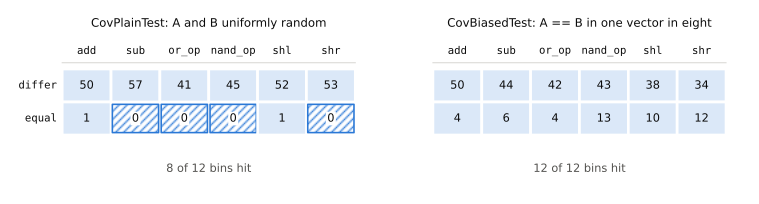
The [COV] x_op_eq lines of the two runs, as grids. A hatched bin is empty.
make cov names only the empty bins. The merged file, build/coverage/merged.xml, has every bin with its count, and Lab 03, Part 2 has you read the length bins’ counts from it with grep.
The percentage
cocotb-coverage’s 82.61 % for alu is the number of bins hit divided by the number of bins, 19 of 23, with every bin of every coverpoint and cross under the group counted the same. The SystemVerilog standard works it out another way, and gives a group the average of its coverpoints’ and crosses’ coverage. For alu that’s the average of 100, 100, 100 and 66.67%, which is 91.67%. The two differ because the cross has 12 of the group’s 23 bins, so it makes up more than half of cocotb-coverage’s number, where in the standard’s average it is one item of four. top comes to 81.48%, 22 of 27, because it counts quirk’s four bins too.
Lab 03, Part 2 does the same sums for the router’s 41 bins, which come to 46.34% by cocotb-coverage’s formula and 61% by the standard’s. Twelve of those bins can’t be hit by any test in that lab, and they count in both percentages, so in Lab 03 neither percentage can reach 100%, however good your stimulus is. The list of bins that were never hit is the same whichever formula you use, so read that list to find the holes, as you did above for the four equal bins.
Ignore bins and illegal values
In cocotb-coverage a coverpoint has no ignore bins. A value that matches none of its bins isn’t counted anywhere, so the way to ignore a value is to leave it out of the bins. SimProc’s ALU has no operations 6 and 7, and alu.op has no bins for them. A cross can ignore combinations of bins. CoverCross takes ign_bins, a list of label pairs such as ("full", "empty"), and leaves those bins out of the cross and out of its count. In the course’s reference testbench for the router, labs/ref, one cross has the seven combinations that the router can’t produce in its ign_bins, so that cross has 13 bins, and the reference testbench’s regression hits all 13. Lab 03 leaves its impossible bins in, and has you work out from the specification which ones they are.
A value that should never happen at all goes in a CoverCheck. At each sample it counts a failure if its f_fail function returns true, and otherwise a pass if its f_pass function does. The example’s check fails on an operation the ALU doesn’t have, and its f_pass passes every other sample:
@CoverCheck("quirk.op_legal", f_fail=lambda op, a, b: op > 5, f_pass=lambda op, a, b: True)CovIllegalTest sends CovPlainTest’s kind of vectors and then one vector with ALUop 6. Among its [COV] lines are:
[COV] quirk: 2 of 4 bins, 50.00%
[COV] quirk.a_no_rel: 2 of 3 bins, 66.67%
[COV] quirk.op_legal: 0 of 1 bins, 0.00%
and the check’s counts, {'PASS': 300, 'FAIL': 1}. The run still ended ok, because a CoverCheck raises no error. The check is one of quirk’s four bins, and a check that has failed counts as an empty bin, so quirk is at 2 of 4 here, where CovPlainTest’s run had 3 of 4. If the check were in alu, its failure would take a bin off alu’s count in the same way. Then make cov merged all three runs:
    top.quirk                                    100.00 %   4 of 4 bins
      top.quirk.a_no_rel                            66.67 %   2 of 3 bins
          not hit: other
      top.quirk.op_legal                           200.00 %   2 of 1 bins
The merge counted the check’s PASS and FAIL as two bins hit, out of a size of 1, so a check that failed came out at 200%. That lifted quirk to 100%, with other still empty below it. So read a check by its FAIL count. If an illegal value should fail the test, give the scoreboard a check of its own for it, rather than leaving it to the coverage. (In the merged report of the passing runs, make cov lists the check’s FAIL bin as “not hit”, which for a check is the result you want.)
Three kinds of empty bin
A bin can be empty for one of three reasons. Some bins can’t be hit by any test, because the specification rules them out. In Lab 03, seven of the router’s cross bins are like that. Three of them, such as ('full', 'empty'), pair a FULL drop with a level of 8 or less, and the router drops a packet as FULL only when the output its route names holds more than 8 beats. The other four pair a forwarded packet with a level of 9 or more, and the router admits a packet only at a level of 8 or less. Some bins can be hit, but not by the testbench you have, because of how it was built. Lab 03’s tracker takes output 1’s level as 0, for example, so ('out1', 'low') stays empty until Lab 04 gives output 1 its real level, and no test in Lab 03 asks for a FULL drop at all. The rest are holes in the stimulus, like the equal bins above, and those are the ones worth your time, because a bug can sit in them. Lab 03, Part 2 asks you to sort the router’s 41 bins into these three groups, and both of the lab’s planted bugs are in bins of the third.
Check yourself
A coverpoint for an output’s level has
bins=[0, (1, 7), 8, 9, (10, 16)]and norel=. A run’s tracker says the levels went up to 12. Which bins can be hit, and what do you change?TipAnswerOnly the three written as numbers, 0, 8 and 9. No level is equal to a tuple, so the two range bins stay empty, with no warning. Write every bin as a range,
(0, 0),(1, 7),(8, 8),(9, 9)and(10, 16), and give the coverpoint arel=that testslow <= value <= high.After a regression,
make covsays a group is at 100%, but one bin under it is listed as not hit. How can that be?TipAnswerSomething under the group counts more than its size. In the example, a
CoverCheckthat failed in one run of three came out as2 of 1after the merge, and that extra bin made up for the emptyother. Read each coverpoint, cross and check on its own, and read a check by itsFAILcount rather than by the group’s percentage.After
CovPlainTest,make covreports19 of 23 binsforalu. Which of the four empty bins would more seeds of the same test fill?TipAnswerAll four, but slowly. They are
equalbins, and only about one vector in 256 has equal operands, so each operation gets one about once in every 1,500 vectors. A test that makesA == Bon purpose, asCovBiasedTestdoes, fills them in one run.
Further reading
For cocotb-coverage’s API, go to its own documentation. ChipVerify’s coverage pages explain the same ideas in SystemVerilog’s covergroup syntax. Where they give a percentage, it’s the standard’s average, not cocotb-coverage’s share of bins hit.
- cocotb-coverage’s Tutorials, for
rel=andign_bins, under “Translating SystemVerilog Constructs to cocotb-coverage”. Correction: in “Using CoverCheck as Assertions”, the callback that should fail the test is alambdawith araisestatement in it, which isn’t valid Python. Write it as a function withdef. - cocotb-coverage’s Reference, for
CoverPoint,CoverCross,CoverCheckandmerge_coverage(). It says that a failedCoverCheckis set to 0 “permanently”. That holds within one run; aftermerge_coverage(), the example’s failed check came out at 200%. - ChipVerify’s Covergroup and Coverpoint, for what bins are for.
- ChipVerify’s Cross Coverage. On that page, a value that falls in
illegal_binsraises an error at run time. cocotb-coverage’s nearest thing, aCoverCheck, raises none, asCovIllegalTestshows.