Lab 04: The same testbench in pyuvm
In this lab you’ll finish our pyuvm port of the Lab 03 testbench. As shipped, it checks only output 0, as Lab 03’s testbench did, and it misses this lab’s two bugs, B06 and B13. You’ll add an agent for output 1 and make the scoreboard check that output’s beats. You’ll write a test that stalls one output at a time, and fix the scoreboard so that it can judge that test. Then you’ll write NoroutePkt, a subclass of RouterPkt that sends one packet in four to a disabled route, and a factory override that puts it in place of every packet the random sequence makes. Last, you’ll count the lines in the port and in your Lab 03 testbench.
Package: labs/lab-04-the-same-testbench-in-pyuvm/
Before you start
Finish Lab 02 and Lab 03. Keep your Lab 03 files in that lab’s
tb/, because Part 5 counts them.Read The pyuvm skeleton, Sequences, sequencers and drivers, Monitors, analysis ports and scoreboards and The factory and ConfigDB.
Look again at
tb/alu_uvm.pyfrom Lab 01. The port has the same kinds of pieces (sequences, drivers, monitors, agents, an environment, and tests that derive fromBaseTest). It also leans onConfigDBandcreate(), which that file used too. From cocotb tests to pyuvm components shows how Lab 01’s testbench uses both, and The factory and ConfigDB has a section on each.Keep the router specification open. Parts 3 and 4 use its Routing section.
Copy this table into your notes and fill it in as you go:
make check-allThe port as shipped (Part 1) After Part 2 After Part 3 After Part 4
Time: about 2 h. Every file you change is Python, so nothing in this lab rebuilds the simulator, and a run of the graded test takes about 5 s.
Part 1: Run the port
Does the port do what the Lab 03 testbench did, and which of this lab’s bugs does it miss?
Open a terminal on the workbench desktop, as in Lab 03, go to the lab folder, and build the simulator:
. /foss/designs/common/.designinit   # in every new terminal
mod dd105-b
cd labs/lab-04-the-same-testbench-in-pyuvm
make build
It ends with:
 built /foss/designs/modules/dd105-b/labs/lab-04-the-same-testbench-in-pyuvm/build/sim_build/Vtop in 2.2 s (1.9M in /foss/designs/modules/dd105-b/labs/lab-04-the-same-testbench-in-pyuvm/build/sim_build)
 ccache:  Hits: 23 / 35 (65.71%)  Misses: 12 / 35 (34.29%)
========================================================================
 /foss/designs/modules/dd105-b/labs/lab-04-the-same-testbench-in-pyuvm/build/sim_build/Vtop is up to date.
This is the same router as in Labs 02 and 03. The ccache counts on that line include our builds of Labs 01 to 03, which came to 17 hits and 11 misses, so this build’s own were 6 hits and 1 miss, as in Lab 03. The course venv you made in Lab 03 is still there, and this lab uses it.
Open the files in
tb/. Every piece of the Lab 03 testbench is in one of these three files, and most of its classes are now pyuvm classes:File What’s in it router_agents.pythe packet, RouterPkt, which is Lab 03’sRandPacketwith the same fields and the same constraints (c_dst,c_kind,c_len); an agent for the input, one for the APB port, and one output agent class,OutAgent; the sequencesrouter_env.pythe scoreboard, which is Lab 03’s scoreboard and tracker in one component; the coverage, which is our Lab 03 solution’s; and RouterEnv, which builds and connects everythingtest_router.pyFillPlan; the base test,RouterLabTest, with the steps Lab 03’sEnvhad (write_routes,send_random,check_dropsand the rest) andclose_holes(); and the tests, which areRouterClassTest(Lab 02’s),RouterRandTestandRouterFillTest(Lab 03’s), and the two that this lab adds,RouterStallTestandRouterInjectTestYour Lab 02 and Lab 03 testbenches watched only output 0, and so does the port.
RouterEnvmakes only oneOutAgent, the scoreboard queues only output 0’s beats, and the scoreboard’slevel()takes output 1’s level as 0, as Lab 03’s tracker did. With no agent on output 1,out1_readywould stay at the 0 that the base test sets it to before the reset, and output 1 would never be ready. SoRouterEnvholds it at 1, as Lab 03’s sink did. Find theTODO (Part n)comments. There are four inrouter_env.pyand three intest_router.py.Run Lab 02’s test, then the default test, then Lab 03’s random test:
make run TEST=RouterClassTest make run make run TEST=RouterRandTestTEST=picks the test when the simulator starts, so none of these rebuilds anything. You should see, from the first run:20.00ns INFO ..-in-pyuvm/tb/test_router.py(299) [uvm_test_top]: [ENV] 100 packets, routes 0110 6865.00ns INFO ..h-in-pyuvm/tb/router_env.py(207) [uvm_test_top.env.sb]: [DROP] DROP_CNT 00000000 as expected 6870.00ns INFO ..h-in-pyuvm/tb/router_env.py(224) [uvm_test_top.env.sb]: [SB] 100 packets in: 55 to output 0, 45 to output 1, 0 NOROUTE, 0 FULL; the highest level a header saw was 2 6870.00ns INFO ..h-in-pyuvm/tb/router_env.py(227) [uvm_test_top.env.sb]: [SB] beats checked: 233 on output 0, 0 on output 1; 1 DROP_CNT reads checked 6870.00ns INFO ..h-in-pyuvm/tb/router_env.py(230) [uvm_test_top.env.sb]: [SB] 193 beats went to output 1, which nothing watches 6870.00ns INFO ..h-in-pyuvm/tb/router_env.py(268) [uvm_test_top.env.cov]: [COV] router.pkt: 19 of 41 bins hit; coverage.xml written DD105-B BaseTest: 0 errors logged, no bound assertionsand
ok: 0 errors 3.61 s. After the time andINFO, each line names the file and line of the logging call and then, in brackets, the component that logged it:uvm_test_topis the test, anduvm_test_top.env.sbis the scoreboard. The[DROP]line comes from Lab 03’sDROP_CNTcheck, which the scoreboard now makes. It compares every read ofDROP_CNTthat the APB monitor reports with the drops it predicted.The default test is
RouterInjectTest, which for now does whatRouterRandTestdoes: Lab 03’s four phases and itsclose_holes(). The second run prints:0.00ns INFO cocotb.regression running test_router.RouterInjectTest (1/1) 50.00ns INFO ..-in-pyuvm/tb/test_router.py(250) [uvm_test_top]: [PHASE] 1 of 4: routes 0-1-, 200 packets; output 0 ready 100%, output 1 ready 100% 14165.00ns INFO ..h-in-pyuvm/tb/router_env.py(207) [uvm_test_top.env.sb]: [DROP] DROP_CNT 00000000 as expected 14200.00ns INFO ..-in-pyuvm/tb/test_router.py(250) [uvm_test_top]: [PHASE] 2 of 4: routes --10, 200 packets; output 0 ready 100%, output 1 ready 100% 27255.00ns INFO ..h-in-pyuvm/tb/router_env.py(207) [uvm_test_top.env.sb]: [DROP] DROP_CNT 00000000 as expected 27290.00ns INFO ..-in-pyuvm/tb/test_router.py(250) [uvm_test_top]: [PHASE] 3 of 4: routes -1-0, 200 packets; output 0 ready 100%, output 1 ready 100% 41625.00ns INFO ..h-in-pyuvm/tb/router_env.py(207) [uvm_test_top.env.sb]: [DROP] DROP_CNT 00000000 as expected 41660.00ns INFO ..-in-pyuvm/tb/test_router.py(250) [uvm_test_top]: [PHASE] 4 of 4: routes 1-0-, 200 packets; output 0 ready 100%, output 1 ready 100% 54425.00ns INFO ..h-in-pyuvm/tb/router_env.py(207) [uvm_test_top.env.sb]: [DROP] DROP_CNT 00000000 as expected 54600.00ns INFO ..-in-pyuvm/tb/test_router.py(229) [uvm_test_top]: [HOLES] output 0 stalled and filled to 8 by packets of 4 3 1 beats, then 6 beats for DST 0 and 1 for DST 1 55015.00ns INFO ..h-in-pyuvm/tb/router_env.py(207) [uvm_test_top.env.sb]: [DROP] DROP_CNT 00000001 as expected 55020.00ns INFO ..h-in-pyuvm/tb/router_env.py(224) [uvm_test_top.env.sb]: [SB] 805 packets in: 417 to output 0, 387 to output 1, 1 NOROUTE, 0 FULL; the highest level a header saw was 14 55020.00ns INFO ..h-in-pyuvm/tb/router_env.py(227) [uvm_test_top.env.sb]: [SB] beats checked: 1884 on output 0, 0 on output 1; 5 DROP_CNT reads checked 55020.00ns INFO ..h-in-pyuvm/tb/router_env.py(230) [uvm_test_top.env.sb]: [SB] 1720 beats went to output 1, which nothing watches 55020.00ns INFO ..h-in-pyuvm/tb/router_env.py(268) [uvm_test_top.env.cov]: [COV] router.pkt: 24 of 41 bins hit; coverage.xml written DD105-B BaseTest: 0 errors logged, no bound assertionsending in
ok: 0 errors 5.13 s. The routes are written as in Lab 03, with one character per route:0or1for the output,-for disabled.The third run,
RouterRandTest, runs the same code on different packets. Its first phase has the routes-110, and it ends with:51770.00ns INFO ..-in-pyuvm/tb/test_router.py(229) [uvm_test_top]: [HOLES] output 0 stalled and filled to 8 by packets of 1 1 6 beats, then 8 beats for DST 0 and 1 for DST 1 52240.00ns INFO ..h-in-pyuvm/tb/router_env.py(224) [uvm_test_top.env.sb]: [SB] 805 packets in: 314 to output 0, 490 to output 1, 1 NOROUTE, 0 FULL; the highest level a header saw was 16 52240.00ns INFO ..h-in-pyuvm/tb/router_env.py(227) [uvm_test_top.env.sb]: [SB] beats checked: 1328 on output 0, 0 on output 1; 5 DROP_CNT reads checked 52240.00ns INFO ..h-in-pyuvm/tb/router_env.py(230) [uvm_test_top.env.sb]: [SB] 2006 beats went to output 1, which nothing watchesWhy are its packets not the second run’s, when both tests run the same steps on seed 1?
TipAnswercocotb seeds Python’s
randomfor each test from the seed and the test’s name, as you saw in Lab 03, Part 4, step 6. pyuvm gives each test its class’s name, soRouterInjectTestandRouterRandTeststart from different seeds, and every routing table, packet and fill plan differs.Look at the coverage of the three runs:
make covYou should see:
========================================================================
 COVERAGE   3 runs, merged by cocotb-coverage into build/coverage/merged.xml
========================================================================
  top                                           58.54 %   24 of 41 bins
    top.router                                    58.54 %   24 of 41 bins
      top.router.pkt                                58.54 %   24 of 41 bins
        top.router.pkt.len                           100.00 %   8 of 8 bins
        top.router.pkt.dst                           100.00 %   4 of 4 bins
        top.router.pkt.fate                           75.00 %   3 of 4 bins
            not hit: full
        top.router.pkt.level                          80.00 %   4 of 5 bins
            not hit: at_9
        top.router.pkt.x_fate_level                   25.00 %   5 of 20 bins
            not hit: ('noroute', 'empty'), ('noroute', 'low'), ('noroute', 'at_8'), ('noroute', 'at_9'), ('full', 'empty'), ('full', 'low'), ('full', 'at_8'), ('full', 'at_9'), ('full', 'high'), ('out0', 'at_9'), ('out0', 'high'), ('out1', 'low'), ... (3 more)
========================================================================
The three bins behind
... (3 more)are('out1', 'at_8'),('out1', 'at_9')and('out1', 'high'). The 17 empty bins fall into four groups:- seven that no test can hit, as you found in Lab 03:
('full', 'empty'),('full', 'low'),('full', 'at_8'),('out0', 'at_9'),('out0', 'high'),('out1', 'at_9')and('out1', 'high'); full,('full', 'at_9')and('full', 'high'): no packet was dropped as FULL;('out1', 'low')and('out1', 'at_8'): the scoreboard takes output 1’s level as 0;at_9,('noroute', 'empty'),('noroute', 'low'),('noroute', 'at_8')and('noroute', 'at_9'): the only NOROUTE drops areclose_holes()’s packets for DST 1, one in each of the last two runs. They met levels of 14 and 16, and they were the only headers that met a level above 8.
Keep the second and third groups in mind for Part 3.
- seven that no test can hit, as you found in Lab 03:
The port should catch what your Lab 02 and Lab 03 testbenches caught. Write down which of B05, B07, B08 and B09 you expect it to catch, then check:
make check-all BUG_LIST="B05 B07 B08 B09"You should see
4 of 4 caught., with 50, 1, 2 and 50 errors. The scoreboard stops a test at its 50th error, so 50 means it found at least that many.Now check this lab’s two bugs, B06 and B13:
make check-allYou should see:
      ok  the golden design                        0 errors                        5.1s
------------------------------------------------------------------------
  MISSED  tier 2  B06_disabled_route_forwards      0 errors                        5.1s
  MISSED  tier 5  B13_admission_checks_other_output 0 errors                        5.1s
------------------------------------------------------------------------
 0 of 2 caught.
 Still hiding from this test:
   B06_disabled_route_forwards
      hides behind: never disabling a route
   B13_admission_checks_other_output
      hides behind: stalling both outputs together, or never letting one fill
followed by a note and an error line from
make, because the verdict is a fail. Write the result in your table. B06 forwards a packet for a disabled route when its output has room. B13 judges whether an output has room from the level of the other output. Why does this test miss each of them?TipAnswerRouterPkt’sc_dstconstraint sends random packets only to enabled routes. The only packet the test sends to a disabled route isclose_holes()’s packet for DST 1. It arrives when output 0 already holds 9 to 16 beats (14 on this seed: the fill of 4, 3 and 1 beats, then a 6-beat packet for DST 0), so there’s no room, and B06 drops it just as the golden router does.B13 changes a packet’s fate only when one output holds more than 8 beats and the other 8 or fewer. In the random phases both outputs are always ready, so neither holds more than a beat or two (
RouterClassTestreported a highest level of 2 in step 3). Inclose_holes()output 0 fills, but the packet for DST 0 arrives when output 0 holds exactly 8 beats. B13 admits that packet too, because it judges from output 1, which is empty. The last packet goes to a disabled route, which is a NOROUTE drop on either router. No packet for an enabled route met an output holding more than 8 beats, which is also whyfullwas never hit.
Check: 4 of 4 caught. for Lab 02’s and Lab 03’s bugs, and 0 of 2 caught. for this lab’s.
Part 2: Watch the second output
What does it take to watch output 1, when an output agent is a class you can make twice?
Read
OutAgent,OutMonitorandOutReadyDriverinrouter_agents.py. Nothing in them says which output they’re on. The driver and the monitor each get anOutCfgfromConfigDB, and itsportsays which pins to use (out0_readyorout1_ready, and so on). The base test’sbuild_phaseputs anOutCfginConfigDBfor the pathsenv.out0*andenv.out1*, so output 1’s is already there for an agent namedout1.In
RouterEnv, do the two Part 2 TODOs: make the agent for output 1 withOutAgent.create("out1", self)and add it toself.out, and connect its monitor’sapto the scoreboard’sout_imp.analysis_export, as output 0’s is. Leave the scoreboard alone for now. Before you run, write down what you expectRouterRandTestto report on the golden router.Run it:
make run TEST=RouterRandTestIt should fail on the golden router, with 50 errors that start:
   195.00ns ERROR    ..h-in-pyuvm/tb/router_env.py(105) [uvm_test_top.env.sb]: output 1: got 40 last in cycle 20, and no beat was expected
   325.00ns ERROR    ..h-in-pyuvm/tb/router_env.py(105) [uvm_test_top.env.sb]: output 1: got 42 last in cycle 33, and no beat was expected
   335.00ns ERROR    ..h-in-pyuvm/tb/router_env.py(105) [uvm_test_top.env.sb]: output 1: got 83 in cycle 34, and no beat was expected
and then
50 errors: stopping the test,DD105-B BaseTest: 50 errors loggedandFAIL: 50 errors. The cycle in each message is the monitor’s count of falling edges since the start of the test, so cycle n is the clock period that holds the nth falling edge, which is where the monitor saw the beat. What is wrong, the router or the testbench?TipAnswerThe testbench. The new monitor reports every beat on output 1, but
write_instill queues only output 0’s beats (that’s the scoreboard’s Part 2 TODO), so the scoreboard has nothing to compare them with. When a check fires on the golden router, look for the bug in the check first.Do the Part 2 TODO in
RouterScoreboard.write_in: queue every forwarded beat onself.expected[self.in_port]. RunRouterRandTestagain. You should see:52280.00ns INFO ..h-in-pyuvm/tb/router_env.py(221) [uvm_test_top.env.sb]: [SB] 805 packets in: 314 to output 0, 490 to output 1, 1 NOROUTE, 0 FULL; the highest level a header saw was 16 52280.00ns INFO ..h-in-pyuvm/tb/router_env.py(224) [uvm_test_top.env.sb]: [SB] beats checked: 1328 on output 0, 2006 on output 1; 5 DROP_CNT reads checkedand
ok. The 2006 beats that went unwatched in Part 1 are now checked. The number in parentheses after each file name is the line of the logging call, so it moves when you add or delete lines above that call. We left each TODO comment in place when we filled it in. If you deleted yours, your line numbers here and in Part 3 are a few lower, such as 218 and 221 for these two lines.These are the same 805 packets as Part 1’s run of this test, although the new agent’s
OutReadyDriverruns in every cycle. Read itsrun_phase: why did it change none of them?TipAnswerEvery packet comes from Python’s
random, one draw after another, so a component that draws a number in between changes every packet after it, as you saw in Lab 03.OutReadyDriverdraws only whenready_pctis between 0 and 100. Output 1’s is 100, so its driver setsout1_readyto 1 in every cycle without drawing anything.Predict whether
make check-allcatches B06 or B13 now, then run it, and write the result in your table.TipAnswerNeither.
make check-allsays0 of 2 caught.again. The scoreboard now sees both outputs, but the stimulus hasn’t changed, so the router never gets a packet that either bug would treat differently.
Check: RouterRandTest passes with beats checked on both outputs, and make check-all still says 0 of 2 caught.
Part 3: Stall one output at a time
What does B13 need from the stimulus, and does the scoreboard know enough to judge the result?
Read the Routing section of the specification, and
level()andwrite_inin the scoreboard. Then write down the situation in which B13 does something different from the golden router, given that it judges an output’s room from the other output’s level.TipAnswerWhen a header arrives, one output has to hold more than 8 beats and the other 8 or fewer. A packet for the output with room is then dropped as FULL, because B13 looks at the full one, and a packet for the full output is admitted, because B13 looks at the one with room.
Do the Part 3 TODO in
test_router.py: inRouterStallTest, overrideset_sinks(k)so that in phasekone output is ready in 5% of cycles and the other in 100%. Output 0 stalls in phases 1 and 3, and output 1 in phases 2 and 4.RouterRandTestcallsset_sinks(k)at the start of each phase, withkfrom 1 to 4. Setself.ocfg[p].ready_pct. The base test made thoseOutCfgobjects and kept them, and eachOutReadyDriverreads itsready_pctagain after every rising edge, so a change takes effect at the next edge.ready_pctis Lab 03’sSink.stallgrown into a percentage, where 0 is a stall and 100 is a sink that is always ready.Before you run it, look at
level()again. Phase 2 stalls output 1. What will the scoreboard predict for the packets routed there?Run the stall test on the golden router:
make run TEST=RouterStallTestYou should see phase 1 end with its
DROP_CNTcheck, and phase 2 fail:13575.00ns INFO ..h-in-pyuvm/tb/router_env.py(204) [uvm_test_top.env.sb]: [DROP] DROP_CNT 00007900 as expected 13610.00ns INFO ..-in-pyuvm/tb/test_router.py(250) [uvm_test_top]: [PHASE] 2 of 4: routes 1-10, 200 packets; output 0 ready 100%, output 1 ready 5% 16505.00ns ERROR ..h-in-pyuvm/tb/router_env.py(105) [uvm_test_top.env.sb]: output 1: got 9d in cycle 1651, expected 0b 16995.00ns ERROR ..h-in-pyuvm/tb/router_env.py(105) [uvm_test_top.env.sb]: output 1: got 3d in cycle 1700, expected feFULL_CNTis bits 15:8 ofDROP_CNT, so phase 1 dropped 0x79, or 121, packets as FULL, and the scoreboard predicted every one of them. The grader can’t use this test yet, because it fails on the golden router.make check BUG=B13 TEST=RouterStallTeststops after the golden run:FAIL the golden design 50 errors 3.5s RouterStallTest: AssertionError: 50 errors logged, the first: output 1: got 9d in cycle 1651, expect ------------------------------------------------------------------------ VERDICT: FAIL -- your test does not pass the GOLDEN design.Why does phase 2 fail on the golden router?
TipAnswerlevel()returns 0 for output 1. That shortcut was safe while output 1 was always ready, which it was in every test before this one. With output 1 ready in only 5% of cycles, output 1 fills past 8 beats, and the router drops the next packets for it as FULL, as the specification says, while the scoreboard still expects them to come out. The packet starting0bhas DST 0, which1-10routes to output 1, and the router dropped it in cycle 1396, when output 1 held 13 beats. So the next header to come out of output 1,9d(DST 2, also routed to output 1), was compared with0b. Output 0’s level was right all along, which is why phase 1 passed.Do the Part 3 TODO in
level(), so that it gives output 1’s level the way it gives output 0’s. Run the stall test again. You should see:13575.00ns INFO ..h-in-pyuvm/tb/router_env.py(202) [uvm_test_top.env.sb]: [DROP] DROP_CNT 00007900 as expected 28245.00ns INFO ..h-in-pyuvm/tb/router_env.py(202) [uvm_test_top.env.sb]: [DROP] DROP_CNT 00007400 as expected 41775.00ns INFO ..h-in-pyuvm/tb/router_env.py(202) [uvm_test_top.env.sb]: [DROP] DROP_CNT 00002700 as expected 54985.00ns INFO ..h-in-pyuvm/tb/router_env.py(202) [uvm_test_top.env.sb]: [DROP] DROP_CNT 00004c00 as expected 55485.00ns INFO ..h-in-pyuvm/tb/router_env.py(202) [uvm_test_top.env.sb]: [DROP] DROP_CNT 00000001 as expected 55490.00ns INFO ..h-in-pyuvm/tb/router_env.py(219) [uvm_test_top.env.sb]: [SB] 804 packets in: 206 to output 0, 245 to output 1, 1 NOROUTE, 352 FULL; the highest level a header saw was 16 55490.00ns INFO ..h-in-pyuvm/tb/router_env.py(222) [uvm_test_top.env.sb]: [SB] beats checked: 935 on output 0, 1014 on output 1; 5 DROP_CNT reads checkedand
ok. The four phases dropped 121, 116, 39 and 76 packets as FULL, 352 in all, and the scoreboard predicted each one. The random test dropped none.Ask for the verdict on B13:
make check BUG=B13 TEST=RouterStallTestYou should see:
      ok  the golden design                        0 errors                        5.2s
  caught  B13_admission_checks_other_output        50 errors                       2.4s
        RouterStallTest: AssertionError: 50 errors logged, the first: output 0: got cf in cycle 125, expecte
------------------------------------------------------------------------
 VERDICT: PASS
Phase 1 stalls output 0 and routes DST 2 and DST 3 to it (
-100), and DST 1 to output 1. The first error is on output 0 in cycle 125, whencfcame out. Which of B13’s two wrong decisions from step 1 put a wrong beat on output 0?TipAnswerB13 admits a packet for output 0 while output 0 holds more than 8 beats, because it judges output 0’s room from output 1, which is nearly empty. In the waves of this run (
make waves TEST=RouterStallTest BUG=B13), the first such packet was the one with header83(DST 2), which arrived in cycle 40, from 390 to 400 ns. Output 0 held 11 beats then and output 1 none; the router’s own counts,level0andlevel1, read0band00in Surfer’s hex. The golden router dropped the packet as FULL. B13 admitted it, and more packets for output 0 after it, and in cycle 59, from 580 to 590 ns,level0read14, which is 20 beats. The buffer holds 16, and it writes each beat at the next place in a ring, so the beats beyond 16 wrote over beats that were still waiting. Output 0 was ready in only 5% of cycles, so the first wrong beat took until cycle 125 to come out.B13 also made the other wrong decision, from cycle 75 on. It dropped packets for output 1 as FULL because output 0 held more than 8 beats, and the first of them was
47(DST 1). Those packets never came out of output 1, and the scoreboard’s first error on output 1 came in cycle 185, when5acame out where it expected47. That was 60 cycles after the first error on output 0.Run
make check-alland write the result in your table. It prints1 of 2 caught., becauseRouterInjectTestderives fromRouterStallTestand so stalls the outputs too.
Check: RouterStallTest passes on the golden router with 352 FULL drops, and make check BUG=B13 TEST=RouterStallTest prints VERDICT: PASS.
Part 4: A factory override for disabled routes
How do you make a test send some packets to disabled routes, without editing the sequence that makes them or the driver that sends them?
Read
RouterRandSeqinrouter_agents.py. It makes each packet withRouterPkt.create("pkt"), which asks the factory for aRouterPkt. If a test has told the factory to substitute a subclass ofRouterPkt, the sequence gets the subclass without knowing it. Then readRouterPkt’sc_dstconstraint, which is Lab 03’s.Do the first Part 4 TODO: write
NoroutePkt, which extendsRouterPktand sends one packet in four to a disabled route. Decorate it with@vsc.randobj, asRouterPktis, and give it a constraint of its own namedc_dst. A pyvsc constraint is a method, and a Python method with the same name as one in the parent class replaces the parent’s, soRouterPkt’sc_dstno longer applies. Decide which packets go to a disabled route with a non-random attribute,self.to_disabled = vsc.uint8_t(0), whichpre_randomize()sets from Python’srandom. pyvsc callspre_randomize()before it solves, soc_dstreadsto_disabledas a fixed value, the way it readsroute_en. Draw it only when some route is disabled (int(self.route_en) != 0xF). Every routing table thatrandom_routes()writes has a disabled route, butRouterClassTest’s0110doesn’t, and ifto_disabledwere 1 with no route disabled,c_dstcouldn’t be met.pyvsc also solves a
distbeside another constraint (line 3 of Lab 03’s experiments), so a randomto_disabledwith adistworks as well. We tried it, and it caught both bugs on seeds 1 to 5. The counts below come from thepre_randomize()version.Do the second Part 4 TODO: in
RouterInjectTest, add abuild_phasethat callsuvm_factory().set_type_override_by_type(RouterPkt, NoroutePkt)and thensuper().build_phase(). Nothing else in the test changes, so it’s still the stall test, with different packets.The override reaches every packet the factory makes, wherever it’s made.
close_holes()picks the DST of its two random packets itself, so they have to stay plainRouterPkts. It makes both innew_packet()with the constructor,RouterPkt("pkt"), which the override can’t reach. When we made them withcreate()instead,RouterInjectTestendedBROKEN: SolveFailureon 2 of seeds 1 to 20. The packet for DST 0 was then aNoroutePkt, and wheneverpre_randomize()set itsto_disabledto 1, no DST could meet both itsc_dstandhdr_dst == 0, sinceROUTE0is the one enabled route.Write down what you expect the golden run’s first
[SB]line to say about NOROUTE drops. Then run the default test:make runWith the reference solution you should see:
 53890.00ns INFO     ..h-in-pyuvm/tb/router_env.py(212) [uvm_test_top.env.sb]: [SB] 804 packets in: 193 to output 0, 196 to output 1, 218 NOROUTE, 197 FULL; the highest level a header saw was 16
 53890.00ns INFO     ..h-in-pyuvm/tb/router_env.py(215) [uvm_test_top.env.sb]: [SB] beats checked: 860 on output 0, 818 on output 1; 5 DROP_CNT reads checked
and
ok: 0 errors 5.29 s. You didn’t have to change the scoreboard for this. It was written from the specification’s Routing table, so it already predicts a NOROUTE drop for a packet to a disabled route. Until now, no test had sent such a packet while its output had room. Your counts match ours only if yourpre_randomize()makes the same draws fromrandomas ours, so if they differ, compare your draw with the reference solution’s once step 5 says2 of 2 caught.The line numbers in this output come from the files insolutions/, which have the TODO comments removed. If you kept yours, as we did for the runs in Parts 2 and 3, your line numbers are higher, such as 219 and 222.Ask for the lab’s verdict:
make check-allYou should see:
      ok  the golden design                        0 errors                        5.3s
------------------------------------------------------------------------
  caught  tier 2  B06_disabled_route_forwards      50 errors                       2.6s
  caught  tier 5  B13_admission_checks_other_output 50 errors                       2.2s
------------------------------------------------------------------------
 2 of 2 caught.
Write the result in your table.
You can also apply a factory override from the command line, without a test class. pyuvm 4.0.1 has no plusarg for this, so the base test reads one of its own,
+OVERRIDE, and callsuvm_factory().set_type_override_by_name()with the two class names before it builds anything. Apply your override to Lab 03’s test that way, on the golden router and then on B06, and time the first run:time make run TEST=RouterRandTest PLUSARGS=+OVERRIDE=RouterPkt,NoroutePkt make run TEST=RouterRandTest PLUSARGS=+OVERRIDE=RouterPkt,NoroutePkt BUG=B06The first prints
[OVERRIDE] the factory makes NoroutePkt for every RouterPkt (+OVERRIDE)at 0 ns, then806 packets in: 333 to output 0, 264 to output 1, 209 NOROUTE, 0 FULLandok, in 5.2 s. The second is caught with 50 errors, and its first error is:545.00ns ERROR ..h-in-pyuvm/tb/router_env.py(105) [uvm_test_top.env.sb]: output 0: got 04 in cycle 55, and no beat was expectedWithout the plusarg, the same test on B06 says
MISSED.Record both runs from step 6 and look at the first packet that B06 forwards:
make waves TEST=RouterRandTest PLUSARGS=+OVERRIDE=RouterPkt,NoroutePkt
make waves TEST=RouterRandTest PLUSARGS=+OVERRIDE=RouterPkt,NoroutePkt BUG=B06
surfer build/runs/RouterRandTest-s1/waves.fst &
surfer build/runs/RouterRandTest-s1-B06/waves.fst &
Add
clk,in_valid,in_ready,in_data,in_last,out0_valid,out0_ready,out0_dataandout0_lastfromrouter, androute_en_q,status_qandcnt_noroute_qfromrouter.u_regs, and look at 480 to 600 ns: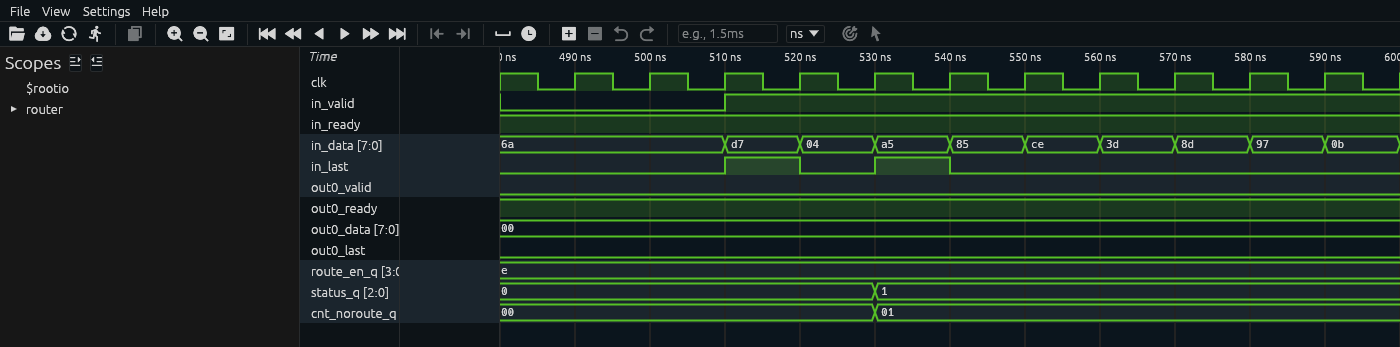
A packet for a disabled route on the golden router, in Surfer The golden router. The header
04(DST 0) is accepted at the edge at 530 ns, whileroute_en_qise(routes 1, 2 and 3 enabled, route 0 disabled).status_qandcnt_noroute_qchange at that edge (bit 0 ofstatus_qisSTATUS.NOROUTE), andout0_validstays low.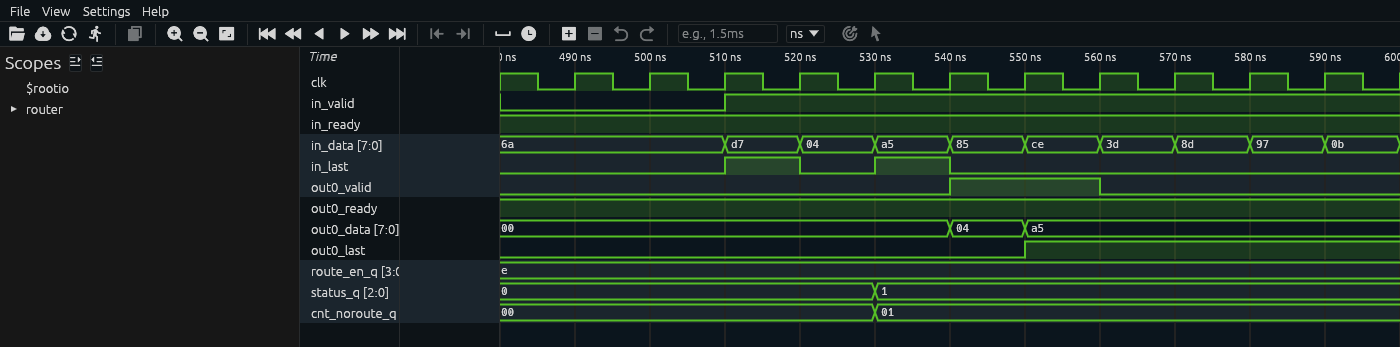
The same packet with B06 on, in Surfer B06. The router counts the same NOROUTE drop, and then puts
04anda5on output 0 in the cycles that end at 550 and 560 ns. The header comes out two cycles after the cycle in which it went in, which is when rule O8 says a forwarded beat first appears on an output.Both pictures have the same input and the same register values. The seed is the same, and this is the first packet for a disabled route in the run, so B06 has changed nothing before it.
Run every test on five seeds and read the coverage:
make regress SEEDS="1 2 3 4 5"It took us about 97 s. You should see
25 ok (25 runs), and then the coverage of those runs:top 82.93 % 34 of 41 bins top.router 82.93 % 34 of 41 bins top.router.pkt 82.93 % 34 of 41 bins top.router.pkt.len 100.00 % 8 of 8 bins top.router.pkt.dst 100.00 % 4 of 4 bins top.router.pkt.fate 100.00 % 4 of 4 bins top.router.pkt.level 100.00 % 5 of 5 bins top.router.pkt.x_fate_level 65.00 % 13 of 20 bins not hit: ('full', 'empty'), ('full', 'low'), ('full', 'at_8'), ('out0', 'at_9'), ('out0', 'high'), ('out1', 'at_9'), ('out1', 'high')The seven empty bins are the ones no test can hit, so this is as far as the percentage goes. The stall test’s FULL drops hit the three bins of Part 1’s second group, and the drops at a level of 9 hit the fourth group’s
at_9as well. The two bins of the third group are hit becauselevel()now gives output 1’s real level. The fourth group’s four NOROUTE bins are hit now thatRouterInjectTestsends packets to disabled routes while one output is stalled.
Check: 2 of 2 caught. from make check-all, and the bin full hit.
Part 5: Count what the port cost
Where did the lines go, compared with your Lab 03 testbench, and what did they buy you?
Count both testbenches.
FILEStakes the paths of your Lab 03 files, which are in Lab 03’stb/with the coverage, the constraints and theclose_holes()you wrote:make loc FILES="../lab-03-constraints-and-coverage/tb/*.py"With the reference solution’s edits, the pyuvm part prints:
This lab's pyuvm testbench:
  file                  lines    code
  tb/router_agents.py     439     261
  tb/router_env.py        284     173
  tb/test_router.py       355     196
  total                  1078     630
Code lines leave out blank lines, comments and docstrings. As shipped, the pyuvm testbench was 1062 lines and 616 code lines, so the reference solution’s edits added 14 code lines. With our Lab 03 solution in Lab 03’s
tb/, theFILES:part totals 1033 lines and 595 code lines. Write your two totals, for this lab’s testbench and for your Lab 03 testbench, in your notes.For each piece of your Lab 03 testbench, find the pyuvm piece that does its job, and write down whether its code moved across nearly unchanged or changed shape. Then list the pyuvm pieces that have no Lab 03 counterpart at all.
TipAnswerLab 03 Lab 04 What happened PacketandRandPacketRouterPktmoved: the fields and the constraints c_dst,c_kindandc_lenare the same; it derives fromuvm_sequence_itemand is made through the factoryGeneratorand the queue to the driverRouterRandSeqon the input agent’s sequencerchanged shape: start_item()andfinish_item()instead of a queue’sput()DriverSrcDrivermoved: get_next_item()anditem_done()replace the queue’sget(), and the idle cycles and the drives are the sameSinkand itsstallknobOutReadyDriverandOutCfg.ready_pctmoved: the stall grew into a percentage, which the driver reads after every rising edge Monitorand the queues to the scoreboardSrcMonitor,OutMonitorand their analysis portschanged shape: each beat goes to ap.write()as it moves, instead of a whole packet into a queueScoreboardandTracker, each with its ownrun()coroutinewrite_in,write_out,write_apb,level()changed shape: one component, which the monitors call through its three Fwdinputs, with no coroutine; it predicts FULL drops as well, from the tracker’s levelscoverage.pythe same coverpoints, and RouterCoverageas a subscribermoved: the same bins, sampled from the scoreboard’s fate_apApbMasterwithwrite()andread()ApbAgent,ApbRwSeq,write_reg(),read_reg()grew: a driver, a monitor and a sequence, and the monitor reports every transfer to the scoreboard Envand its steps (write_routes,send_random,check_drops, …)RouterEnv, and the steps as methods ofRouterLabTestchanged shape: build_phaseandconnect_phaseinstead of a constructor that makes the queuesFillPlanandclose_holes()the same, in test_router.pymoved: the same steps in the same order, now sent through the agents’ sequences RouterCfgand its plusargsplusargs read in the tests moved, except +SHOW, which is gonen_errors()and theassertat the end of each testself.logger.error()andBaseTestchanged: BaseTestcounts every component’s errors, and the scoreboard stops the test at 50three test functions RouterLabTestand five test classesmoved: the three tests run the same steps, and two tests are new; TEST=picks one at run time, as it did in Lab 03nothing the agent classes, OutCfgandConfigDB, theFwdinputsnew The code that touches the router (the drives, the sampling, the prediction) does the same work in both testbenches. In the port, the pieces find each other through
ConfigDBand the factory instead of through the environment’s constructor, and they pass data through sequencers and analysis ports instead of queues.Using Parts 2 to 4, what did the extra lines buy you in this lab?
TipAnswerWatching output 1 took two lines in
RouterEnvand one in the scoreboard, where the code from Lab 03 had queued only output 0’s beats. Two lines were enough inRouterEnvbecause the output agent’s driver and monitor get fromConfigDBeverything that differs between the two outputs. Stalling one output took a short method in a new test, which you pick at run time, and it works because the test holds theOutCfgobjects that the drivers read. The factory override changed every packet that the sequence made, in every phase, without an edit to the sequence or the driver, and you could apply it from a test class or from the command line. Lab 03’s testbench could have done each of these, but each would have meant editing classes that already worked. In DD105-A, whose testbench is SystemVerilog, each of these edits also cost a rebuild of 30 to 105 s, and applying the override from the command line saved one. Here none of them rebuilt anything, and the port has 35 more code lines than our Lab 03 solution (630 against 595).
Check: your notes have a line count for both testbenches, and your table has a make check-all result for each part.
Finishing
You’re done when make check-all prints 2 of 2 caught. with the RouterStallTest, NoroutePkt and RouterInjectTest you wrote.
Questions:
The first B13 error came in phase 1, where output 1 is always ready and the old
level()shortcut gave the right answer. Why did you still have to fixlevel()beforemake checkwould give a verdict on B13?TipAnswermake checkruns the golden router first and stops if your test fails it (Part 3, step 4), because a test that fails on a correct design tells you nothing about a broken one. The shortcut predicted the wrong fate for output 1’s packets in phases 2 and 4, where output 1 stalls, so the scoreboard reported errors on the golden router.In Part 4, step 7, why does the B06 run’s
cnt_noroute_qagree with the golden run’s?TipAnswerB06 changes only whether the packet is written to its output, and the router still counts it as a NOROUTE drop. So at this point the counters agree, and the bug shows as beats on an output that should have stayed idle, which the scoreboard checks.
Submit: Nothing to submit.
Next on the Course path: the reading on assertions, reactive agents and virtual sequences, then Lab 05: Protocol rules and backpressure.