Lab 05: Protocol rules and backpressure
In this lab you’ll write three SystemVerilog assertions for the router’s output rules. The testbench binds them into the router, and the base test fails any test in which one of them fails. Then you’ll finish a sink driver that answers each output beat with an item from a sequence, and write a virtual sequence that changes the routing table, the traffic and the backpressure together. You start from our Lab 04 testbench, which already catches two of this lab’s three planted bugs, B10 and B12. Your assertions fail on both of them as well, and each failure names a rule that the router broke. On B10 your first assertion failure comes 8 cycles before the scoreboard’s first error. The third bug, B11, shows only on packets of more than 8 beats. No Lab 04 test sends packets that long, so you’ll send them from your virtual sequence.
Package: labs/lab-05-protocol-rules-and-backpressure/
Before you start
- Finish Lab 04.
- Read Assertions for interface rules, Reactive agents and backpressure and Virtual sequences.
- Keep the router specification open at Valid/ready rules. The rule names on this page (I1, I2, O1, O2, O6, O7 and O8) are the ones defined there.
The package is Lab 04’s testbench with our solution to Lab 04 in it: the agent for output 1, the scoreboard’s queue of output 1’s beats, a level() that gives output 1’s real level, RouterStallTest, NoroutePkt and the factory override. If your own Lab 04 printed 2 of 2 caught., your code does the same job, but use ours anyway, because this lab’s additions are already in our copies of the same three files, router_agents.py, router_env.py and test_router.py. We added these pieces for you:
| File | What Lab 05 adds |
|---|---|
tb/router_sva.sv, tb/router_sva_bind.sv |
the assertion module and the bind that puts it in the router; you write three of its assertions (Part 2) |
tb/router_agents.py |
SinkDriver, which replaces OutReadyDriver and can answer each beat with a ReadyItem from the sink’s sequence, SinkSeq (you finish the driver in Part 3); an oversize length kind in RouterPkt, switched off until a sequence gives it a weight; how long each output beat waited, which the output monitor stamps on the beat; the cycle in which each APB transfer completed, which the APB monitor stamps on the transfer; and gap_one_in and w_over on RouterRandSeq, which send_rand() sets (Part 4) |
tb/router_env.py |
the coverage group router.wait, an oversize bin in router.pkt.len, and a scoreboard that follows route writes made while packets are coming in |
tb/router_vseq.py |
the virtual sequences; you write RouterLab05Vseq (Part 4) |
tb/test_router.py |
RouterTest (Lab 04’s RouterInjectTest, then your virtual sequence), RouterLab05Test (the sequence alone) and RouterSinkTest (Part 3); the base test now starts a SinkSeq on each output |
Time: about 2 h. Part 2’s edit is SystemVerilog, so it rebuilds the simulator, which took us 2.4 s. Every other file you change is Python, and editing one rebuilds nothing. A run of RouterTest takes about 6 to 7 s.
Part 1: The Lab 04 testbench against this lab’s bugs
Which of this lab’s bugs does the testbench you already have catch, and how close does it get to the cycle in which the router went wrong?
Open a terminal on the workbench desktop, as in Lab 04, go to the lab folder, and build the simulator:
. /foss/designs/common/.designinit   # in every new terminal
mod dd105-b
cd labs/lab-05-protocol-rules-and-backpressure
make build
Near the top it prints
BUILD router with 2 bound file(s), which aretb/router_sva.svandtb/router_sva_bind.sv, and it ends with:built /foss/designs/modules/dd105-b/labs/lab-05-protocol-rules-and-backpressure/build/sim_build/Vtop in 2.4 s (2.0M in /foss/designs/modules/dd105-b/labs/lab-05-protocol-rules-and-backpressure/build/sim_build) ccache: Hits: 29 / 42 (69.05%) Misses: 13 / 42 (30.95%) ======================================================================== /foss/designs/modules/dd105-b/labs/lab-05-protocol-rules-and-backpressure/build/sim_build/Vtop is up to date.Our counts include the builds of Labs 01 to 04, which came to 23 hits and 12 misses, so this build’s own were 6 hits and 1 miss.
Run the graded test,
RouterTest. It runs everythingRouterInjectTestdid in Lab 04 and thenRouterLab05Vseq, which is empty for now:make runYou should see
ok: 0 errors, 0 assertions 7.14 s, and above it:53830.00ns INFO ..kpressure/tb/test_router.py(407) [uvm_test_top]: [VSEQ] RouterInjectTest's steps are done; starting RouterLab05Vseq 53830.00ns INFO ..ckpressure/tb/router_env.py(229) [uvm_test_top.env.sb]: [SB] 806 packets in: 184 to output 0, 189 to output 1, 179 NOROUTE, 254 FULL; the highest level a header saw was 16 53830.00ns INFO ..ckpressure/tb/router_env.py(232) [uvm_test_top.env.sb]: [SB] beats checked: 788 on output 0, 828 on output 1; 5 DROP_CNT reads checked 53830.00ns INFO ..ckpressure/tb/router_env.py(276) [uvm_test_top.env.cov]: [COV] router.pkt: 34 of 42 bins hit; router.wait: 13 of 14; coverage.xml written DD105-B BaseTest: 0 errors logged, 0 assertion failures (u_sva.n_fail)In Lab 04 the
BaseTestline endedno bound assertions. NowBaseTestreads the bound assertions’ failure count,cocotb.top.u_sva.n_fail, at the end of every test, and fails the test if it isn’t 0. The packets differ from the onesRouterInjectTestsent in Lab 04, because cocotb seeds each test from its name (you saw this in Lab 04, Part 1, step 3), and this test isRouterTest. The run’s first[PHASE]line shows the routes--01, with output 0 ready in 5% of cycles, and step 7 of this part uses that phase.Look at the coverage of that run:
make covYou should see, among the other lines:
        top.router.pkt.len                            88.89 %   8 of 9 bins
            not hit: oversize
and at the end:
      top.router.wait                               92.86 %   13 of 14 bins
        top.router.wait.port                         100.00 %   2 of 2 bins
        top.router.wait.wait                         100.00 %   4 of 4 bins
        top.router.wait.x_port_wait                   87.50 %   7 of 8 bins
            not hit: ('out1', 'short_wait')
For each packet that an output delivers,
router.waitrecords the longest time that any of its beats waited forout_ready. Its bins arenonefor 0 cycles,short_waitfor 1 to 3,long_waitfor 4 to 20 andstalledfor more than 20.oversizecounts packets of 9 beats or more on the input, before the router cuts them. Lab 04’s sink decidesout_readyanew in every cycle, without looking at what is on the output. At 100% it is always 1, so a beat never waits, and at 5% it is 1 in one cycle in twenty, so a beat waits about 20 cycles on average. So a packet whose longest wait is 1 to 3 cycles is rare, and output 1 delivered none in this run.Now run Lab 04’s graded test on its own:
make run TEST=RouterInjectTestYou should see
ok, and these two lines:53890.00ns INFO ..ckpressure/tb/router_env.py(229) [uvm_test_top.env.sb]: [SB] 804 packets in: 193 to output 0, 196 to output 1, 218 NOROUTE, 197 FULL; the highest level a header saw was 16 53890.00ns INFO ..ckpressure/tb/router_env.py(232) [uvm_test_top.env.sb]: [SB] beats checked: 860 on output 0, 818 on output 1; 5 DROP_CNT reads checkedThey are the lines
RouterInjectTestprinted in Lab 04, Part 4, step 4, number for number. (The line numbers afterrouter_env.pydiffer, because the file has grown.) This lab’s base test starts a new sequence on each sink, and each sink has a new driver. Why didn’t they change any of Lab 04’s packets?TipAnswerEvery packet comes from Python’s
random, one draw after another, so anything that drew one more number would change every packet after it. In Lab 04’s tests, none of this lab’s new code draws a number. Every sink in them stays inSNK_PCT, Lab 04’s mode, whereSinkDriverruns Lab 04’s loop, which draws only whenready_pctis between 0 and 100 and asks for no items.SinkSeqdecides each item’s values only afterstart_item()returns, which happens when the driver asks for the item, so in these tests it waits instart_item()and draws nothing. The new oversize kind has a weight of 0.Run the grader against this lab’s three bugs:
make check-allYou should see:
      ok  the golden design                        0 errors, 0 assertions          5.8s
------------------------------------------------------------------------
  MISSED  tier 4  B11_cut_packet_has_no_last       0 errors, 0 assertions          5.8s
  caught  tier 4  B10_output_reloads_while_stalled 50 errors, 0 assertions         3.0s
  caught  tier 5  B12_out1_uses_out0_ready         50 errors, 0 assertions         2.0s
------------------------------------------------------------------------
 2 of 3 caught.
 Still hiding from this test:
   B11_cut_packet_has_no_last
      hides behind: sending only legal packets of 8 beats or fewer
make check, which grades the first bug in the list, saysVERDICT: FAIL -- your test passes B11_cut_packet_has_no_last too.B12 shows only when the twoout_readysignals differ, and B10 only when a beat has to wait forout_ready. Lab 04’s stall test already makes both happen. B11 needs a packet of more than 8 beats, and none of Lab 04’s tests sends one.Look at the first errors for the two bugs the testbench catches:
make run BUG=B10
make run BUG=B12
You should see, from the first:
 caught: 50 errors, 0 assertions   2.98 s   log: build/runs/RouterTest-s1-B10/run.log
   RouterTest: AssertionError: 50 errors logged, the first: output 0: got e5 last in cycle 34, expected 80
and from the second:
 caught: 50 errors, 0 assertions   2.05 s   log: build/runs/RouterTest-s1-B12/run.log
   RouterTest: AssertionError: 50 errors logged, the first: output 1: got c2 in cycle 34, expected 3b
Predict a cycle before you go on. In phase 1, routes
--01send DST 2 to output 0, which is ready in 5% of cycles. The router accepts the 2-beat packet80 e5into an empty output 0, the header80in cycle 21 ande5in cycle 24, and output 0’s sink is next ready in cycle 34. By rule O8, in which cycle is80first onout0_data? B10 loads the next beat into the output register even whileout0_readyis 0. In which cycle doesout0_datafirst change while80waits? Write that cycle down; Part 2 checks it.TipAnswerBy O8, a beat that goes into an empty output appears two cycles after its input handshake, so
80is on the output from cycle 23. B10 loadse5over it as soon ase5gets there, two cycles after its own handshake, soout0_datafirst changes in cycle 26. The scoreboard sees only beats that are taken, and output 0’s sink took nothing until cycle 34, when it tooke5where the scoreboard expected80. The router went wrong 8 cycles before the scoreboard could see it.
Check: make check-all printed 2 of 3 caught., and you’ve written down a cycle for B10.
Part 2: Assertions for the output rules
Which rule did B10 break, and in which cycle?
Open
tb/router_sva.sv. The modulerouter_svahas two assertions written for you,a_I1anda_I2, for the source’s rules I1 and I2, so they check the testbench’s own source driver. Reada_I1with the specification’s I1 beside it. The part left of|=>(the antecedent) picks the cycles the rule talks about, and|=>means “then, in the next cycle”.disable iff (!rst_n)switches the check off whilerst_nis 0, because a reset ends a beat without a handshake and that doesn’t break the rule. A failure adds one ton_I1and calls$error.In
router_sva_out, which is instantiated once per output, write the three assertions the TODOs describe:a_O1: onceout_validis 1, it stays 1 until the handshake;a_O2: whileout_validis 1 andout_readyis 0,out_dataandout_lastdon’t change;a_O6: a beat taken whenbeatsis 7 hasout_last= 1. (beatscounts the beats of the current output packet already taken, and the file keeps it for you.) This one is about the cycle of the handshake itself, so it uses|->(the same cycle).
Count each one’s failures in its own counter (
n_O1,n_O2,n_O6) and give each one an$errormessage, asa_I1does. The outputs on this page show our messages. For O1 and O2 they area_I1’s anda_I2’s withO1andO2in place ofI1andI2, andout_in place ofin_. For O6 it isO6: an output packet is longer than 8 beats.Open
tb/router_sva_bind.sv. Why does the testbench attach the assertions withbind?TipAnswercocotb’s top level is the router itself, so there is no SystemVerilog top module to put an instance of
router_svain, and editing the router’s RTL to add one would change the design under test.bindputs an instance,u_sva, inside the router, wired to the router’s own ports, from a file of its own. The same file works on the golden design and with any planted bug switched on, and the checker sees the same pins that the rules are written about. Python reads the failure count through the router ascocotb.top.u_sva.n_fail, which is howBaseTestgets it.Rebuild and run on the golden design:
make build
make run
The rebuild took us 2.4 s, with 6 of its 7 files from the ccache. You should see
ok, the same two[SB]lines as in Part 1, andDD105-B BaseTest: 0 errors logged, 0 assertion failures (u_sva.n_fail). A failure here means one of your assertions is wrong, because the golden router keeps all three rules.Run B10 with the simulator’s own error limit, which is 1. The course’s makefile gives every run of a lab with assertions
+verilator+error+limit+100000, andERROR_LIMIT=1makes that+verilator+error+limit+1:make run BUG=B10 ERROR_LIMIT=1 cat build/runs/RouterTest-s1-B10/exit_statusYou should see the run stop at the first failure, and
catprint1after it. The failure looks like this:[260000] %Error: router_sva.sv:53: Assertion failed in router.u_sva.u_out0.a_O2: O2: out_data or out_last changed while the beat waited %Error: /foss/designs/modules/dd105-b/labs/lab-05-protocol-rules-and-backpressure/tb/router_sva.sv:53: Verilog $stop Aborting...and, at the end:
 caught: 1 assertion   1.98 s   log: build/runs/RouterTest-s1-B10/run.log
   router_sva.sv:53: Assertion failed in router.u_sva.u_out0.a_O2: O2: out_data or out_last changed while the bea
   note: Verilator stopped the run at its error limit, so the rest of the test didn't run. Runs through make raise it (+verilator+error+limit+N).
The line number is the line of the
$errorcall in youra_O2, so yours may differ, here and later. The time, 260000, is in picoseconds, so the failure was at 260 ns. The clock’s period is 10 ns, so cycle \(n\) is the period that ends at the rising edge at \(10n\) ns, and its falling edge, where the monitors read the pins and count the cycle, is at \(10n - 5\) ns. This failure was sampled at the edge that ends cycle 26. Compare it with your prediction from Part 1.With a limit of 1, the first failing assertion ends the run with exit status 1, and nothing after it is checked. The makefile raises the limit so that every failure prints, each assertion’s counter keeps counting, and
BaseTestreports their sum at the end of the test.Run B10 again with the makefile’s limit, and find the first check of each kind that fired:
make run BUG=B10
grep -m1 "%Error" build/runs/RouterTest-s1-B10/run.log
grep -m1 ERROR build/runs/RouterTest-s1-B10/run.log
You should see
caught: 50 errors, 284 assertions, then:[260000] %Error: router_sva.sv:53: Assertion failed in router.u_sva.u_out0.a_O2: O2: out_data or out_last changed while the beat waited 335.00ns ERROR ..ckpressure/tb/router_env.py(116) [uvm_test_top.env.sb]: output 0: got e5 last in cycle 34, expected 80The assertion fired at the edge that ends cycle 26, and the scoreboard reported its first error 8 cycles later, in cycle 34.
To see the rule break, record both runs and open them in Surfer:
make waves
make waves BUG=B10
surfer build/runs/RouterTest-s1/waves.fst &
surfer build/runs/RouterTest-s1-B10/waves.fst &
Add
clk,in_valid,in_ready,in_data,in_last,out0_valid,out0_ready,out0_data,out0_lastandlevel0fromrouter, andn_O2fromrouter.u_sva.u_out0, and look at 190 to 360 ns: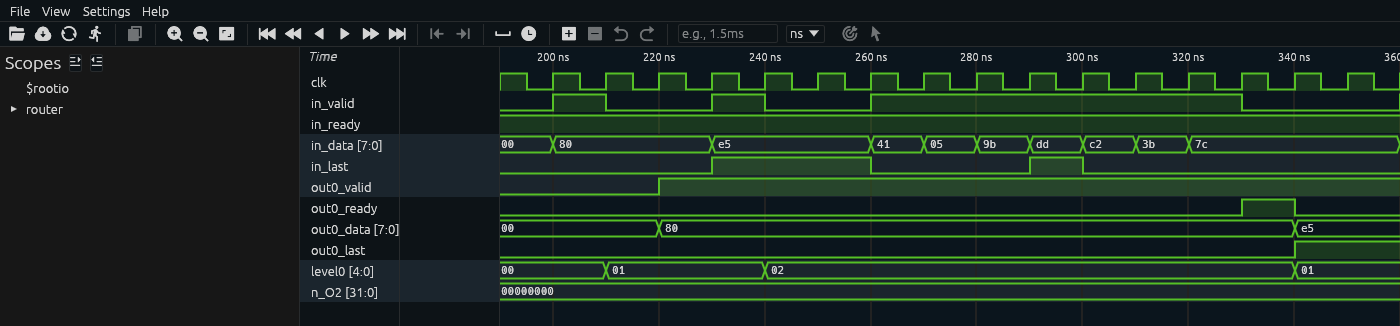
The golden router in phase 1 of RouterTest, in Surfer The golden router. The header
80is taken at the edge at 210 ns ande5at the edge at 240 ns.80reachesout0_dataat the edge at 220 ns, the start of cycle 23, and stays there whileout0_readyis 0;level0goes to 2 whene5arrives.out0_readyis 1 in cycle 34, from 330 to 340 ns, the sink takes80at the edge at 340 ns, ande5follows.n_O2stays 0.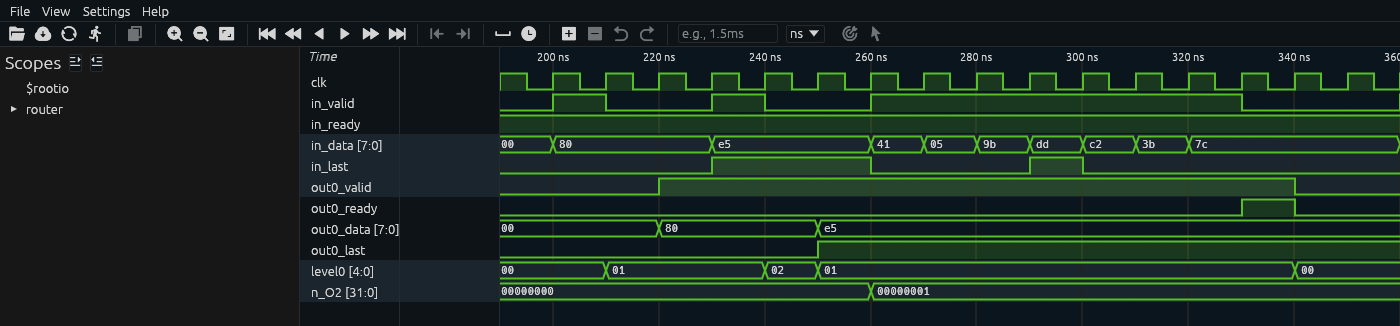
The same window with B10 on, in Surfer B10.
out0_datachanges from80toe5at the edge at 250 ns, whileout0_readyis 0, andlevel0drops from 2 to 1.n_O2counts its first failure at the edge at 260 ns, which ends cycle 26. Whenout0_readyrises in cycle 34, the beat on the output ise5, and after the sink takes itout0_validfalls, so80is lost.Run the grader again:
make check-allYou should see B10 caught by your assertions as well, B12 with three assertion failures, and B11 still missed:
  MISSED  tier 4  B11_cut_packet_has_no_last       0 errors, 0 assertions          5.6s
  caught  tier 4  B10_output_reloads_while_stalled 50 errors, 284 assertions       2.9s
  caught  tier 5  B12_out1_uses_out0_ready         50 errors, 3 assertions         2.0s
------------------------------------------------------------------------
 2 of 3 caught.
The three failures on B12 are all
a_O6, on output 1, and the first was at the edge at 400 ns, which ends cycle 40. Rungrep -m1 "%Error" build/grade/B12/run.logto see it. The scoreboard’s first error was in cycle 34. B11 is the bug that breaks O6, but youra_O6passes on B11 and fails on B12. Why?TipAnswerAn assertion can only fail on something that the stimulus makes the router do. Under B11, O6 can fail only on the 8th beat of a packet that has a 9th, and nothing in
RouterTestsends a packet longer than 8 beats yet, so on B11 the router never has a packet to cut.B12 makes output 1’s buffer move on
out0_ready. In phase 1 output 1’s sink is ready in every cycle, so it takes whatever beat is on output 1’s pins. Output 0 is ready in only 5% of cycles, so in most of those cycles the buffer behind output 1’s pins doesn’t move on to the next beat, and the pins show a handshake with the same data again. In cycle 34 the scoreboard, which had already matchedc2, saw the sink takec2again where3bwas due. Each repeat is one more beat of the packet on output 1’s pins, so once eight beats in a row have had noout_last, O6 fails. O1 and O2 check only cycles in whichout_readyis 0, andout1_readyis 1 all through phase 1. The run stops at its 50th error in cycle 83, long before phase 2 stalls output 1.
Check: make check-all prints 50 errors, 284 assertions for B10, and the cycle you predicted in Part 1 matches cycle 26.
Part 3: A sink that answers each beat
What changes when each sink answers each beat at its own pace, instead of setting out_ready in every cycle whatever is on the output?
Read the output agent in
tb/router_agents.py:OutCfg,ReadyItem,SinkSeq,SinkDriverandOutAgent.OutCfg.modepicks how the sink answers. InSNK_PCT, the default, the driver works as Lab 04’s did, and setsout_readyto 1 right after every rising edge with probabilityready_pctpercent. In the other modes it is a reactive driver. The router decides when a beat appears, and the driver answers each beat with aReadyItemfromSinkSeq. Withpre_readyset,readyis already 1 when the beat appears; otherwise the sink waitsdelaycycles after the beat’s first cycle on offer, then raisesready.SNK_FASTmakes every itempre_ready,SNK_SLOWgives every beat a delay of 4 to 20, andSNK_RANDOMrandomizes each item. In those modes the driver looks at the output at the falling edge in the middle of each cycle, decides the next cycle’sreadythere, and drives it just after the rising edge; that loop is written for you.pyuvm’s driver has
get_next_item(), which waits until its sequence hands over an item. It doesn’t havetry_next_item(). The base test starts aSinkSeqon each sink before it resets the router, and the sequence never ends. Why does the driver need a sequence like that, when the source driver can work with sequences that send a few packets and stop?TipAnswerThe source driver can wait in
get_next_item(), because nothing happens on the input until it has a packet. The sink driver can’t wait there, because it drivesout_readyin every cycle, and the router puts a beat on the output whether or not the sink has an item for it.SinkSeqis always waiting instart_item()with the next item, so the driver’sget_next_item()returns in the same time step, and the loop goes on to drive the next cycle’sout_ready. If no sequence were running on the sink, the driver would stop at that call for the rest of the test,out_readywould keep the last value it drove, and no beat on that output would be answered again.RouterSinkTestis Lab 03’s random test with both sinks inSNK_RANDOM. Run it as shipped, on its own, and look at its waits:rm -rf build/runs make run TEST=RouterSinkTest make covYou should see
okin about 6 s, a first[PHASE]line that endsoutput 0 SNK_RANDOM, output 1 SNK_RANDOM, and:54960.00ns INFO ..ckpressure/tb/router_env.py(229) [uvm_test_top.env.sb]: [SB] 805 packets in: 456 to output 0, 348 to output 1, 1 NOROUTE, 0 FULL; the highest level a header saw was 16top.router.wait 50.00 % 7 of 14 bins top.router.wait.port 100.00 % 2 of 2 bins top.router.wait.wait 50.00 % 2 of 4 bins not hit: short_wait, stalled top.router.wait.x_port_wait 37.50 % 3 of 8 bins not hit: ('out0', 'short_wait'), ('out0', 'stalled'), ('out1', 'short_wait'), ('out1', 'long_wait'), ('out1', 'stalled')As shipped, the driver is always ready in the per-beat modes, whatever the item says, so the packets on output 1 never waited, and no FULL drop happened. The
long_waitpackets on output 0 come fromclose_holes(), which stalls output 0 in Lab 04’s mode,SNK_PCT.Fill in the two TODOs in
SinkDriver.run_phase: the countdown while a beat waits, and the expression forrdy, the next cycle’sready. The countdown has to stop at 0. A beat whose wait is over can still be on offer if a virtual sequence then stalls its output (Part 4), and the countdown goes on running in every cycle the beat waits, inSNK_PCTtoo, since the driver still holds the item. One more count would takewait_leftbelow 0, and once the sink was back in a per-beat mode, a test forwait_left == 0would never let it raisereadyfor that beat.Before you run it again, predict what happens to the
[SB]line’sFULLcount and to therouter.waitbins.TipAnswerEach beat now waits 0 cycles when its item is
pre_readyand otherwise 1 to 13, so packets land inshort_waitandlong_waiton both outputs. A sink that waits a cycle or more on about half its beats takes them more slowly than the input can bring them, so an output sometimes fills past 8 beats, and the packets that arrive for it then are FULL drops.Run it again and look at the coverage. Your edit is Python, so nothing rebuilds:
rm -rf build/runs make run TEST=RouterSinkTest make covIf your driver does what the TODOs say, you should see
okand:53660.00ns INFO ..ckpressure/tb/router_env.py(229) [uvm_test_top.env.sb]: [SB] 804 packets in: 369 to output 0, 319 to output 1, 1 NOROUTE, 115 FULL; the highest level a header saw was 16top.router.wait 92.86 % 13 of 14 bins top.router.wait.port 100.00 % 2 of 2 bins top.router.wait.wait 100.00 % 4 of 4 bins top.router.wait.x_port_wait 87.50 % 7 of 8 bins not hit: ('out1', 'stalled')The run passed, so every phase’s
DROP_CNTread matched the scoreboard’s count, which means the scoreboard predicted all 115 FULL drops. The packets differ from step 2’s (804 of them instead of 805), because each itemSinkSeqmakes inSNK_RANDOMdraws fromrandom, and your driver asks for its items in different cycles from the shipped driver. Output 1 has nostalledpacket, because aReadyItem’s longest wait is 13 cycles and nothing stalls output 1 in this test.Run the grader:
make check-allYou should see
2 of 3 caught.again, with the same counts as in Part 2.RouterTestkeeps its sinks inSNK_PCTuntil its virtual sequence starts, and that sequence is still empty, so your driver changes none of its stimulus, and B11 still needs a packet longer than 8 beats.
Check: RouterSinkTest passes with 115 FULL in its [SB] line, and make check-all says 2 of 3 caught.
Part 4: A virtual sequence
How do you make the configuration, the traffic and the backpressure change together, from one place?
Read
RouterBaseVseqandRouterLab05Vseqintb/router_vseq.py. pyuvm has nop_sequencer, so a virtual sequence is given the environment when it’s made, and it runs on no sequencer of its own:RouterTeststarts yours withawait RouterLab05Vseq("vseq", self.env).start(). The helpers you’ll use areroute(n, en, port),ctrl(en),sink(p, mode),stall(p),burst(dst, n, length),send_rand(n, gap_one_in, w_over),backpressure(),cycles(n),drain()andrd(DROP_CNT). Most of them are the base test’s steps from Lab 04, rewritten as methods of a sequence, and they start the same Lab 04 sequences that the steps started. Why dosink()andstall()change the sink’sOutCfg, and not start a sequence on the sink’s sequencer?TipAnswerThe base test starts each sink’s
SinkSeq, and it runs for the whole test, one item per beat. A virtual sequence steers the backpressure by changingmodeandready_pctin the sink’sOutCfg.SinkSeqreadsmodefor every item, and the driver readsmodein every cycle, andready_pctas well while the mode isSNK_PCT. Starting another sequence on a sink’s sequencer would compete with the one already running there.Run the test that runs your sequence alone, as it is now:
make run TEST=RouterLab05TestYou should see
FAIL: 1 error, 0 assertions 1.90 s, and above it:20.00ns ERROR ..ckpressure/tb/router_env.py(116) [uvm_test_top.env.sb]: no beat was checked: neither output delivered a beat that matched a predictionThe scoreboard fails a test that checked nothing.
make regress, which runs every test in the Makefile, fails for the same reason until you finish this part.Read
write_apband the start ofwrite_inin the scoreboard. In Lab 04 a route write changed the scoreboard’s routing table at once, which was safe because the tests wrote routes only between phases. Now the APB monitor stamps each transfer with the cycle it completed in,write_apbputs a route write inpendingwith that cycle, andwrite_inapplies it at the first header of a later cycle. Why does the scoreboard go by the cycle, and not by the order in which the two calls arrive?TipAnswerThe specification’s Routing section says a header accepted in the cycle a register write completes still uses the old value. The APB monitor and the input monitor both read the pins at the same falling edge, and cocotb runs them in no fixed order (which is also why
level()adds back a beat taken in the header’s own cycle), so a header and a route write in the same cycle could reach the scoreboard in either order. The cycle stamps don’t depend on that order.Write
RouterLab05Vseq.body(). The TODO lists four steps:- Configure the router: every route enabled, two DSTs to each output, and
CTRL.ENset. - Stall output 1 and send packets to both outputs, then stall output 0 instead, with a
drain()after each. - Send oversize packets (9 beats or more) to every DST with both sinks in
SNK_RANDOM, then drain. - All at once: random packets with oversize ones among them (
send_rand()’sw_over),backpressure(), and a coroutine that moves two routes to the other output and back while the packets are in flight. Then drain, and readDROP_CNT.
Step 4 has this shape.
par()starts each coroutine and waits until all of them are done, andbackpressure()loops untiltraffic_doneis set:self.traffic_done = False async def traffic(): await self.send_rand(...) # the packets self.traffic_done = True async def moves(): ... # route changes, with cycles() between them await self.par(traffic(), self.backpressure(), moves())send_rand()takes two settings.gap_one_inmakes one beat in that many wait 1 to 3 idle cycles first, and it’s 4, as in Lab 04, unless you give it.w_overis the weight of oversize packets, against 100 for the other lengths.- Configure the router: every route enabled, two DSTs to each output, and
Predict how each oversize packet should come out, and which bug your sequence now reaches.
TipAnswerEach one should come out cut to 8 beats, with
out_laston the 8th, and the router takes the rest of its beats from the input and throws them away (example E6 in the specification). Your sequence now reaches B11. Under B11 the 8th beat has noout_last, so O6 fails on it, and the scoreboard, which already expected the cut, sees the wrongout_laston the same beat.Run both tests and look at the coverage. Your sequence is Python, so nothing rebuilds:
rm -rf build/runs
make run TEST=RouterLab05Test
make run
make cov
You should see
okfrom both runs, androuter.pkt.lenwith all 9 bins hit. The counts depend on your sequence. OurRouterLab05Testsent 317 packets, andRouterTestsaid:77350.00ns INFO ..ckpressure/tb/router_env.py(229) [uvm_test_top.env.sb]: [SB] 1123 packets in: 282 to output 0, 286 to output 1, 179 NOROUTE, 376 FULL; the highest level a header saw was 16 77350.00ns INFO ..ckpressure/tb/router_env.py(232) [uvm_test_top.env.sb]: [SB] beats checked: 1283 on output 0, 1254 on output 1; 6 DROP_CNT reads checkedThe first 806 packets are the ones from Part 1, and our sequence sent the other 317. Our
make covof the two runs showedtopat87.50 % 49 of 56 binsandrouter.waitat14 of 14 bins. The seven empty bins are the seven ofx_fate_levelthat the specification rules out, so no test can hit them.Run the grader:
make check-allYou should see
3 of 3 caught.Our run printed:ok the golden design 0 errors, 0 assertions 7.1s ------------------------------------------------------------------------ caught tier 4 B11_cut_packet_has_no_last 20 errors, 18 assertions 7.2s caught tier 4 B10_output_reloads_while_stalled 50 errors, 284 assertions 2.9s caught tier 5 B12_out1_uses_out0_ready 50 errors, 3 assertions 2.0s ------------------------------------------------------------------------ 3 of 3 caught. Every bug in the list, each one caught by a check that fired.On B11 our
a_O6failed at the edge that ends cycle 5496, and the scoreboard reported the same beat in the same cycle:[54960000] %Error: router_sva.sv:58: Assertion failed in router.u_sva.u_out1.a_O6: O6: an output packet is longer than 8 beats 54955.00ns ERROR ..ckpressure/tb/router_env.py(116) [uvm_test_top.env.sb]: output 1: got 55 in cycle 5496, expected 55 lastgrep -m1 "%Error" build/grade/B11/run.logandgrep -m1 ERROR build/grade/B11/run.logshow them, andBaseTestended the test withDD105-B BaseTest: 20 errors logged, 18 assertion failures (u_sva.n_fail). What did O6 add that the scoreboard’s error didn’t already give you?TipAnswerO6 names the rule, and it needs no model of the router. It checks one line of the specification against the pins, so it would catch B11 in any testbench that binds the file and sends an oversize packet, including one whose scoreboard didn’t know that the router cuts long packets. The scoreboard knows what every beat should be, so it catches far more, but its message gives only the beat that was wrong and what it expected instead.
Now run B12 against your sequence alone, which stalls output 1 first, and compare the first check of each kind:
make run TEST=RouterLab05Test BUG=B12
grep -m1 "%Error" build/runs/RouterLab05Test-s1-B12/run.log
grep -m1 ERROR build/runs/RouterLab05Test-s1-B12/run.log
Ours said
caught: 50 errors, 39 assertions, and:[330000] %Error: router_sva.sv:53: Assertion failed in router.u_sva.u_out1.a_O2: O2: out_data or out_last changed while the beat waited 3515.00ns ERROR ..ckpressure/tb/router_env.py(116) [uvm_test_top.env.sb]: output 1: got 46 in cycle 352, expected 44Our O2 failed in cycle 33 and the scoreboard complained in cycle 352. In
RouterTestthe scoreboard was first. Why is it so much later here?TipAnswerStep 2 of the sequence stalls output 1 while output 0 takes its beats. Under B12 output 1’s buffer moves on
out0_ready, so its beats leave whileout1_readyis 0. None of them has a handshake on output 1’s pins, so its monitor reports nothing. By the time the stall ends, every beat routed to output 1 has left its buffer, so output 1’s sink has nothing to take either, anddrain()waits its full 300 cycles, because the scoreboard still expects those beats. Output 1’s first handshake of the run is in cycle 352, when the second half of step 2 sends it new packets, and that is the scoreboard’s first chance to compare a beat on output 1. O2 watches the pins, so it fails in the first cycle the beat on output 1 changes while it waits. InRouterTest’s phase 1 the readies differ the other way round, with output 1 ready and output 0 stalled, so output 1’s sink takes the repeated beats and the scoreboard sees them at once.Check that your testbench still passes the golden design on other seeds:
make seeds SEEDS="1 2 3 4 5"You should see
5 ok (5 runs), at about 7 s a run.
Finishing
You’re done when make check-all prints 3 of 3 caught. with your assertions, your sink driver and your virtual sequence in tb/, and make seeds SEEDS="1 2 3 4 5" prints 5 ok (5 runs).
Questions:
B12 breaks rule O7, because it makes output 1 depend on
out0_ready. Your file has noa_O7. Which checks caught B12, and why is there no assertion for O7?TipAnswerIn
RouterTestthe scoreboard reported errors from cycle 34, and O6 on output 1 failed from cycle 40. InRouterLab05TestO2 on output 1 failed from cycle 33 and O1 from cycle 38, the scoreboard’s first error was in cycle 352 (Part 4, step 8), and O6 on output 1 failed in cycle- O7 says what an output does not depend on, and the specification points out that no single trace can show that. You can only see its consequences, when the two
out_readysignals differ and output 1 then does something that O1, O2, O6 or the scoreboard’s model forbids. Lab 04’s stall test was the first test to make them differ while both outputs carried traffic, which is why your Lab 04 testbench already caught B12.
- O7 says what an output does not depend on, and the specification points out that no single trace can show that. You can only see its consequences, when the two
Your O1 and O2 are disabled while
rst_nis 0. What would O1 do on the golden design, withoutdisable iff, in a test that resets the router while a beat waits on a stalled output?TipAnswerIt would fail. A reset lowers
out_validat once, with no handshake (the specification’s Valid/ready rules and example E8), but O1’s consequent needsout_validto be 1 in the next cycle. Rules about normal operation don’t hold across a reset, so their assertions are switched off during one.
Submit: Nothing to submit.
Next on the Course path: the reading on register models and regressions, then Lab 06: The register block.