Reactive agents and backpressure
This page answers: the design decides when each beat appears on its output. How does a testbench answer each one, and how do you choose how long each beat waits?
Your Lab 04 sink flipped a coin in every cycle to set out_ready, which was 1 with probability ready_pct percent whether or not a beat was on offer. That gave the router backpressure, but the only thing you could set was ready_pct, and with it you can’t make a particular beat wait a number of cycles that you choose. In Lab 05, Part 1, the coverage group router.wait takes each packet that an output delivers and records the longest that any of its beats waited for out_ready. Its bins are none for 0 cycles, short_wait for 1 to 3, long_wait for 4 to 20 and stalled for more than 20, and the group crosses them with the two outputs. With Lab 04’s sinks, make cov reports:
      top.router.wait                               92.86 %   13 of 14 bins
        top.router.wait.port                         100.00 %   2 of 2 bins
        top.router.wait.wait                         100.00 %   4 of 4 bins
        top.router.wait.x_port_wait                   87.50 %   7 of 8 bins
            not hit: ('out1', 'short_wait')
No packet on output 1 had a longest wait of 1 to 3 cycles. In Part 3 you’ll finish a sink driver that answers each beat separately, with an item from a sequence. On this page we build an agent like that in pyuvm for a small design of our own, and measure how long the beats wait with each kind of sink. The files are in guide-examples/reactive-agents-and-backpressure/.
Who starts a transfer
In the agents of Labs 01 and 04 that take items from a sequence, the testbench decides when each transfer happens. Lab 04’s source driver, for example, calls get_next_item(), waits until its sequence hands over a packet, and then puts the packet on the input. Nothing happens on the input until the driver has a packet, so the driver can wait as long as it likes.
A reactive agent works the other way round. The design decides when something happens, and the testbench answers. A sink is the simplest example. The router decides when a beat appears on an output, and the sink decides how long that beat waits before it’s taken. Other examples are a memory model that answers a processor’s read requests, and a bus slave. A reactive agent has the usual pieces (an item, a sequence, a sequencer, a driver and a monitor), but each of its items describes an answer to something the design does, rather than a transfer for the driver to start. Its driver also has to drive its side of the interface in every cycle, whether or not it has an item.
Our example’s design, beat_src, numbers its beats 0, 1, 2 and so on. After each handshake it leaves its output idle for 1 to 4 cycles, a number it takes from an LFSR, and then puts the next beat on the output, where the beat stays until the sink takes it. The sink agent has two modes, which +MODE= picks. In coin mode its driver does what Lab 04’s did. In beat mode the driver answers each beat with one SnkItem, and the item says how many cycles the beat waits after it first appears:
class SnkItem(uvm_sequence_item):
    def __init__(self, name="snk_item"):
        super().__init__(name)
        self.delay = 0
        self.max_delay = 12

    def randomize(self):
        self.delay = random.randint(0, self.max_delay)
A delay of 0 means ready is already 1 when the beat appears.
A sequence that never ends
The sink’s sequence makes one item per beat, for as long as the test runs:
async def body(self):
    make = vsc_item_class() if self.cfg.item == "vsc" else SnkItem
    while True:
        it = make("snk_item")
        await self.start_item(it)
        it.max_delay = self.cfg.max_delay
        self.timed(it.randomize)
await self.finish_item(it)(vsc_item_class() makes the pyvsc version of the item that one of the measurements below uses, and timed() calls randomize() and adds up how long it took.) The test starts this sequence with cocotb.start_soon(seq.start(self.snk.sqr)), so the sequence runs beside the test’s run_phase, and the test never waits for it to return. A pyuvm sequence raises no objection of its own. The test raises one, and it drops it once the monitor has counted 2,000 beats, so the test’s objection alone decides when the run ends. Lab 05’s base test starts a SinkSeq on each output the same way, before it resets the router.
pyuvm hands the item over in two steps. start_item() puts the item in the sequencer’s queue and waits there until the driver’s get_next_item() takes it. When start_item() returns, the sequence sets the item’s fields and calls finish_item(), which tells get_next_item() that the item is ready and then waits until the driver calls item_done(). So the sequence is never more than one item ahead of the driver, and it decides each item’s values only when the driver asks for that item. If the sequence is already waiting in start_item(), no simulation time passes between the driver’s call to get_next_item() and its return. In the run with per-beat delays from random.randint, the driver’s [DRV] line at the end said:
[DRV] get_next_item() returned 2000 items, 1 of them at a later time than it was called (called at 5 ns, returned at 10 ns)The one late item was the first, which the driver asked for at 5 ns, before the test had started the sequence at 10 ns. Every other get_next_item() returned in the time step in which the driver called it.
A driver that can’t wait
The driver’s loop has two halves, one for each half of the clock cycle. Here it is without the countdown of the item’s delay or the expression for the next cycle’s ready, because in Part 3 you’ll write both of them for the router’s sink driver:
while True:
    await RisingEdge(d.clk)
    if cfg.mode == "coin":
        rdy = int(random.randrange(100) < cfg.ready_pct)
    d.ready.value = rdy                         # ready for the cycle that starts here
    if cfg.mode == "coin":
        continue
    await FallingEdge(d.clk)                    # the middle of the cycle
    v = bool(d.valid.value)
    if v and rdy:                               # a handshake at the next edge
        self.seq_item_port.item_done()
        it = None
    ...                                         # one more cycle of this beat's wait
    if it is None:
        it = await self.seq_item_port.get_next_item()
        ...
    rdy = ...                                   # ready in the next cycle
It drives ready just after the rising edge and looks at valid at the falling edge in the middle of the cycle. That’s the timing rule that the course has followed since Lab 02. At the falling edge the driver can see valid, and it knows the ready it drove for this cycle, so it can tell whether a beat moves at the next rising edge. If one does, that beat has had its answer, so the driver calls item_done() and asks for the item for the next beat.
A pyuvm driver gets its items with get_next_item(), which waits until its sequence hands one over. pyuvm has no call that returns at once when the sequence has nothing ready. The sink’s driver can’t afford to wait, because it has to drive ready at the next edge whatever happens. It gets away with get_next_item() because the sequence never ends and is always waiting in start_item() with the next item, so the call comes back in the same time step, as the [DRV] line showed. When no sequence is running on the sink, the call doesn’t come back at all. With +NOSEQ the test starts no sequence on the sink. We ran it that way in beat mode for 3,000 cycles (+MAX_CYCLES=3000), and at the end it printed:
[WAIT] per beat, delays 0 to 12 from random.randint: 0 beats taken in 3001 cycles
[DRV] get_next_item() returned 0 items, 0 of them at a later time than it was called; it has been waiting in get_next_item() since 5 ns
The driver drove ready to 0 at the first rising edge, called get_next_item() at the first falling edge, and never got past it, so ready stayed 0 and the first beat waited for the whole run. Lab 05’s SinkDriver calls get_next_item() in the same place, at the falling edge, and Part 3 asks you why it needs a sequence that never ends.
Measured waits for each sink
We ran 2,000 beats through each sink and counted, for each beat, the cycles it waited between appearing and being taken. The table sorts the waits into the same ranges as router.wait’s bins, but it counts every beat, where router.wait counts each packet once, by its longest wait.
| Sink | Waited 0 | 1 to 3 | 4 to 20 | More than 20 | Mean wait |
|---|---|---|---|---|---|
| coin flip, 5% | 82 | 289 | 911 | 718 | 18.98 |
| coin flip, 50% | 973 | 890 | 137 | 0 | 1.06 |
| coin flip, 95% | 1890 | 110 | 0 | 0 | 0.06 |
per beat, delays 0 to 12 from random.randint |
164 | 465 | 1371 | 0 | 6.03 |
per beat, delays 0 to 12 from pyvsc’s randomize() |
143 | 380 | 1477 | 0 | 6.48 |
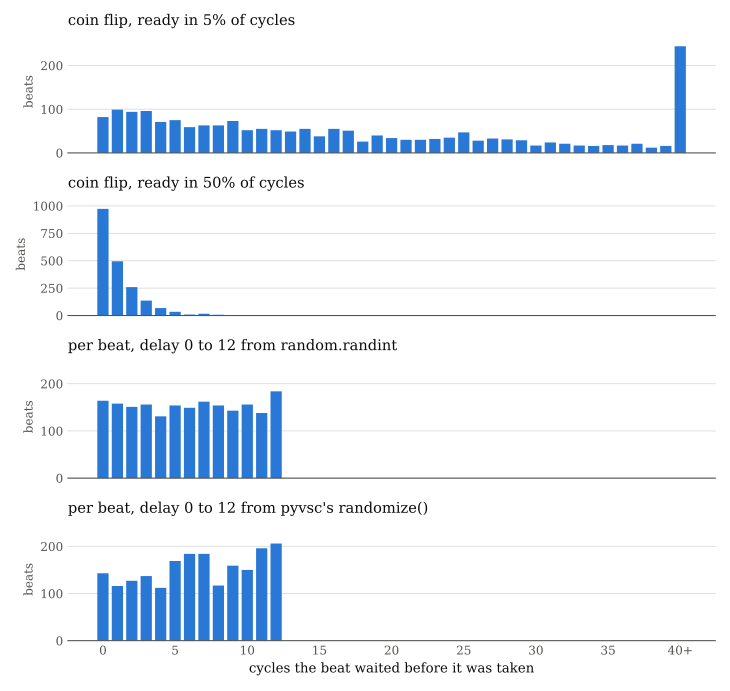
A coin-flip sink gives each beat the same chance of being taken in every cycle, so its waits fall off geometrically. If \(p\) is ready_pct as a fraction, a beat waits \(w\) cycles with probability \(p\,(1-p)^{w}\), and the mean wait is \((1-p)/p\), which is 19 cycles at \(p = 5\%\), 1 cycle at 50% and 0.05 at 95%, against our measured 18.98, 1.06 and 0.06. Whatever the setting, a wait of 0 cycles is the most likely, and each wait is \(1-p\) times as likely as a wait one cycle shorter, so ready_pct sets only how quickly the waits fall off. At 5%, 1,629 of the 2,000 beats waited 4 cycles or more, and only 289 waited 1 to 3. At 50%, no beat waited more than 10 cycles. At 95%, 1,890 of the 2,000 beats were taken in the cycle they appeared.
The test you inherit from Lab 04 runs each sink at 100% or 5% in its four phases, and stalls output 0 completely while close_holes() runs. At 100% a beat never waits. At 5% a packet of more than one beat nearly always has a beat that waits 4 cycles or more, so a packet whose longest wait is 1 to 3 cycles is rare, and in the run at the top of this page output 1 delivered none.
A per-beat sink makes each beat wait for the delay in its item, so the spread of the waits is the spread of the delays that the sequence produced. With delays of 0 to 12, 1,371 of the beats with random.randint and 1,477 with pyvsc waited 4 to 20 cycles, and none waited more than 20. Lab 05’s OutCfg.mode offers both kinds of sink. SNK_PCT is Lab 04’s coin flip, and in SNK_FAST, SNK_SLOW and SNK_RANDOM the driver answers each beat with an item.
Check the distribution you got
If the sequence picked each of the thirteen delays from 0 to 12 equally often, each would come up about 154 times in 2,000. With random.randint every value came up between 131 and 184 times on seed 1. The pyvsc item leaves the delay to pyvsc’s solver, with the constraint self.delay <= self.max_delay on an 8-bit random field, and its values weren’t spread evenly. On seed 1 the delays 11 and 12 came up 196 and 206 times, and 1 and 4 only 116 and 112 times. On seeds 2 and 3, 12 came up 225 and 235 times, and on all three seeds each of the values 0 to 4 and 8 came up fewer than 154 times. As in Lab 03, a constraint tells you which values are allowed, not how often each one comes out, so count what the stimulus actually produced.
The solver is also slow for a job that runs once per beat. The 2,000 calls to pyvsc’s randomize() took 2.02 s, which is 988 a second, and the run as a whole took 6.36 s against 1.04 s with random.randint. The router’s sinks make one item for every beat that leaves the router, so Lab 05’s ReadyItem draws from Python’s random instead. Its randomize() makes half the items pre_ready, which means ready is already 1 when the beat appears. It picks each item’s delay in two steps, first the range (0 for half the items, 1 to 3 for three in ten, 4 to 12 for the rest) and then a value inside it. A ReadyItem’s delay counts from the beat’s first cycle on offer, so a beat whose item isn’t pre_ready waits one cycle more than the delay, 1 to 13 cycles in all. In Lab 05, Part 3 you see the waits that these items give in router.wait.
The sink’s configuration object
The sink’s driver reads its mode and ready_pct from a configuration object, SnkCfg, in every cycle, and its sequence reads max_delay for every item. So a test, or a virtual sequence, can change the backpressure in the middle of a run just by writing a field of that object, without starting anything on the sink’s sequencer. In Lab 05, Part 4, backpressure() changes both sinks’ modes this way, by writing their OutCfg, every 30 to 250 cycles while the packets go in. Virtual sequences explains how a sequence gets hold of the object.
Check yourself
A coin-flip sink has
ready_pctset to 20. What fraction of the beats are taken in the cycle they appear, and what is the mean wait?TipAnswer20% of beats wait 0 cycles, because the coin comes up 1 in the beat’s first cycle with probability 0.2. The mean wait is \((1-p)/p = 0.8/0.2 = 4\) cycles.
SinkTeststarts the sink’s sequence withcocotb.start_soon(seq.start(self.snk.sqr)). What would happen if it wroteawait seq.start(self.snk.sqr)instead?TipAnswerThe sequence’s
body()loops forever, soseq.start()never returns, and the test’srun_phasewould wait at that line for the rest of the run. It would never reach the wait for 2,000 beats or drop its objection, so the run would go on until something stopped it from outside. In the course that’smake’s run timeout, and a run that it stops is graded BROKEN.An item with a delay of 0 reaches the driver while the design’s output is idle. What does the driver drive, and how long does the beat wait when it appears?
TipAnswerFrom the next edge on it drives
ready= 1, because a delay of 0 leaves nothing to wait for. When the beat appears,readyis already 1, so the handshake happens in the beat’s first cycle and the beat waits 0 cycles. With a coin-flip sink, a particular beat is sure to wait 0 cycles only whenready_pctis 100.
Further reading
ChipVerify’s pages are about SystemVerilog UVM. The ideas carry over, but pyuvm’s driver has get_next_item() and no try_next_item(), and a pyuvm sequence raises no objection.
- UVM Reactive Sequence: the responder pattern for a slave agent, with a sequence that keeps its own memory model and answers the design’s reads and writes from it. The test starts that sequence in a background thread, with no objection.
- Using get_next_item(): the driver-sequencer handshake, which call blocks and what releases it, and
try_next_item(), which pyuvm doesn’t have. - UVM Driver. Correction: its “simplified” loop calls
item_done()after one edge and never clears the request, which is the mistake the same page warns against further down. - Handshake Properties, in the formal section, on why a sink that is always ready hides bugs in the sender.
Next: Virtual sequences.