The pyuvm skeleton
This page answers: what are the pieces of a pyuvm testbench, and in what order does pyuvm run them?
In Lab 01 you read a whole pyuvm testbench, the ALU’s tb/alu_uvm.py, from its tests down to its driver, monitor and scoreboard, and you added the flag check to its scoreboard. Labs 02 and 03 were plain cocotb. Each test was a function marked @cocotb.test(). An Env class made the pieces in its constructor and handed them queues, and one of its methods then started each piece’s coroutine. In Lab 04 you finish our pyuvm port of the Lab 03 router testbench, and in Part 5 of that lab you count its lines against those of your own Lab 03 testbench.
The example for this page, guide-examples/the-pyuvm-skeleton/, has no design to test. Lab 01’s ALU is its toplevel only because cocotb needs one. It has a test, an environment, two agents with one child each, and a component called mon that loops forever the way a monitor does. Each of them prints a line in every function phase, and the test, the two children and mon also print in the run phase, so you can watch the order in which pyuvm calls them.
Objects and components
Every pyuvm class in a testbench derives from either uvm_object or uvm_component. (In the library, uvm_component is itself built on uvm_object, but a testbench uses the two in different ways.)
A uvm_object is data: a packet, an APB transfer, a beat that a monitor saw. You make one whenever you need it, pass it around and drop it, and many of them come and go in a run. Lab 04’s RouterPkt, StreamBeat and ApbItem derive from uvm_sequence_item, which is a uvm_object. Its OutCfg, the knobs of one output agent, is a plain Python class, since nothing makes it through the factory or sends it through a port.
A uvm_component is one of the testbench’s fixed parts, such as a driver, a monitor, a scoreboard or the test. It’s made once, at the start, and lasts for the whole run. Every component has a name and a parent, given to it when it’s made, as in SrcAgent.create("src", self), and the parents link the components into a tree. Lab 04’s tree looks like this:
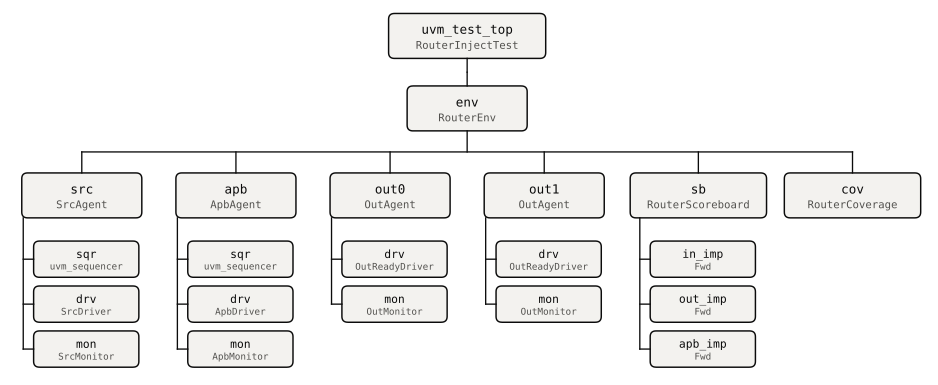
The components that RouterLabTest, RouterEnv and the agents build in Lab 04, once you’ve added out1 in Part 2, drawn from a printout of the solution’s tree. The test drawn at the top is RouterInjectTest, one of the tests built on RouterLabTest. The printout also had the ports, which are left out here: each monitor’s ap, the scoreboard’s fate_ap, the seq_item_port of SrcDriver and of ApbDriver, each sequencer’s seq_item_export, and an analysis_export under each Fwd and under cov. When a component logs a message, the line names it by its path down this tree, such as uvm_test_top.env.sb for the scoreboard.
The test is at the top of everything the testbench builds, and pyuvm always names it uvm_test_top. Above it sits pyuvm’s own root, uvm_root, which has no name in a path. The test makes the environment, env, and the environment makes the agents, the scoreboard and the coverage. An agent holds the components for one interface: a driver that drives its pins, a monitor that watches them, and, if the agent sends items, a sequencer that hands the driver its items.
In pyuvm, ports and exports are components too, so they’re in the tree with everything else. The example’s mon makes an analysis port called ap, and the tree printed below has it under mon. The course’s BaseTest walks this whole tree, ports included, when it adds its error counter to every component’s logger.
pyuvm has a class for each job: uvm_test, uvm_env, uvm_agent, uvm_driver, uvm_monitor, uvm_sequencer, uvm_scoreboard and uvm_subscriber. Most of them add little or nothing to uvm_component. uvm_driver adds the port it gets items through, seq_item_port, and uvm_subscriber adds the export it receives transactions on, analysis_export; the next two pages describe both. uvm_agent’s build_phase reads an is_active setting. uvm_test, uvm_env, uvm_monitor and uvm_scoreboard add nothing, and each is a plain component whose name says what it’s for. In Lab 04’s output agent, OutReadyDriver takes no items, so it derives from uvm_component rather than uvm_driver.
pyuvm has no registration lines like SystemVerilog UVM’s `uvm_component_utils. It registers every class that derives from one of its own with the factory as soon as Python defines the class, under the class’s name. A component made with ClassName.create(name, parent) goes through the factory, so a test can tell the factory to make something else in its place. In Lab 04 the environment, the agents, the drivers, the monitors, the scoreboard and the coverage are made that way. The sequencers, the scoreboard’s Fwds and the ports are made with the constructor, as in uvm_sequencer("sqr", self), and a test can’t swap those. The factory page explains how an override works.
@pyuvm.test() and TEST=
cocotb runs functions marked @cocotb.test(). @pyuvm.test() wraps a test class in such a function and gives the function the class’s name. When cocotb calls that function, the function asks pyuvm’s uvm_root to make an instance of the class, name it uvm_test_top, and run the phases. make run TEST=SkPhaseTest passes cocotb a filter that matches the test name SkPhaseTest exactly, and cocotb runs only the test whose name matches, so one build serves all of a testbench’s tests.
@pyuvm.test() adds the cocotb test to the module that the decorator is written in, and cocotb looks for tests only in the modules that the lab’s TEST_MODULES names. So write each test class, with its decorator, in one of those modules. A test module that imports a decorated class from another module doesn’t get the class’s test. A class that derives from a decorated test is a test only if it has a decorator of its own, as Lab 04’s RouterStallTest, which derives from RouterRandTest, does. The class that a test derives from can be in any module, as BaseTest is in dd105b_base.
If the name matches no test, nothing runs. make run TEST=SkPhaseTset, with two letters of the name swapped, printed:
0.00ns WARNING cocotb.regression No tests left after filtering with: (^|\.)SkPhaseTset$and the verdict BROKEN: every test skipped, with a hint to compare the name with make tests.
Phases
Where Lab 03’s Env started each piece’s coroutine itself, pyuvm calls a fixed list of methods, the phases, on every component in the tree, and finishes each phase in the whole tree before it starts the next. A component overrides the phases it needs. pyuvm 4.0.1 has these nine, in this order:
| Phase | Kind | Order in the tree | What goes in it |
|---|---|---|---|
build_phase |
function | top down | make the children; read configuration |
connect_phase |
function | bottom up | connect ports between children |
end_of_elaboration_phase |
function | top down | print or check the finished tree |
start_of_simulation_phase |
function | top down | last settings before time moves |
run_phase |
async |
all at once | everything that takes simulated time |
extract_phase, check_phase, report_phase |
function | top down | collect results, look for leftovers, print summaries |
final_phase |
function | top down | the very end |
The function phases take no simulated time. run_phase is a coroutine, and pyuvm starts every component’s run_phase at the same moment, each as a cocotb task of its own. SystemVerilog UVM runs every phase but build_phase and final_phase from the bottom up, and has twelve more run-time phases (reset_phase, main_phase and so on) beside run_phase. In pyuvm 4.0.1’s s09_phasing.py, only connect_phase runs from the bottom up, the run_phase tasks are started in that order too, and there are no run-time phases. So if you read SystemVerilog UVM material, expect the order of the later phases to differ. Here is the start of SkPhaseTest’s output:
0    ns  build_phase                uvm_test_top
0    ns  build_phase                uvm_test_top.env
0    ns  build_phase                uvm_test_top.env.mon
0    ns  build_phase                uvm_test_top.env.a1
0    ns  build_phase                uvm_test_top.env.a1.child
0    ns  build_phase                uvm_test_top.env.a0
0    ns  build_phase                uvm_test_top.env.a0.child
0    ns  connect_phase              uvm_test_top.env.mon
0    ns  connect_phase              uvm_test_top.env.a1.child
0    ns  connect_phase              uvm_test_top.env.a1
0    ns  connect_phase              uvm_test_top.env.a0.child
0    ns  connect_phase              uvm_test_top.env.a0
0    ns  connect_phase              uvm_test_top.env
0    ns  connect_phase              uvm_test_top
The build phase has to go from the top down, because a component’s children don’t exist until its own build_phase makes them, so pyuvm can’t call env’s build_phase until the test’s has created env. Within each parent, pyuvm visits the children in the order the parent made them. env made mon, then a1, then a0, and that’s the order in the output above. (DD105-A’s SystemVerilog UVM library visited them in the order of their names.)
The connect phase goes from the bottom up, so by the time env connects its agents’ monitors to the scoreboard, every agent has already connected its own pieces. A component connects ports in connect_phase and not in build_phase, because during its own build_phase the components below its children don’t exist yet. pyuvm finishes build_phase in the whole tree before any connect_phase starts, so every component exists by the time it connects.
pyuvm has no method that prints the tree, so the example’s test walks it in end_of_elaboration_phase, printing each component’s name and class:
uvm_test_top            SkPhaseTest
  env                   SkEnv
    mon                 SkWatcher
      ap                uvm_analysis_port
    a1                  SkLongAgent
      child             SkLongLeaf
    a0                  SkAgent
      child             SkLeaf
Objections
A driver loops forever asking for items, and a monitor loops forever watching pins, so the run phase can’t wait for every run_phase to return. Instead, pyuvm keeps the run phase going while any component holds an objection. A component that is in the middle of something calls self.raise_objection(), and calls self.drop_objection() when it’s done, and the run phase ends as soon as every objection has been dropped. SystemVerilog UVM can also keep the phase open for a drain time after the last drop; pyuvm 4.0.1 has no drain time.
In SkPhaseTest the test holds an objection for 100 ns, env.a1.child holds one for 150 ns, and env.mon loops forever, printing every 40 ns:
0    ns  run_phase: still looping   uvm_test_top.env.mon
0    ns  run_phase starts           uvm_test_top.env.a1.child
0    ns  run_phase starts           uvm_test_top.env.a0.child
0    ns  run_phase starts           uvm_test_top
40   ns  run_phase: still looping   uvm_test_top.env.mon
80   ns  run_phase: still looping   uvm_test_top.env.mon
100  ns  drops after 100 ns         uvm_test_top
120  ns  run_phase: still looping   uvm_test_top.env.mon
150  ns  drops after 150 ns         uvm_test_top.env.a1.child
150  ns  extract_phase              uvm_test_top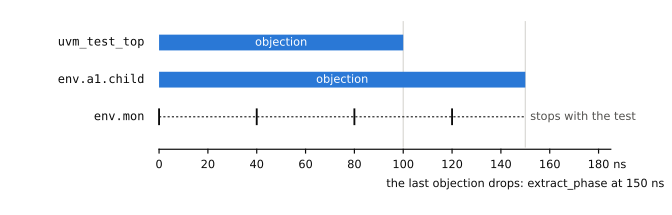
The run phase of SkPhaseTest. When the test dropped its objection at 100 ns, a1.child still held one. The phase ended when that one dropped, at 150 ns, and the remaining phases ran in the same time step. mon’s loop, which had been running the whole time without holding the phase open, printed nothing more, because the test ended at 150 ns.
SkNoObjTest builds the same tree with no component holding an objection. Every run_phase still starts at 0 ns, pyuvm logs a warning, and the phase ends in the same time step:
0    ns  run_phase starts           uvm_test_top
     0.00ns WARNING  root                               You did not call self.raise_objection() in any run_phase
0    ns  extract_phase              uvm_test_top
A new test can pass this way without testing anything. If it starts its sequence in run_phase and forgets to raise an objection, the run ends before the first item reaches the driver, and the only sign of it that pyuvm gives is that warning. Lab 04’s RouterLabTest raises its objection at the start of run_phase, resets the router, runs the test’s body() and drops the objection when body() returns, or sooner if the watchdog below fires or the scoreboard logs its 50th error. The tests built on it override body() and leave run_phase alone, so none of them has to raise an objection itself.
A test that never drops its objection never ends on its own. RouterLabTest runs a watchdog beside body(), and if the test is still running after +MAX_CYCLES clock cycles (200,000 unless you set it), the watchdog logs an error that starts [WATCHDOG], and the test ends. cocotb can also stop a test at a time limit that you set on the decorator. SkHangTest, marked @pyuvm.test(timeout_time=1, timeout_unit="us"), raises an objection and waits 10 µs, and cocotb stopped it at 1,000 ns with the verdict FAIL: SimTimeoutError.
After the run phase
Checks that need the whole run go in the three function phases that follow the run phase, extract_phase, check_phase and report_phase. Lab 04’s scoreboard uses check_phase to log an error for each output that still has beats it expected and never saw, and one more if it checked no beat at all. It uses report_phase to print the [SB] lines you’ll read in every run.
pyuvm reports through Python’s logging, and every component has a logger, self.logger. A logged error prints a line and fails nothing. SkPlainErrorTest derives from pyuvm’s uvm_test and logs one error at 50 ns, and with make run TEST=SkPlainErrorTest BASE_TEST=0 it printed:
    50.00ns ERROR    ..-pyuvm-skeleton/sk_tests.py(184) [uvm_test_top]: a check failed at 50 ns
    50.00ns INFO     cocotb.regression                  sk_tests.SkPlainErrorTest passed
and the verdict ok: passed. The ERROR line has the shape of every message that the labs’ components log: the time, the level, the file and line that logged it, the component’s full name in brackets, and the text. cocotb cuts a long file path to fit its column, which is why the path starts with ...
Every pyuvm test in the labs derives from the course’s BaseTest, which makes a logged error fail the test. In end_of_elaboration_phase it adds a counting handler to the logger of every component in the tree, and in final_phase it prints one line with the count and raises AssertionError if the count isn’t 0. From Lab 05 on, the labs bind assertions into the router, and the same line also gives the number of assertion failures, which fails the test too if it isn’t 0. The example binds no assertions, so its line says no bound assertions. SkErrorTest logs the same error and derives from BaseTest:
    50.00ns ERROR    ..-pyuvm-skeleton/sk_tests.py(175) [uvm_test_top]: a check failed at 50 ns
DD105-B BaseTest: 1 error logged, no bound assertions
and the verdict was FAIL: 1 error, with AssertionError: 1 error logged, the first: a check failed at 50 ns under it. The graders count that AssertionError as a check that fired. They also call a test BROKEN if it passes without BaseTest’s line, as make run TEST=SkPlainErrorTest without BASE_TEST=0 did (BROKEN: no BaseTest line), because a logged error in such a test would have failed nothing.
final_phase runs from the top down, so the test’s final_phase runs before its children’s. In SkPhaseTest the DD105-B BaseTest: line came straight after the final_phase line for uvm_test_top and before the one for env. An error that a component below the test logs in its own final_phase therefore comes after BaseTest has printed its count and decided whether to raise AssertionError. SkFinalErrorTest has a component that does that, and the run printed DD105-B BaseTest: 0 errors logged before the error and ended ok: 0 errors. So put your checks in check_phase or report_phase.
Check yourself
In Lab 04,
RouterEnv.build_phasemakes the agents and the scoreboard. Why can’t it connectself.src.mon.apto the scoreboard there, straight after making them?TipAnswersrc.mondoesn’t exist yet.SrcAgent.build_phasemakes the monitor, and pyuvm calls it only afterRouterEnv.build_phasehas returned, because the build phase goes from the top down. The scoreboard’s inputs are made in its ownbuild_phasetoo. Byconnect_phase, every component in the tree has been built.A test’s
run_phasestarts a sequence of 200 packets and doesn’t raise an objection. What happens, and which of Lab 04’s checks would notice?TipAnswerThe run phase ends at 0 ns, as
SkNoObjTest’s did, before any packet reaches the pins, and pyuvm logs only a warning. Lab 04’s scoreboard expected nothing and saw nothing, so it finds no leftover beats, but itscheck_phasealso logs an error when it checked no beat at all, andBaseTestfails the test on it.A scoreboard compares its counts in
final_phaseand logs an error when they disagree. The run logs the error and passes, asSkFinalErrorTestdid. Why?TipAnswerfinal_phaseruns from the top down, soBaseTest’sfinal_phaseinuvm_test_tophad already counted the errors, printed its line and returned before the scoreboard’sfinal_phaseran. Move the comparison tocheck_phaseorreport_phase.
Further reading
- pyuvm’s documentation walks through a whole testbench for a small ALU, from its tests to its monitor and driver, and UVM and Python explains what pyuvm changes from SystemVerilog UVM. The pages are for pyuvm’s latest release, which is newer than the course’s 4.0.1. The SV-UVM-style reporting they describe, which
set_sv_uvm_style_reporting_enabled()turns on, isn’t in 4.0.1. - pyuvm’s phases are in its source,
s09_phasing.pyat 4.0.1, and each phase class says whether it runs from the top down or the bottom up. - ChipVerify’s UVM Phases and UVM Objection describe SystemVerilog UVM. They give its order of phases, with every phase but build and final from the bottom up, and its twelve run-time phases, and neither matches pyuvm 4.0.1. Their objections take the component as an argument,
phase.raise_objection(this), where pyuvm’s are the component’s own methods, and pyuvm has no drain time. - ChipVerify’s UVM Component and UVM Object describe the two kinds of class, in SystemVerilog UVM.