Lab 06: The register block
In this lab you’ll give the Lab 05 testbench a register model built on pyuvm’s register classes. You write the fields of STATUS, DROP_CNT, LEVEL and the four ROUTE registers, and the adapter that turns a register operation into an APB transfer. You also write a reset sequence, a predictor and a bit-bash sequence. SystemVerilog UVM’s library has all three ready to use, but pyuvm 4.0.1 doesn’t have them. The reset sequence reads each register that the router doesn’t change on its own and compares it with its reset value. The predictor keeps the model’s copy of the registers in step with every transfer on the bus, and the bit bash writes each bit both ways and reads it back, except the bits that the router changes on its own. After that you test the 246 addresses that the model can’t reach, and make the scoreboard check irq against STATUS and INT_EN in every cycle. The Lab 05 testbench misses all five of this lab’s planted bugs (B01, B02, B03, B04 and B14), and with your additions it catches all five by the end of Part 5.
Package: labs/lab-06-the-register-block/
Before you start
- Finish Lab 05.
- Read Register models in pyuvm and Regressions and seeds.
- Keep the router specification open at its Register map, APB, STATUS, INT_EN and Reset sections.
The package is the Lab 05 testbench with our solution to Lab 05 in it: the three assertions, the sink driver’s countdown and RouterLab05Vseq.body(). If your own Lab 05 printed 3 of 3 caught., your code did the same job, but use ours anyway, because this lab adds to the same files. What we added for you:
| File | What Lab 06 adds |
|---|---|
tb/router_ral.py |
the register model, the adapter, the predictor and the two register sequences; seven registers’ fields, the adapter and the reset sequence are yours (Part 2), and so are the predictor and the bit-bash sequence (Part 3) |
tb/router_agents.py |
SysMonitor, which reports rst_n and irq every cycle |
tb/router_env.py |
the environment makes the register model, the adapter and the predictor, and you connect the predictor (Part 3); the scoreboard models STATUS and INT_EN, checks STATUS reads, PSLVERR and reads of bad addresses, and has an irq check for you to write (Part 5); its Lab 05 error no beat was checked is now nothing was checked, and it fires only in a test that also reads no register |
tb/router_vseq.py |
helpers that go through the model (wr_reg, rd_reg, check_reg, rd_all_regs), and RouterLab06Vseq, with one TODO for each of Parts 2, 4 and 5 and two for Part 3 |
tb/test_router.py |
RouterTest runs RouterLab06Vseq first, then everything Lab 05’s RouterTest ran; RouterLab06Test runs the sequence alone |
src/predict.py |
make predict, which shows what predict() does to your model (Part 3) |
Time: about 2 h 15 min. Every file you change is Python, so after the build in Part 1 nothing you change rebuilds the simulator. A run of RouterTest takes about 8 s, and make check-all, which runs it six times, about 45 s.
Part 1: The Lab 05 testbench against the registers
What does your Lab 05 testbench check about the registers?
Open a terminal on the workbench desktop, as in Lab 05, go to the lab folder, and build the simulator:
. /foss/designs/common/.designinit   # in every new terminal
mod dd105-b
cd labs/lab-06-the-register-block
make build
It ends with:
 built /foss/designs/modules/dd105-b/labs/lab-06-the-register-block/build/sim_build/Vtop in 2.4 s (2.1M in /foss/designs/modules/dd105-b/labs/lab-06-the-register-block/build/sim_build)
 ccache:  Hits: 41 / 56 (73.21%)  Misses: 15 / 56 (26.79%)
========================================================================
 /foss/designs/modules/dd105-b/labs/lab-06-the-register-block/build/sim_build/Vtop is up to date.
Our counts include the builds of Labs 01 to 05 and the rebuild in Lab 05’s Part 2. Those builds came to 35 hits and 14 misses, so this build’s own were 6 hits and 1 miss.
Run the graded test,
RouterTest, and pull the scoreboard’s summary out of the log:make run grep -o '\[SB\] [0-9a-z].*' build/runs/RouterTest-s1/run.logYou should see
ok: 0 errors, 0 assertions 8.61 sfrommake run, and fromgrep:[SB] 1123 packets in: 282 to output 0, 286 to output 1, 179 NOROUTE, 376 FULL; the highest level a header saw was 16 [SB] beats checked: 1283 on output 0, 1254 on output 1; 6 DROP_CNT reads checked [SB] registers: 6 reads, 0 of STATUS checked; 0 transfers to bad addresses; irq checked in 0 cycles, wrong in 0The third line is new in this lab. The six reads are
RouterInjectTest’s fiveDROP_CNTreads and the one at the end of your Lab 05 sequence. Nothing checksirqyet, so the line says it was checked in 0 cycles.The first two lines are the ones
RouterTestprinted at the end of Lab 05 (Part 4, step 6), number for number.RouterTestnow makesRouterLab06Vseqand starts it before anything else, and every packet comes from Python’srandom, one draw after another, so a single extra draw would change every packet after it. Why didn’t the new sequence change any?TipAnswerRouterLab06Vseqdoes nothing yet, and making and starting a pyuvm sequence draws nothing fromrandom. The other things this lab added (the sys monitor, the scoreboard’s model ofSTATUSandINT_EN, the register model and the predictor) don’t callrandomat all. We also ran our finishedRouterTestwithRouterLab06Vseqleft out, on seeds 1 to 5, and it printed Lab 05’s lines every time. Part 5 comes back to this, at the step where the numbers change.make check-allrunsRouterTeston the golden router and on this lab’s five bugs. Write down how many you expect the starter to catch, then run it:make check-allYou should see:
      ok  the golden design                        0 errors, 0 assertions          7.2s
------------------------------------------------------------------------
  MISSED  tier 1  B01_status_write_clears_all      0 errors, 0 assertions          7.2s
  MISSED  tier 1  B02_irq_ignores_int_en           0 errors, 0 assertions          7.2s
  MISSED  tier 1  B03_route3_readback_swapped      0 errors, 0 assertions          7.2s
  MISSED  tier 1  B04_misaligned_address_accepted  0 errors, 0 assertions          7.3s
  MISSED  tier 6  B14_enable_resets_to_one         0 errors, 0 assertions          7.2s
------------------------------------------------------------------------
 0 of 5 caught.
followed by each bug’s “hides behind” hint.
make check, which grades the first bug in the list, saysVERDICT: FAIL -- your test passes B01_status_write_clears_all too.B14 makes
CTRL.ENreset to 1 instead of 0. Why doesn’t your testbench see it?TipAnswerA wrong reset value shows only between the reset and the first write to the register. In that window a read of
CTRLwould return 1, and a packet offered then would be taken, althoughin_readyshould stay 0 after reset until software setsCTRL.EN. Lab 04’s steps writeCTRLbefore the first packet and never read it, and the scoreboard wouldn’t check a read ofCTRLanyway, because the only register reads it checks are those ofDROP_CNTandSTATUS. Nothing checks thatin_readystays 0 untilCTRL.ENis set. B02 hides because nothing checksirqyet, as the third[SB]line says.
Check: 0 of 5 caught., and irq checked in 0 cycles.
Part 2: The register model
What does a register model need to know about each register, and what does a reset sequence do with it?
Open
tb/router_ral.pyand readIdReg,CtrlReg,IntEnRegandRouterRegs. Each register is auvm_regsubclass whosebuild()makes its fields and configures each one withfield.configure(parent, size, lsb_pos, access, is_volatile, reset)that is, its width, its lowest bit, its access policy (
"RO","RW","W1C","WC"and so on), whether the router changes it on its own (volatile), and its reset value.RouterRegsconfigures each register at its address and adds it to the map. pyuvm keys the map by the address as Python’shex()writes it,"0x8", so the addresses are given ashex(addr). The specification’s Register map gives each field’s policy and volatility, and Configuring a field, on the pyuvm register API page, gives the meaning of each argument and shows what pyuvm does with a field that’s configured wrongly.The graders build the model on its own, outside the simulator, before every verdict. Run that build yourself:
make regcheckYou should see:
 REGCHECK  tb/router_ral.py:RouterRegs
     0x0  ID         ID[31:0] RO
     0x4  CTRL       EN[0:0] RW
     0x8  STATUS
     0xc  INT_EN     NOROUTE[0:0] RW, FULL[1:1] RW, OVERSIZE[2:2] RW
    0x10  DROP_CNT
    0x14  LEVEL
    0x20  ROUTE0
    0x24  ROUTE1
    0x28  ROUTE2
    0x2c  ROUTE3
   the model builds: 10 registers
The seven registers with no fields listed are the ones you finish in the next step.
Write
build()forStatusReg,DropCntReg,LevelRegandRouteReg, as theirTODOs describe; the fourROUTEregisters are all made fromRouteReg. pyuvm checks each field against the one configured just before it, so configure them from bit 0 up. Then runmake regcheckagain. You should see every register with its fields:0x8 STATUS NOROUTE[0:0] W1C, FULL[1:1] W1C, OVERSIZE[2:2] W1C 0xc INT_EN NOROUTE[0:0] RW, FULL[1:1] RW, OVERSIZE[2:2] RW 0x10 DROP_CNT NOROUTE_CNT[7:0] WC, FULL_CNT[15:8] WC 0x14 LEVEL LEVEL0[4:0] RO, LEVEL1[12:8] RO 0x20 ROUTE0 EN[0:0] RW, PORT[1:1] RWwith
ROUTE1toROUTE3likeROUTE0. When we configuredSTATUS’s fields from bit 2 down,make regcheckprinted this instead, spaces and all:the model doesn't build: AssertionError: STATUS -- _add_field: Fields FULL overlap with field OVERSIZEand
make checkstopped withVERDICT: FAIL -- the register model doesn't build, so nothing was graded.In a test, thatAssertionErrorwould have looked like a check that fired, which is why the graders build the model first.Write the adapter’s two methods,
ApbRegAdapter.reg2bus()andbus2reg(). The map callsreg2bus()with each register operation and starts theApbItemit returns on the APB sequencer. When the driver has finished the transfer, the map callsbus2reg()with the same item, and the statusbus2reg()puts inrw.statusis what the register’sread()orwrite()returns. Give a transfer that ended withPSLVERRthe statusuvm_resp_t.ERROR_RESP. pyuvm passes the address as the string the register was configured with, soreg2bus()turns it back into a number withint(rw.addr, 16).Write
RegResetSeq.body(). It puts the mirror (the model’s copy of each register) at the reset values. Then it reads each register that has at least one field that isn’t volatile, and compares the value read with the register’s reset value outside its volatile fields.reset_value(reg)andvolatile_mask(reg), above the adapter, compute the reset value and the bits of the volatile fields for you. Then write the Part 2 step ofRouterLab06Vseqintb/router_vseq.py. That step starts the sequence, and itsTODOgives the line.Write down which of the ten registers you expect your sequence to read. Then run the test and look at the line the sequence logs when it ends:
make run
grep -o '\[RegResetSeq\].*' build/runs/RouterTest-s1/run.log
You should see
okand:[RegResetSeq] 0 writes and 7 reads of 7 registers (ID, CTRL, INT_EN, ROUTE0, ROUTE1, ROUTE2, ROUTE3); 0 mismatchesRight after the reset,
STATUS,DROP_CNTandLEVELhold their reset values too. Why does the sequence leave them out?TipAnswerEvery field in those three is volatile, because the router changes it without any write. The router sets a
STATUSbit on a drop or an oversize packet, counts drops inDROP_CNT, and changesLEVELwith every beat. A register model doesn’t compare a volatile field, because the design may have changed it since the model last looked, and a reset sequence skips a register in which nothing would be compared. SystemVerilog UVM’s built-in reset sequence skips the same three. If your sequence read more than seven registers, one of your fields in those three isn’t marked volatile.Run
make check-all. B14’s row becomescaught tier 6 B14_enable_resets_to_one 1 error, 0 assertions 7.2sand the other four stay
MISSED, for1 of 5 caught.The error is your reset sequence’s:grep ERROR build/grade/B14/run.log | grep -o '\[uvm_test_top[^]]*\]: .*'[uvm_test_top.env]: [RegResetSeq] CTRL reads 0x1 after reset; its reset value is 0x0(Your message may be worded differently; that one is ours.)
RouterTestrunsRouterLab06Vseqbefore Lab 04’s steps. What would the reset sequence report on the golden router if it ran after them?TipAnswerIt would report errors although the router is right. The sequence puts the mirror at the reset values and compares every read with them, but the router is reset only once, at time 0, and Lab 04’s steps leave
CTRL.ENat 1 and some of the routes set. When we ran it afterRouterInjectTest’s steps, whose last routing table is0---, it reportedCTRLandROUTE0, both reading0x1. A reset sequence has to run while the registers still hold their reset values, which in this testbench means first.
Check: B14 is caught, and the other four are MISSED.
Part 3: The predictor and the bit bash
How does the register model keep its mirror in step with the router, and what does a bit-bash sequence test?
A predictor updates the mirror by calling a register’s
predict()with the value a transfer wrote or read, and the kind of prediction says what to do with that value:UVM_PREDICT_WRITE(it was written, so each field takes what its policy gives it),UVM_PREDICT_READ(it was read) orUVM_PREDICT_DIRECT(take it as it is).make predictbuilds your model and callspredict()on four of its registers. Readsrc/predict.py, write down what the mirror ofSTATUSshould hold after each of its four calls, then run it:make predictYou should see:
STATUS (W1C), after the reset: 0x0
  then predict(0x7, UVM_PREDICT_DIRECT)     0x7
  then predict(0x1, UVM_PREDICT_WRITE)      0x6
  then predict(0x6, UVM_PREDICT_READ)       0x0
  then predict(0x6, UVM_PREDICT_DIRECT)     0x6
DROP_CNT (WC), after the reset: 0x0
  then predict(0x302, UVM_PREDICT_DIRECT)   0x302
  then predict(0x5, UVM_PREDICT_WRITE)      0x0
  then predict(0x302, UVM_PREDICT_DIRECT)   0x302
  then predict(0x302, UVM_PREDICT_READ)     0x0
CTRL (RW), after the reset: 0x0
  then predict(0x1, UVM_PREDICT_WRITE)      0x1
  then predict(0x1, UVM_PREDICT_READ)       0x1
ID (RO), after the reset: 0xd1050001
  then predict(0x1234, UVM_PREDICT_WRITE)   0xd1050001
A write of
0x1toSTATUSclears only bit 0, any write clearsDROP_CNT, andIDignores a write. Your predictor will callpredict()after every read it sees. Which kind should it use?TipAnswerUVM_PREDICT_DIRECT. After a read of0x6,UVM_PREDICT_READleft the mirror ofSTATUSat 0, and after a read of0x302it leftDROP_CNT’s at 0, although the registers held the values that were read. In pyuvm 4.0.1, a read prediction puts a field whose policy isW1CorWC, or one of twelve other policies, back at its reset value instead of the value read; anRWorROfield keeps the value read.UVM_PREDICT_DIRECTtakes the value read for every policy. No check in this testbench would notice the difference, because theW1CandWCfields here are all volatile, and the mirror is never compared in a volatile field. WithUVM_PREDICT_READour solution still passed the golden router and still caught all five bugs. Code that uses the mirror ofSTATUS, for example to clear exactly the bits it last read, would go wrong.Lab 04’s steps and your Lab 05 sequence set up the router with raw transfers, which go around the model, and
route()andctrl()inRouterBaseVseqsend raw transfers too. Write the second Part 3TODOofRouterLab06Vseq, “the router set up around the model”: the five raw writes it lists, thencheck_reg()onCTRLand the fourROUTEregisters.check_reg()reads a register through the model and compares the value read with what the mirror held before the read, as SystemVerilog UVM’smirror()does when it’s told to check. Leave the first Part 3TODO, the bit bash, for step 4.The predictor isn’t written yet. Predict what
RouterTestdoes on the golden router, then run it:make run grep ERROR build/runs/RouterTest-s1/run.log | grep -o '\[uvm_test_top[^]]*\]: .*'You should see
FAIL: 5 errors, 0 assertions 7.15 sfrommake run, and fromgrep:[uvm_test_top.env]: [VSEQ] check_reg: CTRL read 0x1; the mirror held 0x0 [uvm_test_top.env]: [VSEQ] check_reg: ROUTE0 read 0x1; the mirror held 0x0 [uvm_test_top.env]: [VSEQ] check_reg: ROUTE1 read 0x3; the mirror held 0x0 [uvm_test_top.env]: [VSEQ] check_reg: ROUTE2 read 0x2; the mirror held 0x0 [uvm_test_top.env]: [VSEQ] check_reg: ROUTE3 read 0x3; the mirror held 0x0The test fails on the golden router. Which side is wrong, and would writing the five registers through the model, with
wr_reg(), fix it?TipAnswerThe mirror is wrong, and the router returned what was written. The mirror changes only when something calls
predict(), and so far no code in the testbench calls it. The raw writes went around the model, and pyuvm doesn’t predict after the model’s own operations either, because its auto-predict is off. We wrote the five registers withwr_reg()instead, and the same five errors came back. The testbench needs a predictor that updates the mirror from every transfer on the bus, whoever started it.Write the predictor,
RouterRegPredictor.write()intb/router_ral.py. The APB monitor calls it with every transfer it sees complete. Skip a transfer that ended withPSLVERR, or to an address with no register. Predict a write withUVM_PREDICT_WRITE. For a read, first compare the value read with the mirror outside the volatile fields, report a mismatch withself.logger.error(), and then predict the value read with the kind you chose in step 1. Count the reads, writes and mismatches as theTODOsays, for the[RAL]line. Then write the Part 3TODOinRouterEnv.connect_phase()intb/router_env.py: give the predictor the model, and connect the APB monitor’s analysis port to it, the way the coverage is connected earlier in the same method. Run the test again:make run grep -o '\[RAL\].*' build/runs/RouterTest-s1/run.logYou should see
ok: 0 errors, 0 assertions 7.17 s, and:[RAL] 18 register reads checked against the mirror, 39 writes predicted; 0 mismatchesThe 18 reads are the reset sequence’s 7, your 5
check_reg()reads and the 6 reads ofDROP_CNTfrom Labs 04 and 05.Write
RegBitBashSeq.body()intb/router_ral.py. For every bit that isn’t in a volatile field, it does the same thing twice: it writes the register with that bit flipped from the mirror, takes the mirror, reads the register back, and compares the value read with the mirror it took. It has to take the mirror before the read, because once the read completes your predictor puts the value read in the mirror, and a sequence that compared with it then would be comparing the value read with itself. Then write the first Part 3TODOofRouterLab06Vseq. It runs the bit bash, before the raw writes of step 2. Run the test and look at the lines of the two sequences and the predictor:make run grep -o '\[\(RAL\|RegResetSeq\|RegBitBashSeq\)\].*' build/runs/RouterTest-s1/run.logYou should see
okand:[RegResetSeq] 0 writes and 7 reads of 7 registers (ID, CTRL, INT_EN, ROUTE0, ROUTE1, ROUTE2, ROUTE3); 0 mismatches [RegBitBashSeq] 582 writes and 582 reads of 10 registers (ID, CTRL, STATUS, INT_EN, DROP_CNT, LEVEL, ROUTE0, ROUTE1, ROUTE2, ROUTE3); 0 mismatches [RAL] 600 register reads checked against the mirror, 621 writes predicted; 0 mismatchesEvery field of
STATUSis volatile, and the bit bash skips the bits of volatile fields. What does it test inSTATUS?TipAnswerBits 3 to 31, which belong to no field. A bit with no field is read-only and reads 0, and the mirror has 0 there, so both writes write a 1 to the bit, and each read must still return 0 there. That way the bit bash tests the reserved bits of every register that has them. In
STATUS,DROP_CNTandLEVELit tests only the reserved bits, with two writes and two reads for each: 29 bits ofSTATUS, 16 ofDROP_CNTand 22 ofLEVEL. With all 32 bits ofID,CTRL,INT_ENand eachROUTEregister, that is 291 bits and 582 writes.Run
make check-all. You should seecaughton B03 (4 errors) and B14 (2), and the other threeMISSED, for2 of 5 caught.B14 has one error more than in Part 2, because your predictor now checks the reset sequence’s read ofCTRLas well. Look at B03’s errors:grep ERROR build/grade/B03/run.log | grep -o '\[uvm_test_top[^]]*\]: .*'[uvm_test_top.env.predictor]: [RAL] ROUTE3 read 0x2 in cycle 3663; the mirror holds 0x1 [uvm_test_top.env]: [RegBitBashSeq] writing a 1 to bit 0 of ROUTE3 (was 0x0) read back 0x2, not 0x1 [uvm_test_top.env.predictor]: [RAL] ROUTE3 read 0x2 in cycle 3677; the mirror holds 0x1 [uvm_test_top.env]: [RegBitBashSeq] writing a 0 to bit 1 of ROUTE3 (was 0x3) read back 0x2, not 0x1When we took the mirror after the read instead, our bit bash reported nothing on B03, and only the predictor’s two errors caught it. Where did the 1 written to
ENcome back, and why did your Lab 05 testbench never notice B03?TipAnswerIt came back in bit 1,
PORT, because B03 swapsROUTE3’s two fields when it’s read. The route itself works, because B03 is in the read path only, so every packet still went whereROUTE3sent it. Lab 04’s steps and your Lab 05 sequence never read aROUTEregister, so no read ever came back with the fields swapped. Thecheck_reg()you wrote in step 2 readsROUTE3afterroute(3, 1, 1), and0x3swapped is still0x3. The bit bash reads the register back after every write, and each write changes one bit, so the two fields hold different values at some point.
Check: B03 and B14 are caught, and B01, B02 and B04 are MISSED.
Part 4: The addresses outside the map
Which addresses can the register model never test?
The APB address has 8 bits, so there are 256 addresses, and the map has a register at ten of them. A transfer to any of the other 246 completes with
PSLVERR; a bad read returns 0 and a bad write changes nothing. The model can’t send a transfer to an address it has no register for, so you have to reach these with raw transfers. Write the Part 4 step ofRouterLab06Vseq: read every bad address withrd(a), write each withwr(a, 0xFFFF_FFFF), then read every register withrd_all_regs().good_addr(a)is true for the ten good addresses. The scoreboard already checksPSLVERRon every transfer and the data of every bad read.Write down what the golden router should return for a read of
0x01, and whatpslverrshould be. Then runmake check-all, and look at the scoreboard’s summary in the golden run, whose logmake check-allkeeps inbuild/grade/golden/:make check-all grep -o '\[SB\] [0-9a-z].*' build/grade/golden/run.logYou should see B04
caughtwith50 errors(the run stops at 50) and3 of 5 caught., and the last of the three[SB]lines should be:[SB] registers: 856 reads, 59 of STATUS checked; 492 transfers to bad addresses; irq checked in 0 cycles, wrong in 0Look at B04’s first two errors:
grep ERROR build/grade/B04/run.log | grep -o '\[uvm_test_top[^]]*\]: .*' | head -2[uvm_test_top.env.sb]: a read of 01, completing in cycle 4143: pslverr is 0, but 01 is a bad address [uvm_test_top.env.sb]: a read of 01, completing in cycle 4143 returned d1050001; a read of a bad address returns 0d1050001isID’s value. Why did a read of0x01return it?TipAnswerThe registers are 4 bytes apart, so the router finds the register from
paddr[7:2], and for0x01that’s 0, the word whereIDlives. The router calls an address bad if no register is at its word or ifpaddr[1:0]isn’t00. B04 drops the second test, so a misaligned address reaches the register below it, for reads and writes alike.To see these reads in a waveform, record
RouterLab06Test, which runs your sequence alone, on the golden router and on B04. It runs cycle for cycle like the first part ofRouterTest, so the read of01completes in cycle 4143 there too:make waves TEST=RouterLab06Test make waves TEST=RouterLab06Test BUG=B04 surfer build/runs/RouterLab06Test-s1-B04/waves.fst &Add
clk,psel,penable,pwrite,paddr,pready,pslverrandprdatafromrouter, andbad_addrfromrouter.u_regs, and look at 41340 to 41520 ns. Cycle \(n\) ends at the rising edge at \(10n\) ns, so the read of01takes cycles 4141 to 4143, from 41400 to 41430 ns. The first error in the B04 run’s log is printed at 41425 ns, the falling edge of cycle 4143, where the APB monitor sees the read complete.
Reads of 2c, 01, 02 and 03 on the golden router, in Surfer The golden router, 41340 to 41520 ns. The read of
2cis thecheck_reg()ofROUTE3from Part 3, and it returns00000003.bad_addrrises withpaddrat01.pslverris 1 in the last cycle of each of the reads of01,02and03, and each of those reads returns 0.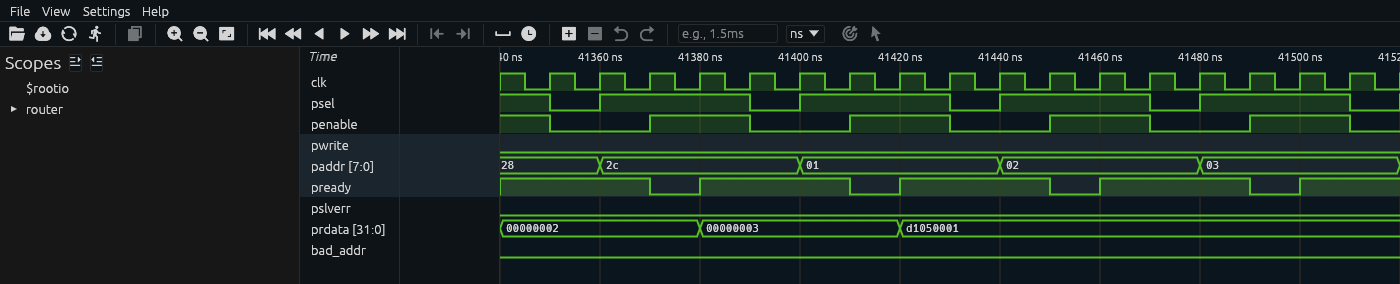
The same reads with B04 switched on, in Surfer With B04,
bad_addrstays 0,pslverrnever rises, andprdataisd1050001for the reads of01,02and03.How many cycles does each read take, and in which of them does the router decide what
prdatawill be?TipAnswerEach read takes three cycles: a setup cycle (
psel1,penable0), a first access cycle withpready0, and a second withpready1, in which the read completes. The router copies the register intoprdataat the edge that ends the first access cycle (rule A8), soprdatachanges in the middle of each read, at 41420 ns for the read of01.pslverris 1 only in the cycle in which a bad transfer completes (rule A7). The idle cycle withpsel0 between reads comes from the APB driver, which waits for a rising edge before it starts each transfer.
Check: B03, B04 and B14 are caught, and B01 and B02 are MISSED.
Part 5: The interrupt
Does irq follow STATUS and INT_EN in every cycle?
The specification’s INT_EN section defines
irqas the OR, over the three bits, ofSTATUS[i] & INT_EN[i], with no delay. The scoreboard already models both registers cycle by cycle. Each drop, oversize packet, or write toSTATUSorINT_ENwaits inchangesuntiladvance()reaches the cycle in which it takes effect, as route writes waited inpendingin Lab 05.irq()combines the two registers into the value thatirqshould have. Write the two Part 5TODOs inRouterScoreboard.write_sys(), which the sys monitor calls every cycle: in a reset cycleirqmust be 0, and in every other cycle it must equalirq().You haven’t written any stimulus for
irqyet. Write down which of B01 and B02 the check will catch with the stimulus you already have, then runmake check-alland look at B02’s error:make check-all grep ERROR build/grade/B02/run.log | grep -o '\[uvm_test_top[^]]*\]: .*'You should see
4 of 5 caught., with B01 stillMISSEDand B02 caught by one error. You chose the wording of your message; in ours it is:[uvm_test_top.env.sb]: irq is 1 from cycle 5927, but STATUS = 001 and INT_EN = 000 make it 0In the golden run, the scoreboard’s summary (the
grepin Part 4, step 2) now saysirq checked in 13632 cycles, wrong in 0. Why does B02 show up in Lab 04’s traffic, and why does B01 still hide?TipAnswerYour
RouterLab06Vseqsends no packets yet, so the drop that setSTATUS.NOROUTEwas in Lab 04’s traffic. Every phase ofRouterInjectTestdisables a route and sends packets to it (inRouterTest’s first phase the routing table is--01).INT_ENstays 0 all through that traffic, because Lab 04’s steps and your Lab 05 sequence never write it, and the bit bash leaves each of its bits the way it found it. Soirqmust stay 0, but B02, which ignoresINT_EN, raises it at the first NOROUTE drop. Nothing after that drop clearsSTATUS, soirqstays wrong and the check reports it once. B01 shows only when something writesSTATUSwhile a bit that the write shouldn’t clear is set. The only writes toSTATUSso far are the bit bash’s, right after the reset, when every bit is 0.Write the Part 5 step of
RouterLab06Vseq:- disable
DST1 withroute(1, 0, 0)and make both sinks fast withsink(p, SNK_FAST); - with
INT_ENstill 0, set all threeSTATUSbits, sending the packets withburst(): one 1-beat packet toDST1, which is a NOROUTE drop, and one 9-beat packet toDST0, which is OVERSIZE; thendrain(), stall output 0 withstall(0), and send ten 1-beat packets toDST0, the last of which is dropped as FULL; - read
STATUS; - turn each
INT_ENbit on by itself, waiting two cycles after each write; - set
INT_ENto0b111, then clear theSTATUSbits one at a time by writing0b001,0b100and0b010, and readSTATUSafter each write; drain(), thenrd_all_regs().
Write
INT_ENandSTATUSwithwr_reg()and read them withrd_reg(). The predictor doesn’t compare a read ofSTATUS, because its fields are volatile, but the scoreboard checks every one.- disable
Run
make check-all. You should see:ok the golden design 0 errors, 0 assertions 8.1s ------------------------------------------------------------------------ caught tier 1 B01_status_write_clears_all 3 errors, 0 assertions 7.9s caught tier 1 B02_irq_ignores_int_en 1 error, 0 assertions 7.9s caught tier 1 B03_route3_readback_swapped 4 errors, 0 assertions 8.0s caught tier 1 B04_misaligned_address_accepted 50 errors, 0 assertions 2.5s caught tier 6 B14_enable_resets_to_one 2 errors, 0 assertions 8.0s ------------------------------------------------------------------------ 5 of 5 caught. Every bug in the list, each one caught by a check that fired.Look at B01’s errors:
grep ERROR build/grade/B01/run.log | grep -o '\[uvm_test_top[^]]*\]: .*'With our wording they are:
[uvm_test_top.env.sb]: irq is 0 from cycle 5955, but STATUS = 110 and INT_EN = 111 make it 1
[uvm_test_top.env.sb]: a read of 08, completing in cycle 5958 returned 00000000; it should return 00000006, STATUS in cycle 5957
[uvm_test_top.env.sb]: a read of 08, completing in cycle 5965 returned 00000000; it should return 00000002, STATUS in cycle 5964
The first write of
0b001clearedNOROUTEand, with B01,FULLandOVERSIZEtoo. B02 is still caught by one error, but the error is nowirq is 1 from cycle 5906, in your own step. Why doesn’t Lab 04’s traffic catch B02 any more?TipAnswerYour step ends with
INT_ENat0b111, and nothing writes it again, so Lab 04’s traffic and your Lab 05 sequence run with every enable on. With every enable on,STATUS & INT_ENisSTATUS, so B02 makes no difference toirq. That is the situation the catalogue means when it says that B02 hides behind “turning on every interrupt enable before looking at irq”. Your step catches B02 earlier, after the NOROUTE drop and whileINT_ENis still 0.Look at the golden run’s summary again:
grep -o '\[SB\] [0-9a-z].*' build/grade/golden/run.logYou should see:
[SB] 1135 packets in: 311 to output 0, 288 to output 1, 177 NOROUTE, 359 FULL; the highest level a header saw was 16
[SB] beats checked: 1423 on output 0, 1285 on output 1; 40 DROP_CNT reads checked
[SB] registers: 870 reads, 64 of STATUS checked; 492 transfers to bad addresses; irq checked in 13918 cycles, wrong in 0
Up to Part 4, the packet and beat counts in the first two lines were Lab 05’s: 1123 packets, 376 of them FULL. The total is now 12 more, which are the 12 packets your step sent. Only one of those 12 was a FULL drop, but there are 359 FULL drops where Lab 05 had 376. Why did Lab 04’s and Lab 05’s packets change now, and not in Parts 2 to 4?
TipAnswerThe 9-beat packet’s 8 payload bytes come from
random, and every packet after them is drawn from a different place in the sequence of random numbers, so the routing tables, the packets and the sinks’ coin flips of Labs 04 and 05 all differ. Parts 2 to 4 drew nothing. With Part 4’s step written, your sequence ran for about 5,900 cycles before Lab 04’s steps began, and every packet after it was still Lab 05’s, so the extra cycles on their own don’t change the packets. We also counted the draws, by savingrandom’s state beforeRouterLab06Vseqand putting it back after the sequence. The sequence had drawn 8 values, and with the state put back, every routing table and random packet after it was Lab 05’s again, as the[PHASE]and[HOLES]lines showed.The register model has a mirror of
INT_ENandSTATUSas well. Why does the scoreboard keep its own copy of both, instead of reading the mirror?TipAnswerThe mirror of
STATUSis out of date most of the time, because the router sets its bits on its own and the model learns their value only when something reads the register. The mirror ofINT_ENchanges at the wrong moment for this check. The predictor updates it when the monitor reports the write, at the falling edge of the cycle in which the write completes, and the router uses the new value from the next cycle. The scoreboard checksirqfor a cycle at that same falling edge, so it would get the old or the newINT_ENdepending on which monitor cocotb ran first. That is the race your Lab 05 scoreboard avoided by stamping route writes with their cycle. To checkirqexactly in every cycle, the scoreboard has to apply each change to the registers in the cycle in which the router applies it, so it keeps its own copy of both.
Check: 5 of 5 caught., and irq checked in 13918 cycles, wrong in 0 in the golden run.
Finishing
You’re done when make check-all prints 5 of 5 caught. with the register fields, the adapter, the reset and bit-bash sequences, the predictor and its connections, the irq check and the RouterLab06Vseq steps you wrote in tb/, and make seeds SEEDS="1 2 3 4 5" prints 5 ok (5 runs).
Questions:
Before this lab, the scoreboard checked one register,
DROP_CNT. What did the register model add, and what did it leave for the scoreboard and for raw transfers?TipAnswerIt added stimulus made from the register description. The reset sequence read every register it could check and caught B14, and the bit bash wrote and read back every bit it could check and caught B03, without a step written for either bug. It also added access by name (
wr_reg(self.regs.INT_EN, ...)), and a mirror that the predictor compares with every read of a field the router doesn’t change on its own. It left raw transfers and the scoreboard to cover the 246 bad addresses (B04), the volatile registers, and what the registers do to the rest of the router, such asirq(B01 and B02). In pyuvm it also left you the predictor and both sequences, which SystemVerilog UVM’s library would have given you.
Submit: Nothing to submit.
Going further (optional)
Run your testbench against every bug in the catalogue:
make check-all BUG_LIST="B01 B02 B03 B04 B05 B06 B07 B08 B09 B10 B11 B12 B13 B14 B15"Our solution catches 14 of the 15, in 88 s. These are the last two rows of its table, with the count under them:
  caught  tier 6  B14_enable_resets_to_one         2 errors, 0 assertions          8.0s
  MISSED  tier 6  B15_output_valid_survives_reset  0 errors, 0 assertions          8.0s
------------------------------------------------------------------------
 14 of 15 caught.
It misses only B15, which hides behind “resetting only at time 0, when every buffer is already empty”. You’ll meet B15 in Lab 07.
Next on the Course path: the reading on verification plans and sign-off and on writing the verification report, then Lab 07: Capstone.