Python classes and cocotb concurrency
This page answers: a testbench has to drive, watch and check all at once, and hand packets from one piece to the next. What do I need to know about Python objects and cocotb tasks before I write a monitor and a scoreboard?
In Lab 02 you’ll write the router’s monitor and scoreboard. They’re plain Python classes, and the testbench they go into has no pyuvm in it. The rest of that testbench comes with the lab: a generator that makes packets, a driver that offers them to the router’s input, a sink for each output, and an environment that makes all of them and runs the test. When the test runs, seven pieces run at the same time and pass packets to each other through three queues. They’re the generator, the driver, the two sinks, the scoreboard, and two monitors made from your class, one on the router’s input and one on output 0. The first half of this page is about the objects those pieces pass around, and the second half is about running the pieces side by side as cocotb tasks.
We ran every example on this page in the course image. The source is in guide-examples/python-classes-and-cocotb-concurrency/, and the section for this page in guide-examples/README.md gives the command behind each output.
Names and objects
The examples use a cut-down version of Lab 02’s Packet, with a serial number added:
class Packet:
    n_made = 0                    # a class attribute: one for the class

    def __init__(self, data=None):
        self.id = Packet.n_made   # instance attributes: one set per object
        Packet.n_made += 1
        self.data = list(data or [])

    def __str__(self):
        return f"pkt {self.id}: " + " ".join(f"{b:02x}" for b in self.data)
Each call of Packet(...) makes a new object and runs __init__ on it. Lab 02’s generator makes a new Packet for every packet it sends, and your monitor will make one for every packet it sees on its stream. A Python variable is a name that refers to an object, and assigning one name to another gives the same object a second name. handles_test does that, and then makes two copies of the packet, one with copy.copy() and one with copy.deepcopy():
a = None
print(f"a is {a}")
a = Packet([0x80, 0x11])
b = a
b.data.append(0x22)
c = copy.copy(a)
c.data.append(0x33)
d = copy.deepcopy(a)
d.data.append(0x44)
It then prints the four packets, four is comparisons and the count in Packet.n_made:
a is None
a: pkt 0: 80 11 22 33
b: pkt 0: 80 11 22 33
c: pkt 0: 80 11 22 33
d: pkt 0: 80 11 22 33 44
a is b: True, a is c: False, a.data is c.data: True, a.data is d.data: False, Packet.n_made: 1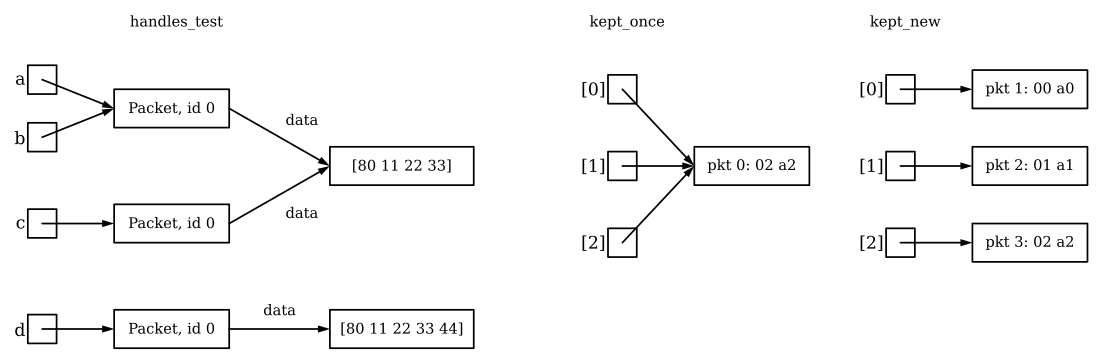
Left, handles_test: a and b name one Packet; c is a second Packet that shares the first one’s list; d is a third Packet, with a list of its own. Right, reuse_test, from the next section: kept_once holds three references to one reused Packet, and kept_new holds three Packets. The values are the ones the tests printed.
b = a didn’t make a packet, so the 22 appended through b shows up when you print a. a is b is True, because is asks whether two names refer to the same object. Two packets made separately are two objects even when their beats match, so is can’t tell you whether two packets carry the same data. That’s why Lab 02’s Packet has a same() method, which compares the beats.
copy.copy(a) made a shallow copy. It made a new Packet and copied each of a’s attributes into it, but where an attribute refers to a list, it copied the reference and not the list. So c.data is a.data, and the 33 appended through c changed a too. copy.deepcopy(a) made a deep copy, which copies the list as well, so the 44 went into d alone. Neither copy ran __init__, so all three packets have id 0 and Packet.n_made is still 1.
You won’t often copy packets in the labs, but you’ll pass references to them all the time. In Lab 02, the Packet that your input monitor builds is the same object that the scoreboard takes out of the queue and, if it’s predicted for output 0, keeps in its list of expected packets. A change made through any of those references shows through all of them.
The same object kept three times
reuse_test has two loops, and each one stands in for a monitor. Each loop builds the same three packets, two bytes each, and keeps them in a list, as Lab 02’s scoreboard keeps the packets it expects. The first loop makes one Packet before it starts and reuses it for every packet, and the second makes a new Packet for each one:
p = Packet()
for k in range(3):
    p.data.clear()
    p.data.append(k)
    p.data.append(0xA0 + k)
    kept_once.append(p)

for k in range(3):
    p = Packet()
    p.data.append(k)
    p.data.append(0xA0 + k)
    kept_new.append(p)
one Packet, reused: [0] pkt 0: 02 a2
one Packet, reused: [1] pkt 0: 02 a2
one Packet, reused: [2] pkt 0: 02 a2
a new Packet each: [0] pkt 1: 00 a0
a new Packet each: [1] pkt 2: 01 a1
a new Packet each: [2] pkt 3: 02 a2kept_once holds three references to one object. That object holds the beats of the last packet, 02 a2, so the list shows them three times, and the first two packets’ beats are gone, cleared by p.data.clear() when the loop reused the object. A queue behaves the same way, because what you put into it is a reference. That’s why the TODO in Lab 02’s monitor.py has you start a new packet when p is None, and set p = None once you’ve put a finished packet into the queue. The next packet then gets an object of its own, and the object that the scoreboard was given keeps the beats it had.
None
If you use an attribute of a name that still refers to None, Python raises an AttributeError, and the test stops there. none_test sets p = None, prints a line, and then appends a beat to p.data:
appending a beat to p
     0.00ns WARNING  cocotb.Test none_test.none_test    'NoneType' object has no attribute 'data'
                                                        Traceback (most recent call last):
                                                          File "/w/guide-examples/python-classes-and-cocotb-concurrency/classes_demo.py", line 78, in none_test
                                                            p.data.append(0x80)
                                                            ^^^^^^
                                                        AttributeError: 'NoneType' object has no attribute 'data'
and the course’s verdict on the run is
BROKEN: AttributeError 0.23 s log: build/runs/none_test-s1/run.logThe traceback names the file and the line where the None was used. The graders mark a run like this BROKEN, because the exception is a mistake in the testbench, and a run counts as catching a bug only when a check fires, such as a failed assert. In Lab 02 you’ll see this error if your monitor appends a beat to p.data before it has made p.
Inheritance and super()
A class can derive from another class, which is then its base class. It inherits the base class’s methods, __init__ among them, and it can override any of them with a version of its own. In Python every method call is looked up on the object’s own class when the call happens, so when a method written in the base class calls another method, the call goes to the derived class’s version if there is one. In dispatch_test, Component has a report() method that calls self.kind(), and Scoreboard derives from Component and overrides kind():
class Component:
    def __init__(self, name):
        self.name = name
        self.n_errors = 0

    def kind(self):
        return "a Component"

    def report(self):
        print(f"report() of Component, on {self.name}: {self.kind()}, {self.n_errors} errors")


class Scoreboard(Component):
    def __init__(self, name):
        super().__init__(name)
        self.expected = []

    def kind(self):
        return "a Scoreboard"
Component("c").report() and Scoreboard("sb").report() both ran Component’s report(), and the call to self.kind() inside it went to each object’s own class:
report() of Component, on c: a Component, 0 errors
report() of Component, on sb: a Scoreboard, 0 errors
pyuvm relies on the same lookup. It calls build_phase() and run_phase() on every component, and when the component is Lab 01’s AluDriver, those calls run the versions written in AluDriver.
Scoreboard.__init__ starts with super().__init__(name), which runs Component’s __init__ and sets name and n_errors. If you leave that line out, Python raises nothing when the object is made. The error comes later, when something first uses an attribute that Component.__init__ would have set. super_test makes a ForgetfulScoreboard. It derives from Component, as Scoreboard does, and its __init__ is Scoreboard’s without the super() line. The test prints the object’s attributes and then calls report():
made a ForgetfulScoreboard; its attributes: ['expected']
     0.00ns WARNING  cocotb.Test super_test.super_test  'ForgetfulScoreboard' object has no attribute 'name'
The traceback in the log points at the print in report(), not at the constructor that left the attribute out. The same rule applies in pyuvm to any method you override when the base class’s version does work of its own. RouterBaseTest.build_phase() puts the router in ConfigDB, and BaseTest.final_phase() prints the closing line that the graders look for and fails the test if any component logged an error, so a test that overrides either one has to call the base version through super().
Class attributes
An attribute assigned in the class body belongs to the class, so every object shares it. Packet.n_made is a class attribute on purpose, because it counts the packets made from the class. A list made in the class body is shared the same way, which is almost never what you meant. class_attr_test uses two classes. Sink has beats = [] in its class body, and OwnSink sets self.beats = [] in __init__. The test makes two sinks, out0 and out1, from each class, appends 0x11 to out0’s list and 0x22 to out1’s, and prints both lists:
Sink: out0 took ['0x11', '0x22'], out1 took ['0x11', '0x22']
OwnSink: out0 took ['0x11'], out1 took ['0x22']
Lab 02’s classes make every list and counter in __init__, and yours should too.
Tasks
A coroutine is an async def function, and await coro() runs it inside your own task until it returns. To run a coroutine alongside your own code instead, you pass coro() to cocotb.start_soon(), which wraps it in a task and returns the Task object. start_soon() returns straight away, and the task first runs when the code that started it reaches its next await. You can wait for a task later, or never.
start_test starts three tasks, A, B and C, which finish 10, 20 and 30 ns after they start, and it does this three times. The first time it waits for all three with await Combine(a, b, c), the second time it waits for the first one to finish with await First(a, b, c), and the third time it waits for none of them:
  0 ns: start A, B and C, and await Combine(a, b, c)
 10 ns:   A finished
 20 ns:   B finished
 30 ns:   C finished
 30 ns: the test goes on after Combine
 30 ns: start A, B and C, and await First(a, b, c)
 40 ns:   A finished
 40 ns: the test goes on after First
 50 ns:   B finished
 60 ns:   C finished
 60 ns: Combine returns
 60 ns: start A, B and C, and await none of them
 60 ns: the test goes on at once
 70 ns:   A finished
 80 ns:   B finished
90 ns: C finishedCombinewaits for every task, so the test went on at 30 ns, when the slowest one finished.Firstwaits for the first task to finish, so the test went on at 40 ns, when A finished.Firstleaves the other two running, and B and C finished at 50 and 60 ns. The test then waited for them withCombinebefore it went on.- When the test waited for none of them, it went on at once, at 60 ns, and the three tasks ran beside it.
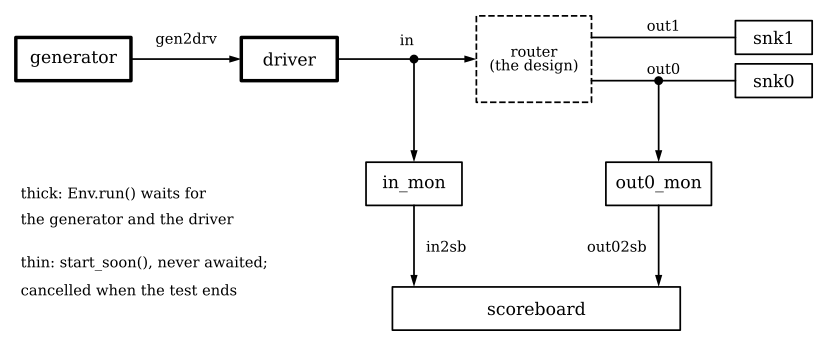
From Lab 02’s env.py. Each solid box is an object whose run() method runs as a task, except the driver, whose run() runs inside the test’s own task. The dashed box is the router. The arrows labelled gen2drv, in2sb and out02sb are the three queues, and in, out0 and out1 are the router’s streams.
Lab 02’s Env.run() starts the two sinks, the two monitors and the scoreboard with cocotb.start_soon() and never waits for them, because none of their run() methods ever returns. Each sink, and each monitor once you’ve written it, runs a while True loop, and the scoreboard’s run() waits for two such loops, which it starts as two more tasks. Env.run() starts the generator with cocotb.start_soon() too, and then runs the driver itself, with await self.drv.run(self.cfg.n), so the driver and the generator work at the same time. When the driver has sent every packet, await gen waits for the generator’s task, which by then has finished. Then the environment waits 50 cycles for the outputs to drain and calls the scoreboard’s report(), while the sinks, the monitors and the scoreboard are still running.
Tasks started in a loop
capture_test starts three tasks in a loop, and then three more in a second loop. In the first loop each task is a coroutine defined inside the loop, which reads the loop variable i. In the second, each task is a coroutine that is given i as an argument:
for i in range(3):
    async def show():
        say(f"  i = {i}")
    cocotb.start_soon(show())
...
for i in range(3):
    cocotb.start_soon(show_arg(i))
0 ns: three tasks, each a closure that reads i
0 ns: the loop has finished
0 ns: i = 2
0 ns: i = 2
0 ns: i = 2
5 ns: three tasks, each given i as an argument
5 ns: the loop has finished
5 ns: j = 0
5 ns: j = 1
5 ns: j = 2None of the six tasks ran before its loop had finished. The first three read i when they ran, by which time the loop had left it at 2. A function defined inside another one reads the outer function’s variables when it runs, not when it’s defined. The second three were each given the value of i at the moment show_arg(i) was called, so they printed 0, 1 and 2. Give a task what it needs as arguments. Lab 02’s environment starts its tasks in a loop too, with cocotb.start_soon(piece.run()), and that’s safe, because piece.run() is called inside the loop, while piece still names that pass’s object, and the coroutine it returns keeps that object as its self.
Queues
A cocotb.queue.Queue carries values from tasks that put() them to tasks that get() them, in the order they were put. await q.get() waits while the queue is empty, and if you gave the queue a maxsize, await q.put() waits while it’s full. queue_test has a generator that makes four items as fast as it can, and a driver that spends 10 ns on each item. It runs them twice, first with an unbounded queue between them and then with a queue that has room for one item:
  0 ns: Queue(maxsize=0)
  0 ns: gen put 0
  0 ns: gen put 1
  0 ns: gen put 2
  0 ns: gen put 3
  0 ns: gen has made all four
  0 ns:   drv got 0
 10 ns:   drv got 1
 20 ns:   drv got 2
 30 ns:   drv got 3
 40 ns: Queue(maxsize=1)
 40 ns: gen put 0
 40 ns:   drv got 0
 40 ns: gen put 1
 50 ns:   drv got 1
 50 ns: gen put 2
 60 ns:   drv got 2
 60 ns: gen put 3
 60 ns: gen has made all four
70 ns: drv got 3maxsize=0, the default, means no limit. With it, the generator made all four items at once, and the driver worked through them, one every 10 ns. With room for one, each put() waited until the driver had taken the item before it, so the generator kept pace with the driver and finished 20 ns after it started. The driver got the same items, 10 ns apart, both ways.
Lab 02’s queues are all unbounded (Queue()), so its generator makes every packet at the start and the driver works through them. The monitors’ queues are the other way round, with the reader waiting for the writer. A monitor puts a packet into its queue each time one finishes on its stream, and the scoreboard’s get() waits until the next one arrives. The scoreboard reads two of these queues, from_in and from_out0, and each fills at its own pace. A task waiting in from_out0.get() can’t take a packet from from_in at the same time, so the scoreboard’s run(), which you write in Part 3, starts two tasks of its own. One predicts each input packet as it arrives, and the other checks each packet from output 0 against the predictions made so far.
Events
A cocotb.triggers.Event lets one task tell others that something has happened. e.set() sets it, and every task waiting in await e.wait() goes on. The event stays set until something calls e.clear(), so a task that calls e.wait() after the set() goes straight on. event_test starts a waiter, sets the event at 10 ns and starts a second waiter at the same time, then clears the event at 20 ns and starts a third:
  0 ns:   first: waiting
 10 ns: done.set()
 10 ns:   first: done.wait() returned
 10 ns:   second: waiting
 10 ns:   second: done.wait() returned
 20 ns: done.clear()
 20 ns:   third: waiting
 30 ns: end of the test
The third waiter never returned, because nothing set the event again. Lab 02 has no events. You’ll meet one in Lab 04, whose scoreboard sets an Event called stop at its 50th error. Lab 04’s tests wait on that event, so the run ends there. pyuvm also uses an event to end the run phase, and sets it when the last objection is dropped.
Stopping tasks
t.cancel() stops a task. cocotb raises CancelledError inside the task, at the await where it’s waiting, and unless the task catches the exception, the task ends there. cancel_test starts a monitor task that counts a tick every 10 ns, and a parent task that counts its own ticks and has started a child task that counts too. At 25 ns the test prints the three counts and cancels the monitor and the parent, and 50 ns later it prints the counts again:
 25 ns: cancel the monitor and the parent: {'mon': 2, 'parent': 2, 'child': 2}
 75 ns: 50 ns later: {'mon': 2, 'parent': 2, 'child': 7}
 75 ns: mon.cancelled() is True, par.cancelled() is True
The monitor and the parent stopped at 2, and the child went on counting. cocotb doesn’t keep track of which task started which, so cancelling a task leaves the tasks it started running. To stop those too, keep their Task objects and cancel each one.
You don’t have to stop the tasks that run for the whole test, because when a test ends, cocotb cancels every task that is still running. end_test starts a monitor that catches CancelledError, prints a line and raises the exception again, and the test returns 35 ns later:
 35 ns: the test returns
 35 ns:   the monitor was cancelled
Lab 02’s sinks, monitors and scoreboard are stopped this way. They’re still running when Env.run() returns and the test makes its assert, and cocotb cancels them when the test function returns.
An exception in a task
A mistake in a task, such as a misspelt name, raises an exception in that task, and what happens next depends on whether anything is waiting for the task. The example’s broken_monitor() waits 20 ns and then appends to a list called pkts, which doesn’t exist. Four tests start it as a task:
| Test | What it does after starting the task | Verdict |
|---|---|---|
unwatched_test |
waits 100 ns and never looks at the task | BROKEN: NameError, at 20 ns |
joined_test |
await t |
BROKEN: NameError, at 20 ns |
first_test |
await First(t.complete, Timer(100, unit="ns")) |
ok: passed, at 20 ns |
first_result_test |
the same, then t.result() |
BROKEN: NameError, at 20 ns |
When nothing waits for a task, cocotb fails the test with the task’s exception as soon as it happens:
20.00ns WARNING cocotb.Task 2.broken_monitor name 'pkts' is not definedawait t raises the task’s exception in the task that waits for it, so joined_test failed the same way. first_test passed. While First waits on the task’s complete trigger, cocotb counts the task as watched and leaves its exception to the code that is waiting. First returns once the task has finished, and nothing raises the exception again:
 20 ns: First returned; t.done() is True
 20 ns: the test reached its end
The test passed even though its monitor had crashed at 20 ns. A monitor that has crashed sends nothing more to the scoreboard, so a test like this can pass on a broken design, unless the scoreboard checks at the end that every packet it expected arrived, as Lab 02’s report() does.
If you ever wait on t.complete, call t.result() once the task is done. t.result() raises the task’s exception if it had one, as first_result_test shows. Lab 04’s tests all derive from RouterLabTest, which does this. Its run_phase() waits with First for its stimulus task, a watchdog task or the scoreboard’s stop event. Then, for each of the two tasks, it calls result() if the task has finished and cancel() if it hasn’t. Lab 02’s environment waits for only one of its tasks, with await gen, and starts the rest without waiting for them, so an exception in your monitor or your scoreboard fails the test as soon as it happens. The verdict is BROKEN, and the traceback is in the log.
Check yourself
Your scoreboard reports that every packet it expected has the same beats as the last packet that the input monitor saw. The monitor does
p = Packet()once, in its__init__. What’s wrong, and how do you fix it?TipAnswerThe monitor puts the same object into the queue for every packet and refills it each time, so every reference that the scoreboard kept refers to one object, and that object holds whatever was written into it last. Make a new
Packetfor each packet the monitor sees, and stop using the old one once it’s in the queue, which is what settingp = Noneafter theput()does.A test starts eight tasks in a loop,
for k in range(8). Each task is a coroutine, defined inside the loop, that logsk. Every task logs 7. Why, and what’s the fix?TipAnswerEach coroutine reads
kwhen it runs, and none of the tasks runs until the test reaches its nextawait. By then the loop has finished and leftkat 7. Passkto the coroutine as an argument, ascapture_test’s second loop passesitoshow_arg(), so that each task gets the value thatkhad when the task was started.What would happen if
Env.run()started the scoreboard withawait self.sb.run()instead ofcocotb.start_soon(self.sb.run())?TipAnswerThe scoreboard’s
run(), once you’ve written it in Part 3, waits for its two loops, and they never return, soEnv.run()would wait there for ever. It would never start the generator or the driver, so no packet would be sent, and the run would go on untilmakestopped it afterRUN_TIMEOUT, 300 s by default, and graded itBROKEN.Your scoreboard’s output loop has a typo that raises
NameErrorat the first packet from output 0. What does the verdict say in Lab 02, and what would it say ifEnv.run()had waited for the scoreboard’s task withFirst(task.complete, ...)?TipAnswerIn Lab 02 the exception fails the test as soon as it happens, and the verdict is
BROKEN: NameError, with the traceback in the log. WithFirst(task.complete, ...)on the scoreboard’s task, the verdict is the same if yourrun()awaits the input loop’s task before the output loop’s. The typo raises in the output loop, which is a separate task, and nothing is waiting on that task when it raises.If the exception does reach the scoreboard’s own task, for example because
run()waits for both loops withCombine,Firstcounts that task as watched and the exception is dropped. The test then runs to the end, wherereport()finds every packet predicted for output 0 still expected and no packet checked. Those errors fail the test with anAssertionError, which the verdict counts as a check that fired, so the golden router’s run saysFAILinstead ofBROKEN. Callingtask.result()afterFirstreturns would raise theNameErrorand make the verdictBROKENagain.
Further reading
- The Python tutorial’s chapter on classes. Its section on class and instance variables shows the shared-list mistake that
class_attr_testmakes. - The
copymodule: shallow and deep copies, and how a class can define its own. - The Python FAQ’s answer to why lambdas defined in a loop all return the same result, which is
capture_test’s first loop with alambdain place of a coroutine. - cocotb 2.0.1’s Coroutines and Tasks:
start_soon,FirstandCombine, and waiting for several things at once. It says thatFirstdoesn’t cancel the tasks that hadn’t finished, asstart_testshows. It doesn’t say what happens to tasks still running when a test ends, or to an exception in a task that nothing waits for;end_testand the four exception tests on this page show what cocotb 2.0.1 does.