Register models in pyuvm
This page answers: what does a register model know about a design’s registers, what does pyuvm’s register layer do for you, and what do you have to write yourself?
Up to the end of Lab 05, your testbench reached the router’s registers with raw APB transfers. In the virtual sequence, route() and ctrl() write the routing table and CTRL, and rd(DROP_CNT) reads the two drop counters. The scoreboard checked reads of one register, DROP_CNT, and nothing in the testbench read any of the other nine. So the testbench had no way to notice a register that reset to the wrong value, or one that read back with its fields swapped. Two of the five bugs planted in Lab 06 are of those kinds (B14 and B03), and your Lab 05 testbench misses all five. In that lab you’ll give the testbench a register model. That is a set of pyuvm objects that describes every register and field the way the specification’s Register map does, and it can turn an operation such as “write 1 to CTRL.EN” into an APB transfer.
pyuvm 4.0.1 has classes for the model, for the map that places its registers at their addresses, and for the adapter that turns a register operation into a bus item. Nothing in it keeps the model’s copy of the registers up to date for you, though, and it has none of the ready-made register sequences that SystemVerilog UVM’s library has. So in Lab 06 you also write a predictor, a reset sequence and a bit-bash sequence. We wrote a small register block for this page, regblk, and a pyuvm testbench for it with a register model, an adapter and a predictor. Both are in guide-examples/register-models-in-pyuvm/, and the sections below use them to show how the pieces work together, and what happens when one of them is missing.
The example block
regblk has four 16-bit registers on a simple bus. Each transfer takes one cycle, in which sel is 1. The block answers in that same cycle, and a write takes effect at the rising edge that ends it.
| Address | Register | Access | Fields |
|---|---|---|---|
0x0 |
ID |
RO | [15:0], reads 105B |
0x4 |
CTRL |
RW | [0] EN, [3:1] MODE; resets to 0 |
0x8 |
FLAGS |
W1C | [0] OVF, set by a pulse on ev_ovf; [1] ERR, set by a pulse on ev_err |
0xC |
COUNT |
WC | [7:0], the number of events (cycles with a pulse on ev_ovf or ev_err) since the last write; any write clears it |
Apart from a reset, only a write changes CTRL, so it holds whatever the testbench last wrote to it. FLAGS and COUNT change on their own whenever the design sees an event, the way the router’s STATUS and DROP_CNT do. A register model has to treat the two kinds of register differently, as the sections on prediction and on volatile fields show.
Fields, registers and the map
Each register is a subclass of uvm_reg, and its build() creates the register’s fields and configures each one. This is CTRL’s:
class CtrlReg(uvm_reg):
    def __init__(self, name="CTRL"):
        super().__init__(name, 16)

    def build(self):
        self.EN = uvm_reg_field("EN")
        self.EN.configure(self, 1, 0, "RW", False, 0)
        self.MODE = uvm_reg_field("MODE")
        self.MODE.configure(self, 3, 1, "RW", False, 0)
The 16 is the register’s width in bits. A field’s configure() takes six arguments: the register it belongs to, its width in bits, its lowest bit, its access policy, whether it’s volatile (changed by the design on its own), and its reset value. Both fields of FLAGS are configured as "W1C" with volatile set to True, and the field in COUNT as "WC", also volatile.
pyuvm checks each field against the one configured just before it, and raises AssertionError if the new field’s lowest bit isn’t above the previous field’s highest bit. So configure the fields from bit 0 up. Lab 06, Part 2 shows the message you get when they’re in the wrong order. pyuvm doesn’t reject an access policy that it doesn’t know, though. When we configured a field with "W1c", a typo for "W1C", pyuvm accepted it without a word and gave the field the policy NOACCESS.
The register block creates the four registers, gives each one its address, and adds each one to the block’s map:
class RegBlk(uvm_reg_block):
    def __init__(self, name="regs"):
        super().__init__(name)
        self.map = uvm_reg_map("map")
        self.map.configure(self, 0)
        self.ID = self.add(IdReg("ID"), 0x0, "RO")
        self.CTRL = self.add(CtrlReg("CTRL"), 0x4)
        self.FLAGS = self.add(FlagsReg("FLAGS"), 0x8)
        self.COUNT = self.add(CountReg("COUNT"), 0xC)

    def add(self, reg, addr, rights="RW"):
        reg.configure(self, hex(addr), "", False, False)
        self.map.add_reg(reg, "0x0", rights)
        return reg
In pyuvm a register’s address is a string, and you give it to the register’s configure(), which also calls the register’s build(). The map’s add_reg() takes an offset, which is also a string. It adds the offset to the register’s address and uses the sum, written the way Python’s hex() writes it, as the register’s key in the map. But when you read or write the register, the map looks it up by the string the register was configured with, so that string has to be the same as the key. With the offset "0x0" used here, the key for address 4 is "0x4", and a register configured at "0x04" is never found. A register that we configured at "0x00" raised KeyError: '0x00' on its first write, before any transfer reached the bus. That is why add() gives every address as hex(addr).
In a lab that has a register model, make regcheck builds the model outside the simulator. It stops with a message if the model doesn’t build, as happens with overlapping fields, or if an address isn’t written the way hex() writes it. The graders run the same check before any verdict. The listing shows each field’s access policy, so a typo such as "W1c" shows up there as NOACCESS. For regblk it printed:
 REGCHECK  test_regblk.py:RegBlk
     0x0  ID         ID[15:0] RO
     0x4  CTRL       EN[0:0] RW, MODE[3:1] RW
     0x8  FLAGS      OVF[0:0] W1C, ERR[1:1] W1C
     0xc  COUNT      COUNT[7:0] WC
   the model builds: 4 registers
For every field, the model keeps a mirror, which is the value that the model believes the design holds in that field right now. A register’s get_mirrored_value() puts the mirrors of its fields together into one value.
From a register operation to a transfer
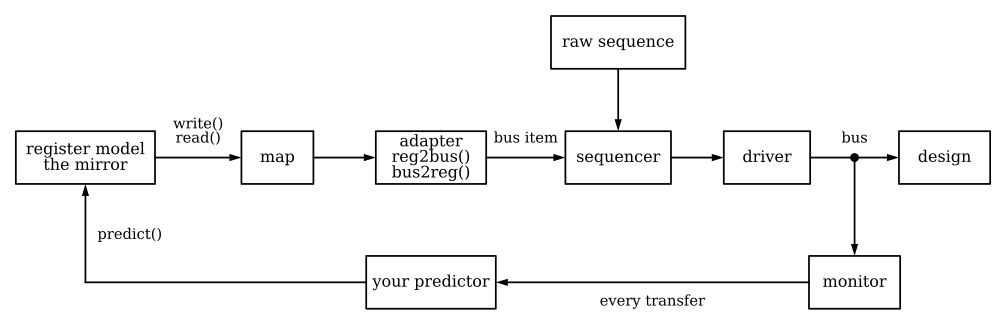
Suppose a test calls regs.CTRL.write(0x0005, regs.map, path_t.FRONTDOOR, check_t.NO_CHECK). All four arguments are required, and the call returns a uvm_resp_t, either PASS_RESP or ERROR_RESP. (read(map, path, check) returns the status and the value read.) The map turns the call into a register operation, here a write of 0005 to the address "0x4", and hands the operation to an adapter. The adapter’s reg2bus() turns the operation into the sequence item that your bus agent uses, and the map starts that item on the agent’s sequencer, so it goes through the same driver as every other transfer. When the driver has called item_done(), the map calls the adapter’s bus2reg() with the same item, and bus2reg() fills in the operation’s data and status from it. Here is the example’s adapter:
class BusAdapter(uvm_reg_adapter):
    def reg2bus(self, rw):
        """rw.addr is the address as the string the register was configured with."""
        write = rw.kind == access_e.UVM_WRITE
        return BusItem("reg", write, int(rw.addr, 16), rw.data if write else 0)

    def bus2reg(self, t, rw):
        rw.kind = access_e.UVM_WRITE if t.write else access_e.UVM_READ
        rw.data = t.wdata if t.write else t.rdata
        rw.status = uvm_resp_t.PASS_RESP
pyuvm’s registers and map don’t look inside a bus item, so on the path from write() or read() to the bus, these two methods are the only code that depends on what your bus looks like. (The predictor later on this page reads bus items too, the ones the monitor reports.) The environment gives the map its sequencer and its adapter, with map.set_sequencer() and map.set_adapter(). In Lab 06, Part 2 you’ll write the two methods for the router’s APB agent, and there bus2reg() also has to report a transfer that ended with PSLVERR as ERROR_RESP.
Keeping the mirror
The model’s mirror follows the bus only if something tells the model about each transfer, by calling a register’s predict() with the value written or read. In SystemVerilog UVM the map can do that itself after each operation it sends, which is called auto-predict. pyuvm 4.0.1’s map has a switch for it, enable_auto_predict, and the switch is off. With the switch on, the map hands each operation to a predictor object after the operation completes, and that object has to be a uvm_reg_predictor, a class that pyuvm leaves empty, with no methods of its own. So in pyuvm the mirror changes only when your code calls predict(). The place to do that is a predictor of your own, a uvm_subscriber connected to the bus monitor’s analysis port. It sees every transfer the monitor reports, whoever started it, and calls predict() on the register at that transfer’s address.
Our example’s RegMirrorTest writes 0005 to CTRL through the model, then writes 000b with a raw bus sequence that goes around the model, the way Lab 05’s wr() does. Then it reads CTRL through the model and compares the value read with what the mirror held before the read. We ran it three times, with +PREDICT= choosing how the mirror is kept each time:
+PREDICT= |
Mirror after the model’s write | After the raw write | The read of 000b against the mirror |
|---|---|---|---|
predictor |
0005 |
000b |
match |
none |
0000 |
0000 |
MISMATCH |
auto |
the write raised UVMError: map -- predictor Not set |
With no predictor, even the model’s own write left the mirror at its reset value, 0000, and the read of 000b didn’t match. regblk ran with no bug switched on, so the design was right, and a comparison that fails on a correct design means the testbench is wrong. (RegMirrorTest only logs MISMATCH, so that run still ended ok.) In the auto run, the map’s own auto-predict was switched on with no predictor object for it to call, so the model’s first write raised UVMError and the test ended there; make run called the run BROKEN. So this testbench needs the predictor. In Lab 06, Part 3 you write one for the router and connect it to the APB monitor, which the scoreboard already listens to.
Kinds of prediction
predict() takes the value and a kind, which says what to do with the value. UVM_PREDICT_WRITE means the value was written, so each field takes what its access policy gives it. UVM_PREDICT_READ means the value was read. UVM_PREDICT_DIRECT means the mirror takes the value as it is. RegPredictTest calls predict() on the mirrors of all four of the example’s registers, with no bus transfers at all. It printed:
[RAL] FLAGS (W1C), after the reset: 0x0
[RAL]   then predict(0x3, UVM_PREDICT_DIRECT)     0x3
[RAL]   then predict(0x1, UVM_PREDICT_WRITE)      0x2
[RAL]   then predict(0x2, UVM_PREDICT_READ)       0x0
[RAL]   then predict(0x2, UVM_PREDICT_DIRECT)     0x2
[RAL] COUNT (WC), after the reset: 0x0
[RAL]   then predict(0x2a, UVM_PREDICT_DIRECT)    0x2a
[RAL]   then predict(0x5, UVM_PREDICT_WRITE)      0x0
[RAL]   then predict(0x2a, UVM_PREDICT_DIRECT)    0x2a
[RAL]   then predict(0x2a, UVM_PREDICT_READ)      0x0
[RAL] CTRL (RW), after the reset: 0x0
[RAL]   then predict(0xb, UVM_PREDICT_WRITE)      0xb
[RAL]   then predict(0x5, UVM_PREDICT_READ)       0x5
[RAL] ID (RO), after the reset: 0x105b
[RAL]   then predict(0x1234, UVM_PREDICT_WRITE)   0x105b
The write predictions follow the access policies. Writing 0x1 to FLAGS clears only OVF, any write clears COUNT, a write to CTRL sets it to the value written, and ID ignores a write. After a read of 0x5, CTRL’s mirror is 0x5, as you’d expect, but after a read of 0x2 the mirror of FLAGS is 0, and after a read of 0x2a the mirror of COUNT is 0. In pyuvm’s source, a field’s predict_read() returns the field’s reset value for W1C, WC and twelve other policies, whatever the value read was, so after those two reads the mirror no longer holds what the design holds. Your predictor calls predict() after every read it sees, and Lab 06, Part 3 asks you which kind it should use.
Volatile fields
FLAGS is set by the design, so the model can’t know its value until something reads it. In the run with the predictor, RegMirrorTest pulses the design’s ev_ovf input, which sets FLAGS.OVF, and then reads FLAGS through the model:
[RAL] after an overflow event, the mirror of FLAGS holds 0000
[RAL] read FLAGS through the model: 0001; the mirror now holds 0001
The mirror said 0000 while the design held 0001, and only the read brought it up to date. A mirror of a volatile field is out of date whenever the design has changed the field since the last read, so nothing should compare a read of a volatile field with its mirror. In pyuvm, nothing compares any read with the mirror unless you write the comparison yourself. read() takes a check_t, but pyuvm passes it on only to the auto-predict predictor, which is off, so check_t.CHECK compared nothing in our run. After a raw write of 0007 to CTRL, we set CTRL’s mirror to 0003 by hand and read the register with CHECK:
[RAL] read(CHECK) of CTRL returned PASS_RESP with 0007, against a mirror of 0003and nothing else was logged. In Lab 06 your predictor does the comparing. It compares every read it sees with the mirror, outside the volatile fields. Every field of the router’s STATUS, DROP_CNT and LEVEL is volatile, so in those three registers the predictor checks only the reserved bits. The Lab 06 scoreboard checks STATUS instead. It keeps its own copies of STATUS and INT_EN, updates both cycle by cycle the way the router does, and checks every STATUS read and the irq output against them.
One operation per register at a time
pyuvm allows one operation at a time on each register. When two coroutines wrote CTRL at once, the first write went through and the second raised an exception before it reached the bus:
[RAL] two writes to CTRL at once: the first PASS_RESP; the second UVMFatalError: CTRL -- write cannot perform an operation while another is in progress(The run of spaces is in pyuvm’s message itself.) SystemVerilog UVM makes the second operation wait for the first instead. UVMFatalError isn’t a check, so the course’s grader calls a run that raises it BROKEN. Lab 06’s helpers in RouterBaseVseq (wr_reg(), rd_reg(), check_reg() and rd_all_regs()) hold a cocotb Lock for the register while the operation runs, so that two parts of a virtual sequence that reach the same register take turns.
Pieces pyuvm doesn’t have
The example’s RegQuirksTest found that pyuvm 4.0.1 doesn’t have these parts of SystemVerilog UVM’s register layer:
uvm_reghas nomirror,update,needs_update,peek,poke,setorget_reset. (A field hasget_reset().) In SystemVerilog UVM,mirror()reads a register and can compare the value with the mirror,set()records the value you want a register to have,update()writes the register only if that value differs from the mirror, andpeek()andpoke()are the back door.- A back-door read, which reads a register through the signal that holds it instead of over the bus, raised
UVMNotImplemented: map -- BACKDOOR not implemented. pyuvm’s source raises the same for a back-door write. - Of
uvm_reg_hw_reset_seq,uvm_reg_bit_bash_seq,uvm_reg_access_seqanduvm_reg_predictor, pyuvm has onlyuvm_reg_predictor, and that class has no methods of its own.
So in Lab 06 you write three pieces that a SystemVerilog UVM student gets from the library: the predictor described above, a reset sequence and a bit-bash sequence. The reset sequence puts the mirror at the reset values (map.reset("HARD")). Then it reads every register that has at least one field that isn’t volatile, and compares the value read with the register’s reset value outside its volatile fields. On regblk it would read ID and CTRL and leave FLAGS and COUNT alone, because every field in them is volatile. It has to run while the design still holds its reset values, which in the labs means before anything has written a register.
The bit-bash sequence goes through every register, and every bit in it that isn’t in a volatile field, one bit at a time. It writes the register with that bit flipped from the mirror’s value, reads the register back and compares the value read with the mirror. Then it does the same for that bit a second time, so the bit is written both ways before the sequence moves on to the next one. It treats a bit with no field as read-only and expects it to read 0, so it checks the reserved bits too, such as bits 2 to 15 of FLAGS.
The model can’t send a transfer to an address that has no register, because there’s no register to name, so the router’s 246 bad addresses still need raw transfers (Lab 06, Part 4). The model also knows nothing about what the registers do to the rest of the design. The router’s irq output depends on STATUS and INT_EN, and the scoreboard checks it (Lab 06, Part 5).
Check yourself
A testbench has a register model and an adapter, and no predictor. A test writes
0x1toCTRLwith the model’swrite(), then readsCTRLand compares the value with what the mirror held before the read. What happens on the golden design?TipAnswerThe read returns
0x1and the mirror still holds0x0, so the comparison fails although the design is right. pyuvm’s auto-predict is off, so not even the model’s ownwrite()updates the mirror. Onlypredict()does, and with no predictor nothing calls it. Lab 06, Part 3, step 2 finds the same thing on the router.Why would a reset sequence on
regblkread onlyIDandCTRL, and what would a bit bash still test inFLAGS?TipAnswerEvery field of
FLAGSandCOUNTis volatile, so a read of either register has nothing that can be compared with a reset value, and the reset sequence skips them. The bit bash skips the bits of volatile fields too, but bits 2 to 15 ofFLAGShold no field, so it treats them as read-only and checks that they still read 0 after it writes 1 to each.After
predict(0x2, UVM_PREDICT_READ), the mirror ofFLAGSis0x0. Does the design hold 0 inFLAGS?TipAnswerNo. The read returned
0x2, soFLAGS.ERRis set, and reading aW1Cfield doesn’t clear it. pyuvm’s read prediction puts aW1Cfield at its reset value, whatever was read. A predictor that used it would leave the mirror ofFLAGSwrong after every read that found a bit set, and code that used that mirror, for example to clear exactly the bits it last read, would go wrong.
Further reading
ChipVerify’s register-layer pages (section 12) build one SystemVerilog UVM model for one small APB block, across several pages. pyuvm has the same structure of fields, registers, maps and adapters. The notes below say where pyuvm 4.0.1 differs, and each “Correction” is something that ChipVerify’s page gets wrong.
- UVM Register Abstraction Layer: registers, fields, maps, and the path of a model write down to the bus.
- UVM Register Model Classes, the clearest account of the desired and mirrored values. pyuvm’s
uvm_reghas noupdate(), so this course uses only the mirror. Correction: its block maps the status register with"RO"rights, but its write-1-to-clear bit can only be cleared through a map that allows writes. - UVM Register Environment: the adapter, and the choice between auto-predict and a predictor. In pyuvm auto-predict is off, and the predictor is yours.
- UVM Register Access Methods. Correction: it says a front-door
write()orread()always updates the mirror. In SystemVerilog UVM that’s true only with auto-predict on or a predictor connected, as the same page says further down. In pyuvm only a predictor that callspredict()updates the mirror. - UVM Register Sequences: the built-in sequences, why the reset test goes before the bit bash, and how to leave a register out. pyuvm has none of these sequences.
Next: Regressions and seeds.