Lab 05: Find the commit that broke it
You’ll get the history of a small analog project, 33 commits long. Its gds workflow went red some time after its last good release, and that release is now too long ago for anyone to remember what broke it. You’ll write a script that git bisect run can trust, use it to find the commit that broke Magic DRC, and undo that commit through a pull request.
Package: labs/lab-05-find-the-commit-that-broke-it/
Before you start
- Read History as evidence.
- Finish Lab 03. This lab uses the course tools from Lab 01 and your token, but not your
ttsky-ic102-a: the history gets a repository of its own in Part 5.
This lab takes about 55 minutes.
Part 1: The history
What does the history tell you before you test anything?
Clone the history from the bundle file that the course ships, into a folder named after the repository you’ll put it in on GitHub in Part 5, and set your identity in it:
mkdir -p /foss/designs/projects && cd /foss/designs/projects
git clone /foss/designs/modules/ic102-a/labs/lab-05-find-the-commit-that-broke-it/history.bundle ttsky-ic102-a-bisect
cd ttsky-ic102-a-bisect
git config user.name "Your Name"
git config user.email "ID+USERNAME@users.noreply.github.com"
git config credential.helper 'cache --timeout=28800'
A bundle is a whole repository in one file. The commits in it have fixed authors and dates, so your hashes are the same as the ones below.
Look around:
git log --oneline -3
git tag -n
git log --oneline -1 v0.1
git log --oneline v0.1..main | wc -l
You should see
mainatfe045fa README: note that the gds workflow is red; one tag,v0.1, described asFirst layout that passes precheck and LVS, on4227d07 Place the inverter and wire it to ua[0] and ua[1]; and 26 commits after it.Confirm that
mainis broken the way the README says, with the runner’s tools:make precheckYou should see two ❌ rows,
Magic DRC | ❌ Fail: Magic DRC failedandKLayout BEOL | ❌ Fail: Klayout beol failed with 1 DRC violations.git bisecthalves the suspects with every test. With 26 commits after the good one, how many tests should it need? Write the number down.TipAnswerFive: \(2^5 = 32 \ge 26\), and four halvings would leave two suspects. git prints its own guess as it starts, “roughly 4 steps” after the first test.
Check: you know the good commit (v0.1), the bad one (main), and how many suspects lie between.
Part 2: A first try
Can you hand git Magic’s exit status and be done?
The package has a script that runs precheck’s first check, Magic DRC, on one GDS file, with precheck’s own Magic and PDK:
magic-drc.sh GDS TOP_CELL REPORT_DIR. Run it onmain:LAB=/foss/designs/modules/ic102-a/labs/lab-05-find-the-commit-that-broke-it $LAB/magic-drc.sh gds/tt_um_ic102_lab05.gds tt_um_ic102_lab05 /tmp/lab05-drc; echo "exit=$?" head -6 /tmp/lab05-drc/magic_drc.txtYou should see
exit=255, and a report that starts with the rule that’s broken:tt_um_ic102_lab05 ---------------------------------------- Metal2 spacing < 0.14um (met2.2) ---------------------------------------- 141.200 12.710 142.740 12.750 142.600 12.710 142.740 12.750and, two lines from its end,
[INFO]: COUNT: 4.Read
$LAB/first-try.sh. It runs that script at whatever commit git has checked out and exits with its status. Before you run it, read the rule from the git manual that History as evidence quotes, and write down what git will do with an exit status of 255.Run it:
git bisect start main v0.1
git bisect run $LAB/first-try.sh
git bisect reset
You should see the first test pass and the second stop the whole bisect:
Bisecting: 12 revisions left to test after this (roughly 4 steps) [b08fd6d6b800b1136b1b8972582ebc554781965d] Keep build output out of git running '/foss/designs/modules/ic102-a/labs/lab-05-find-the-commit-that-broke-it/first-try.sh' Bisecting: 6 revisions left to test after this (roughly 3 steps) [02d92af0591d429d331499929756e07d71531c48] README: rename the build section running '/foss/designs/modules/ic102-a/labs/lab-05-find-the-commit-that-broke-it/first-try.sh' error: bisect run failed: exit code 255 from '/foss/designs/modules/ic102-a/labs/lab-05-find-the-commit-that-broke-it/first-try.sh' is < 0 or >= 128TipAnswergit accepts 0 (good), 1 to 127 except 125 (bad) and 125 (skip). Anything else, and 255 in particular, it treats as the script itself having failed, and it stops. Magic’s DRC script exits with
exit -1, which the shell sees as 255, so the first commit with an error stops the bisect. Mapping 255 to 1 would fix that. It wouldn’t fix what went wrong in the first test, though, and that’s what Part 3 is about.
Check: you’ve seen bisect run failed: exit code 255, and run git bisect reset.
Part 3: A script git can trust
What can go wrong at a commit, besides the layout being bad?
The first test above was
b08fd6d Keep build output out of git, andfirst-try.shcalled it good. Check out that commit and look at what Magic did:git checkout b08fd6d ls gds/ $LAB/magic-drc.sh gds/tt_um_ic102_lab05.gds tt_um_ic102_lab05 /tmp/lab05-drc; echo "exit=$?" grep -A2 "couldn't be read" /tmp/lab05-drc/magic.logYou should see
ls: cannot access 'gds/': No such file or directory,exit=0, and:Cell tt_um_ic102_lab05 couldn't be read No such file or directory Creating new cellThere’s no layout at this commit at all. Magic couldn’t find the cell, made an empty one, checked it, and found nothing wrong. Its report says
COUNT: 0too, so a script that reads only the count is fooled just asfirst-try.shwas.List the commits after
v0.1that changed the GDS, with the size of each version:git log --oneline --stat v0.1..main -- gds/Find the second commit that can’t be tested: one where the GDS shrank to 6000 bytes and the next commit put it back. Check it out and run
magic-drc.shon it. You should seeexit=255,COUNT: 58, and inmagic.log, twice:Error while reading cell "tt_um_ic102_lab05" (byte position 6000): Unexpected EOF.That’s
5e0f367 Add a second inverter (WIP), a GDS cut short when Magic crashed while writing it. Magic read what was there and reported 58 errors in the fragment, so a script would call this commit bad when in fact it can’t be judged at all.Go back with
git checkout main, and write your own script,/foss/designs/projects/bisect.sh, outside the repository so that bisect’s checkouts can’t change it. It has to exit:- 125 when there’s no
gds/<top_module>.gds, or Magic’s log shows it couldn’t read the cell, or the report has noCOUNTline; - 1 when the count is above 0;
- 0 when the count is 0.
Read
top_modulefrominfo.yamlwithpython3 -c 'import yaml; print(yaml.safe_load(open("info.yaml"))["project"]["top_module"])', runmagic-drc.shwithout using its exit status, and decide frommagic.logandmagic_drc.txt. Thenchmod +xit.- 125 when there’s no
Test it by hand on the four kinds of commit before you give it to git:
for c in v0.1 b08fd6d 5e0f367 main; do git checkout -q $c; /foss/designs/projects/bisect.sh > /dev/null 2>&1; echo "$c $?"; done
git checkout -q main
You should see
v0.1 0,b08fd6d 125,5e0f367 125andmain 1. If not, fix the script before Part 4, because git decides from your script’s exit status alone, and one wrong answer sends the bisect into the wrong part of the history.
Check: your script gives those four answers.
Part 4: Bisect
Run it:
git bisect start main v0.1
git bisect run /foss/designs/projects/bisect.sh
It takes a few seconds. You should see seven tests, the first one skipped, and then:
380836cbb3704d4afa0915f9b43a4bb4d3bf0111 is the first bad commit
commit 380836cbb3704d4afa0915f9b43a4bb4d3bf0111
Author: Sam Example <sam@example.com>
Date:   Sun Oct 11 22:40:00 2026 -0400

    Widen Y's wire to ua[1]

    The output wire carries more current than the input one, so give it twice the width.

 gds/tt_um_ic102_lab05.gds | Bin 19636 -> 19572 bytes
 layout/wires.tcl          |   2 +-
 2 files changed, 1 insertion(+), 1 deletion(-)
bisect found first bad commit
That’s seven tests against the five you predicted, because git skipped
b08fd6dand had to choose another commit near the middle, and the skipped test still counts as one of the seven.Run
git bisect reset, then read the commit:git show 380836c -- layout/wires.tcl. The change is one number: the bottom edge ofY’s metal 2 moved from 13.26 to 12.85 µm.A’s metal 2 runs from 12.3 to 12.75 µm. How far apart are they now, and what’s the minimum?TipAnswer12.85 − 12.75 = 0.10 µm, against a minimum of 0.14 µm for metal 2 (
met2.2in Magic’s report). The commit’s message gives a good reason for a wider wire, and the wire is wider; it just grew towards its neighbour. git bisect never reads commit messages, only your script’s exit status.A classmate’s script reads only the
COUNTline and exits 0 when it’s 0. Which commit would git have named with it?TipAnswera4605db Put gds/ and lef/ back: the gds workflow reads them from the repository. The script callsb08fd6dgood even though it has no GDS, so git looks only at the commits after it, and the next commit with a GDS is the one that put it back. That commit’s message would make a very convincing culprit. We ran that script on this history to check, and that’s the commit it named.
Check: your bisect named 380836c.
Part 5: Undo it through a pull request
Put the history on GitHub, so that its workflows run. Make a new repository (the + menu › New repository) with your own account as the owner, the name
ttsky-ic102-a-bisect, Public, and no README,.gitignoreor licence. Then point your clone at it, instead of at the bundle, and pushmain:git remote set-url origin https://github.com/YOUR-USERNAME/ttsky-ic102-a-bisect.git git push -u origin mainThe history includes
.github/workflows/, so this is one of the pushes that needs your token’s Workflows permission.Turn on Pages (Settings › Pages › Source: GitHub Actions), then start a new run: Actions ›
gds› Run workflow onmain, not “Re-run failed jobs”. You should seedocsgreen, and in thegdsworkflow, thegdsandviewerjobs green andprecheckred. That’s the state the README describes.When we tested this on Nov 16, 2026 (with the history pushed to a branch of a test repository rather than to a repository of its own), the push’s
docsrun passed, and itsgdsrun hadgdsgreen,viewerred withFailed to create deployment (status: 404), andprecheckred with the two rows from Part 1:| Magic DRC | ❌ Fail: Magic DRC failed | | KLayout BEOL | ❌ Fail: Klayout beol failed with 1 DRC violations |The run started with Run workflow after Pages was on took 2 min 51 s, with
gdsandviewergreen andprecheckred with the same two rows.Make a branch from
mainand revert the commit:git switch -c lab05-revert git revert --no-edit 380836cYou should see:
warning: Cannot merge binary files: gds/tt_um_ic102_lab05.gds (HEAD vs. parent of 380836c (Widen Y's wire to ua[1])) Auto-merging gds/tt_um_ic102_lab05.gds CONFLICT (content): Merge conflict in gds/tt_um_ic102_lab05.gds Auto-merging layout/wires.tcl error: could not revert 380836c... Widen Y's wire to ua[1] hint: After resolving the conflicts, mark them with hint: "git add/rm <pathspec>", then run hint: "git revert --continue". hint: You can instead skip this commit with "git revert --skip". hint: To abort and get back to the state before "git revert", hint: run "git revert --abort".TipWhy does the GDS conflict when the text file doesn’t?Undoing a commit means applying its change backwards to today’s files. For
wires.tclthat’s easy, because no later commit changed that line. Three later commits changed the GDS, and git can’t apply a binary change to a different binary, so it stops and asks.Resolve it the way you did in Lab 04: rebuild the GDS and LEF from the reverted sources, then check and finish the revert:
make git add gds lef git revert --continue --no-edit make lvs make precheck--no-editkeeps git’s message,Revert "Widen Y's wire to ua[1]", instead of opening an editor. You should seeFinal result: Circuits match uniquely.andPrecheck passed.Push the branch and open a pull request from
lab05-revertintomain:git push -u origin lab05-revertIn the description, name the commit you’re reverting, say how you found it, and paste the
make lvsandmake prechecklines. The template’s workflows run on every push, so the branch gets its owndocsandgdsruns, and the pull request shows them.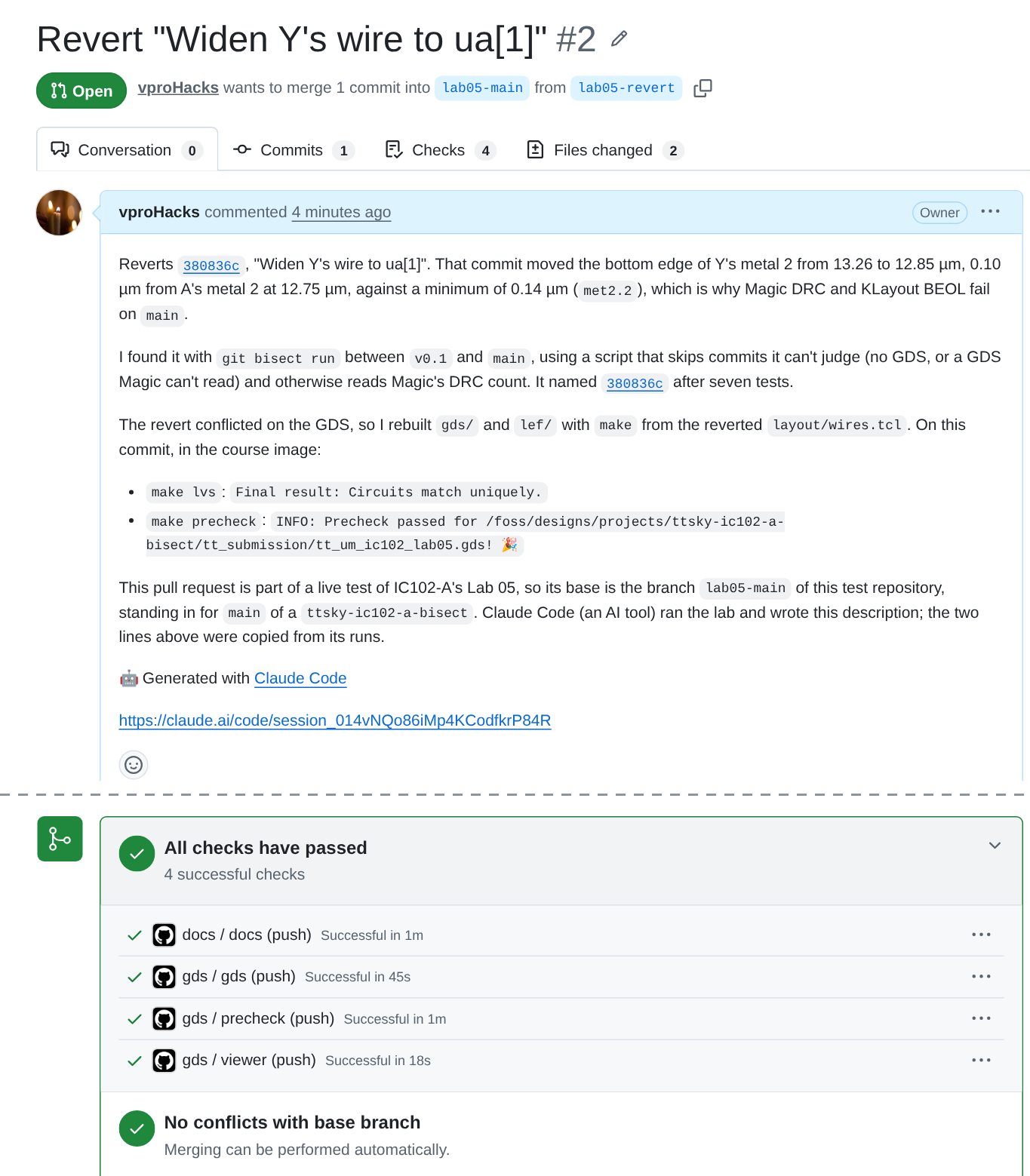
The revert’s pull request, with its description and its four checks green. When the branch’s
gdsrun is green in all three jobs, merge the pull request with Create a merge commit. The merge is a push tomain, so it gets a run of its own. In our test, the branch’sgdsrun passed all three jobs in 2 min 44 s (gds45 s,precheck1 min 54 s,viewer18 s), and the run on the merge passed all three in 3 min 8 s.
Check: the gds run on main after the merge is green in all three jobs.
Finishing
You’re done when your bisect has named 380836c, and main of your ttsky-ic102-a-bisect, with the revert merged, has a green docs run and a green gds run with all three jobs.
Questions:
Your script had to treat a missing GDS as “can’t test”. In the history, is there anything else that would make a commit untestable for this check, even with a GDS that Magic reads?
TipAnswerA
top_moduleininfo.yamlthat doesn’t match the cell inside the GDS, as in Lab 02’s breakage 3: Magic would look for the wrong cell, find none, and check an empty one. Your script catches that through the “couldn’t be read” line, and that’s one reason to judge from Magic’s log rather than from guesses about which files exist.The good commit was easy to find because someone tagged it. What would you have used without the tag?
TipAnswerA commit with a green
gdsrun on GitHub, if its runs were still there (they’re kept 90 days by default), or the oldest commit with a GDS, tested by hand with the same script. Tagging the commit you’d stand behind, as History as evidence suggests, saves this search.
Submit: nothing for this lab.
This is the last row of the Course path.